Math Amateur
Gold Member
MHB
- 3,920
- 48
I have been reading two books on complex analysis and my problem is that the two books give slightly different and possibly incompatible proofs that, for a function of a complex variable, differentiability implies continuity ...
The two books are as follows:
"Functions of a Complex Variable I" (Second Edition) ... by John B. Conway
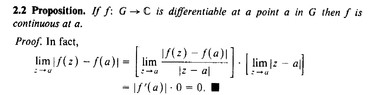
"Complex Analysis for Mathematics and Engineering" by John H. Mathews and Russel W. Howell (M&H) [Fifth Edition] ... Conway's proof that for a function of a complex variable, differentiability implies continuity ... reads as follows:
View attachment 9258
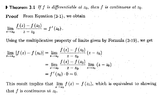
Mathews and Howell's proof that for a function of a complex variable, differentiability implies continuity ... reads as follows:
View attachment 9259
Now, as can be seen in the above proofs, Conway uses modulus/norm signs around the expressions in the proof while Mathews and Howell do not ...Can someone explain the differences ... are both correct ... ?
Surely the Conway proof is more valid as the proof involves limits which involve ideas like "close to" which need modulus/norms ...Hope someone can clarify this issue ...
Peter
The two books are as follows:
"Functions of a Complex Variable I" (Second Edition) ... by John B. Conway
"Complex Analysis for Mathematics and Engineering" by John H. Mathews and Russel W. Howell (M&H) [Fifth Edition] ... Conway's proof that for a function of a complex variable, differentiability implies continuity ... reads as follows:
View attachment 9258
Mathews and Howell's proof that for a function of a complex variable, differentiability implies continuity ... reads as follows:
View attachment 9259
Now, as can be seen in the above proofs, Conway uses modulus/norm signs around the expressions in the proof while Mathews and Howell do not ...Can someone explain the differences ... are both correct ... ?
Surely the Conway proof is more valid as the proof involves limits which involve ideas like "close to" which need modulus/norms ...Hope someone can clarify this issue ...
Peter
Attachments