Math Amateur
Gold Member
MHB
- 3,920
- 48
I am reading Hugo D. Junghenn's book: "A Course in Real Analysis" ...
I am currently focused on Chapter 9: "Differentiation on Rn"
I need some help with an aspect of Theorem 9.2.1 ...
Theorem 9.2.1 reads as follows:
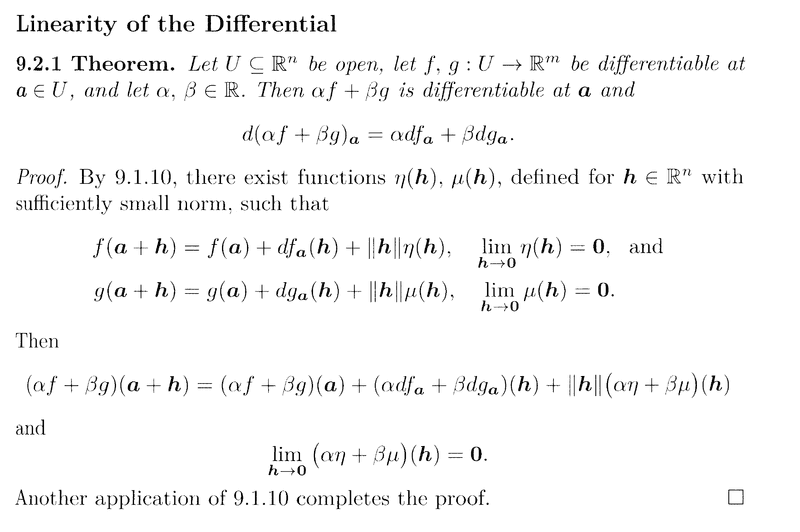
Theorem 9.2.1 refers to and relies on Theorem 9.1.10 ... ... so I am providing the same ... as follows:
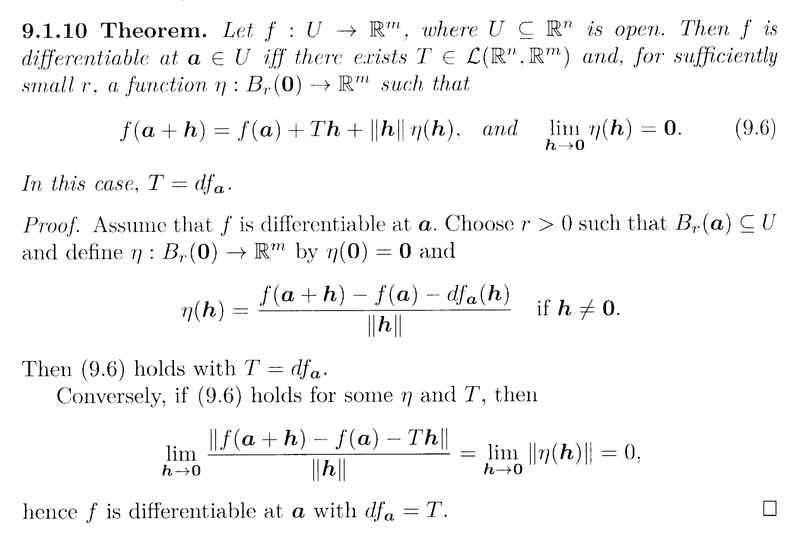
At the end of the proof of Theorem 9.2.1 we read the following:
" ... ... Then
##( \alpha \mathbf{f} + \beta \mathbf{g} ) ( \mathbf{a} + \mathbf{h} ) = ( \alpha \mathbf{f} + \beta \mathbf{g} ) ( \mathbf{a} ) + ( \alpha \mathbf{ df_a } + \beta \mathbf{ dg_a } ) ( \mathbf{ h } ) + \| \mathbf{ h } \| ##and##\lim_{ \mathbf{ h } \rightarrow \mathbf{ 0 } } ( \alpha \eta + \beta \mu ) ( \mathbf{ h } ) = \mathbf{ 0 }##Another application of 9.1.10 completes the proof."
I don't understand the comment: "Another application of 9.1.10 completes the proof." ... ... why do we need another application of 9.1.10 ...
Doesn't the line" ##( \alpha \mathbf{f} + \beta \mathbf{g} ) ( \mathbf{a} + \mathbf{h} ) = ( \alpha \mathbf{f} + \beta \mathbf{g} ) ( \mathbf{a} ) + ( \alpha \mathbf{ df_a } + \beta \mathbf{ dg_a } ) ( \mathbf{ h } ) + \| \mathbf{ h } \| ##and##\lim_{ \mathbf{ h } \rightarrow \mathbf{ 0 } } ( \alpha \eta + \beta \mu ) ( \mathbf{ h } ) = \mathbf{ 0 }## ..."actually complete the proof?
Help will be appreciated ...
Peter*** EDIT ***
I think I see what the author meant ... he is arguing that the statement:" ##( \alpha \mathbf{f} + \beta \mathbf{g} ) ( \mathbf{a} + \mathbf{h} ) = ( \alpha \mathbf{f} + \beta \mathbf{g} ) ( \mathbf{a} ) + ( \alpha \mathbf{ df_a } + \beta \mathbf{ dg_a } ) ( \mathbf{ h } ) + \| \mathbf{ h } \| ##and##\lim_{ \mathbf{ h } \rightarrow \mathbf{ 0 } } ( \alpha \eta + \beta \mu ) ( \mathbf{ h } ) = \mathbf{ 0 }##BY 9.1.10 ! (THAT IS APPLYING 9.1.10 AGAIN)
proves that ##\alpha \mathbf{ df_a } + \beta \mathbf{ dg_a }## is the differential of ##\alpha \mathbf{f} + \beta \mathbf{g}## ...Hence we do apply 9.1.10 again ...
Is that right ...
(If it is correct ... then my apologies for the simple confusion ... )
I am currently focused on Chapter 9: "Differentiation on Rn"
I need some help with an aspect of Theorem 9.2.1 ...
Theorem 9.2.1 reads as follows:
Theorem 9.2.1 refers to and relies on Theorem 9.1.10 ... ... so I am providing the same ... as follows:
At the end of the proof of Theorem 9.2.1 we read the following:
" ... ... Then
##( \alpha \mathbf{f} + \beta \mathbf{g} ) ( \mathbf{a} + \mathbf{h} ) = ( \alpha \mathbf{f} + \beta \mathbf{g} ) ( \mathbf{a} ) + ( \alpha \mathbf{ df_a } + \beta \mathbf{ dg_a } ) ( \mathbf{ h } ) + \| \mathbf{ h } \| ##and##\lim_{ \mathbf{ h } \rightarrow \mathbf{ 0 } } ( \alpha \eta + \beta \mu ) ( \mathbf{ h } ) = \mathbf{ 0 }##Another application of 9.1.10 completes the proof."
I don't understand the comment: "Another application of 9.1.10 completes the proof." ... ... why do we need another application of 9.1.10 ...
Doesn't the line" ##( \alpha \mathbf{f} + \beta \mathbf{g} ) ( \mathbf{a} + \mathbf{h} ) = ( \alpha \mathbf{f} + \beta \mathbf{g} ) ( \mathbf{a} ) + ( \alpha \mathbf{ df_a } + \beta \mathbf{ dg_a } ) ( \mathbf{ h } ) + \| \mathbf{ h } \| ##and##\lim_{ \mathbf{ h } \rightarrow \mathbf{ 0 } } ( \alpha \eta + \beta \mu ) ( \mathbf{ h } ) = \mathbf{ 0 }## ..."actually complete the proof?
Help will be appreciated ...
Peter*** EDIT ***
I think I see what the author meant ... he is arguing that the statement:" ##( \alpha \mathbf{f} + \beta \mathbf{g} ) ( \mathbf{a} + \mathbf{h} ) = ( \alpha \mathbf{f} + \beta \mathbf{g} ) ( \mathbf{a} ) + ( \alpha \mathbf{ df_a } + \beta \mathbf{ dg_a } ) ( \mathbf{ h } ) + \| \mathbf{ h } \| ##and##\lim_{ \mathbf{ h } \rightarrow \mathbf{ 0 } } ( \alpha \eta + \beta \mu ) ( \mathbf{ h } ) = \mathbf{ 0 }##BY 9.1.10 ! (THAT IS APPLYING 9.1.10 AGAIN)
proves that ##\alpha \mathbf{ df_a } + \beta \mathbf{ dg_a }## is the differential of ##\alpha \mathbf{f} + \beta \mathbf{g}## ...Hence we do apply 9.1.10 again ...
Is that right ...
(If it is correct ... then my apologies for the simple confusion ... )
Attachments


Last edited: