Direct Products of Modules .... Canonical Injections ....

  • Context: Undergrad 
  • Thread starter Thread starter Math Amateur
  • Start date Start date
  • Tags Tags
    Modules
Click For Summary

Discussion Overview

The discussion revolves around the proof of Proposition 2.1.4 from Paul E. Bland's book on rings and modules, specifically focusing on the concepts of injective and surjective mappings in the context of direct products and direct sums of modules. Participants seek clarification on the injectivity of a mapping and explore the conditions under which a left inverse exists.

Discussion Character

  • Technical explanation
  • Mathematical reasoning
  • Debate/contested

Main Points Raised

  • Peter seeks clarification on why the mapping ##u_\alpha## is injective, referencing the proof that states ##p_\alpha u_\alpha = \text{id}_{M_\alpha}##.
  • Some participants propose that a mapping is injective if and only if there exists a left inverse, while surjectivity is linked to the existence of a right inverse.
  • A participant attempts to prove that having a left inverse implies injectivity by showing that if ##f(a) = f(b)##, then ##a = b## when a left inverse exists.
  • Another participant notes that the converse direction (injectivity implies a left inverse) is more complex and not necessary for the current proof.
  • Discussion includes the construction of a left inverse function and the requirement for it to be well-defined, especially outside the image of the function.
  • Participants explore the implications of defining a left inverse for injective functions and the subtleties involved in linear mappings.

Areas of Agreement / Disagreement

Participants generally agree on the definitions and implications of injective and surjective mappings, but there is no consensus on the necessity of proving the converse direction or the specifics of defining left inverses outside the image of the function.

Contextual Notes

There are limitations regarding the assumptions made about the mappings and the definitions of injectivity and surjectivity, particularly in relation to linearity and the existence of inverses in different contexts.

Who May Find This Useful

Readers interested in module theory, linear algebra, and the properties of mappings in abstract algebra may find this discussion relevant.

Math Amateur
Gold Member
MHB
Messages
3,920
Reaction score
48
I am reading Paul E. Bland's book: Rings and Their Modules and am currently focused on Section 2.1 Direct Products and Direct Sums ... ...

I need help with some aspects of the proof of Proposition 2.1.4 ...

Proposition 2.1.4 and its proof read as follows:
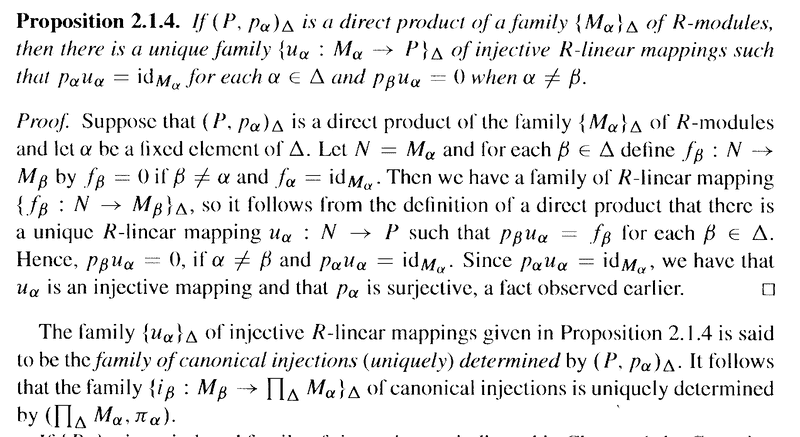
Bland - Proposition 2.1.4 ... .png
In the above proof by Paul Bland we read the following:

" ... ... Since ##p_\alpha u_\alpha = \text{ id}_{ M_\alpha }##, we have that ##u_\alpha## is an injective mapping and that ##p_\alpha## is surjective ... ... "Can someone please explain exactly how/why ##u_\alpha## is an injective mapping ... ?Help will be appreciated ...

Peter
 

Attachments

  • Bland - Proposition 2.1.4 ... .png
    Bland - Proposition 2.1.4 ... .png
    46 KB · Views: 961
Physics news on Phys.org
A mapping is injective if and only if there exists a left inverse for the map. Here, the left inverse is given by ##p_\alpha##.

Also, a mapping is surjective if there exists a right inverse for the map.

As a side note, the converse implication for this last statement also holds, if and only if the axiom of choice is true, but you won't need it here.

Can you prove these 2 claims?
 
Last edited by a moderator:
  • Like
Likes   Reactions: Math Amateur
Hi Math_QED ...

Note the following:

Given ##f \ : \ A \longrightarrow B##, we say that a function ##g \ : \ B \longrightarrow A## is a left inverse for ##f## if ##g \circ f = i_A##

Will try to prove the following:

##f## has a left inverse ##\Longleftrightarrow f## is injective Now assume ##f## has a left inverse, say, ##g## ...

Let ##f(a) = f(b)## ... ... need to show ##a = b## ...

Now ##g \circ f (a) = g( f(a) ) = i_A (a) = a## ... ... ... ... ... (1)

and ##g \circ f (b) = g( f(b) ) = i_A (b) = b## ... ... ... ... ... (2)But since ##f(a) = f(b)## ...

... we have that (2) ##\Longrightarrow g \circ f (b) = b = g( f(b) ) = g( f(a) ) = i_A (a) = a##

... so ##a =b## ... ...

Is that correct ...?

NOTE ... now need to show that ##f## is injective ##\Longrightarrow f## has a left inverse ...

BUT ... not making any meaningful progress ... can you help ...?

Peter
 
Math Amateur said:
Hi Math_QED ...

Note the following:

Given ##f \ : \ A \longrightarrow B##, we say that a function ##g \ : \ B \longrightarrow A## is a left inverse for ##f## if ##g \circ f = i_A##

Will try to prove the following:

##f## has a left inverse ##\Longleftrightarrow f## is injectiveNow assume ##f## has a left inverse, say, ##g## ...

Let ##f(a) = f(b)## ... ... need to show ##a = b## ...

Now ##g \circ f (a) = g( f(a) ) = i_A (a) = a## ... ... ... ... ... (1)

and ##g \circ f (b) = g( f(b) ) = i_A (b) = b## ... ... ... ... ... (2)But since ##f(a) = f(b)## ...

... we have that (2) ##\Longrightarrow g \circ f (b) = b = g( f(b) ) = g( f(a) ) = i_A (a) = a##

... so ##a =b## ... ...

Is that correct ...?

NOTE ... now need to show that ##f## is injective ##\Longrightarrow f## has a left inverse ...

BUT ... not making any meaningful progress ... can you help ...?

Peter

Your first proof is correct. Well done!

The other direction is not necessary in the proof you are working on, and it is the harder one. But it is an interesting and basic theorem anyway.

We have to actually construct a left inverse for ##f##, and once you have seen the trick, you will be able to apply it to similar problems.

So, our goal is to make a function ##g: B \to A## that 'undoes' ##f## from the left.

How can we map an element ##b \in B## to an element in ##a \in A## in a manner that has something to do with ##f##?

Hint: ##f(A) \subseteq B##
 
Last edited by a moderator:
  • Like
Likes   Reactions: Math Amateur
Math_QED said:
Your first proof is correct. Well done!

That direction is not necessary in the proof, and it is the harder one. But it is an interesting and basic theorem anyway.

We have to actually construct a left inverse for ##f##, and once you have seen the trick, you will be able to apply it to similar problems.

So, our goal is to make a function ##g: B \to A## that 'undoes' ##f## from the left.

How can we map an element ##b \in B## to an element in ##a \in A## in a manner that has something to do with ##f##?

Hint: ##f(A) \subseteq B##
Given ##f \ : \ A \longrightarrow B## is injective ... we want to show that ##f## has a left inverse function, say ##g## ...

Define ##g## this way ... where ##f(a) = b## for ##a \in A, b \in B## ... define ##g## such that ##g \ : \ B \longrightarrow A## where ##g(b) = a## ...

... so that ##g \circ f (a) = g(f(a) ) = a## ...

The above definition is possible because ##f## is injective ...

Defining ##g## in the above way for each ##a \in A, b \in B## where ##f(a) = b## means ##g## is the left inverse of ##f## ...Is that correct?

Peter
 
Math Amateur said:
Given ##f \ : \ A \longrightarrow B## is injective ... we want to show that ##f## has a left inverse function, say ##g## ...

Define ##g## this way ... where ##f(a) = b## for ##a \in A, b \in B## ... define ##g## such that ##g \ : \ B \longrightarrow A## where ##g(b) = a## ...

... so that ##g \circ f (a) = g(f(a) ) = a## ...

The above definition is possible because ##f## is injective ...

Defining ##g## in the above way for each ##a \in A, b \in B## where ##f(a) = b## means ##g## is the left inverse of ##f## ...Is that correct?

Peter

The idea is correct, but your function is not defined on ##B## but rather on ##f(A)##. What if ##f## is not surjective? Then some ##b##'s won't be attained by ##f##.

Just this needs fixing. Can you think of a way to give an image to ##b \notin f(A)##?

You noted correctly that injectivity is required to make the function ##g## well-defined.
 
  • Like
Likes   Reactions: Math Amateur
Hmm ... can see the problem ...

But cannot see the answer to the problem ...

Peter
 
Math Amateur said:
Hmm ... can see the problem ...

But cannot see the answer to the problem ...

Peter

In the end, you want that for ##a \in A##,

##g \circ f(a) = g(f(a)) = a##

So, for this condition to be true, it doesn't matter how ##g## is defined outside ##f(A)##.

Can you have another attempt now?
 
Well ... if how ##g## is defined outside ##f(A)## just put ##g(b) = 0## or simply ##g(b)## = arbitrary element of ##A## if ##0## is not an element of ##A## ... and do this for all ##b## outside ##f(A)## ...

Would that do ...?

Peter
 
  • #10
Math Amateur said:
Well ... if how ##g## is defined outside ##f(A)## just put ##g(b) = 0## or simply ##g(b)## = arbitrary element of ##A## if ##0## is not an element of ##A## ... and do this for all ##b## outside ##f(A)## ...

Would that do ...?

Peter

Well, an arbitrary fixed element indeed works!
 
  • Like
Likes   Reactions: Math Amateur
  • #11
Thanks Math_QED ... really appreciate your help...

Peter
 
  • Like
Likes   Reactions: member 587159
  • #12
I agree with everything here. But I would like to remark that the situation here, as QED well knows, is a little more subtle. In this proof the left inverse that is given is also linear. In fact an injective linear map, although it has a left inverse function, need not have one that is linear. So since this injective linear map has a linear left inverse, it is a little more special than just any old injective linear map. E.g. the injection of the even integers into the group of all integers, is injective and linear, but has no linear left inverse. Just didn't want the OP to come away with a possible wrong impression, but maybe no need to worry.
 
  • Like
Likes   Reactions: Math Amateur
  • #13
Thanks mathwonk ... appreciate your help, guidance and support...

Peter
 

Similar threads

  • · Replies 4 ·
Replies
4
Views
2K
  • · Replies 2 ·
Replies
2
Views
1K
  • · Replies 4 ·
Replies
4
Views
2K
  • · Replies 4 ·
Replies
4
Views
2K
Replies
1
Views
1K
  • · Replies 4 ·
Replies
4
Views
2K
Replies
1
Views
1K
  • · Replies 3 ·
Replies
3
Views
2K
Replies
2
Views
2K
Replies
2
Views
2K