Direction of the Magnetic Field due to a Wire
Click For Summary

Homework Help Overview

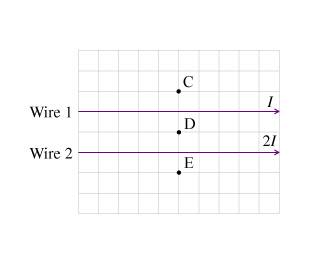
The discussion revolves around determining the direction of the magnetic field at specific points (C, D, E) due to current-carrying wires, utilizing the Right Hand Rule for a Straight Wire.

Discussion Character

  • Exploratory, Assumption checking

Approaches and Questions Raised

  • Participants discuss the individual contributions of different current magnitudes at point D and how they affect the magnetic field direction. There is an emphasis on the application of the Right Hand Rule and the reasoning behind the magnetic field directions at points C and E.

Discussion Status

Some participants have provided insights into the reasoning for the magnetic field directions at points C and E, while others are exploring the implications of differing current magnitudes on point D. There is acknowledgment of the need for further clarification on the reasoning behind the magnetic field at point D.

Contextual Notes

Participants are navigating assumptions regarding the current values and their effects on the magnetic field, particularly at point D, where the relationship between I_1 and I_2 is under scrutiny.

cse63146
Messages
435
Reaction score
0
[SOLVED] Direction of the Magnetic Field due to a Wire

Homework Statement


1013366B.jpg


Find the magnetic field at point C, D, E.

The choices are for all 3 are

i) Out of the page
ii) Into the page
iii) Not into the page or not out of the page, and not = 0
iv) 0

Homework Equations


The Right Hand Rule for a Straight Wire

The Attempt at a Solution


I believe the answer for:

C - Out of the page
D - Not into the page or not out of the page, and not = 0
E - Into the page

Any help would be appreciated.
 
Last edited:
Physics news on Phys.org
Think about the individual contributions of I and 2I for point D, and then add up. C and E are correct, even though you didn't give any reason.
 
Shooting Star said:
Think about the individual contributions of I and 2I for point D, and then add up. C and E are correct, even though you didn't give any reason.

I used the Right Hand Rule for a Straight Wire, I just didnt know how to describe what I did.

Thank you for the suggestion for D.

So since I_1 doesn't equal I_2, D can't be 0.

Since I_2 > I_1, it would have more effect on it, using the right hand rule for a straight wire, D would be coming out of the page
 
Last edited:
Right.
 
Thank You for your help.
 

Similar threads

Replies
4
Views
1K
  • · Replies 1 ·
Replies
1
Views
3K
  • · Replies 10 ·
Replies
10
Views
3K
  • · Replies 6 ·
Replies
6
Views
2K
Replies
7
Views
3K
Replies
2
Views
1K
Replies
34
Views
2K
Replies
14
Views
3K
Replies
8
Views
2K
Replies
5
Views
2K