Distance between planet and vessel - Trig problem

  • Context: Undergrad 
  • Thread starter Thread starter computerex
  • Start date Start date
  • Tags Tags
    Planet Trig Vessel
Click For Summary

Discussion Overview

The discussion revolves around finding an analytic solution for the length \( s \) in a trigonometric problem involving a planet and a vessel, given lengths \( r \), \( d \), and angle \( t \). Participants explore various mathematical approaches, including the Law of Cosines and the Law of Sines, to derive \( s \) without resorting to numerical methods.

Discussion Character

  • Technical explanation
  • Mathematical reasoning
  • Debate/contested

Main Points Raised

  • One participant seeks an analytic solution for \( s \) instead of a numerical approach.
  • Another suggests using the Law of Cosines, but questions arise about the necessary components for its application.
  • Some participants clarify that the Law of Cosines requires two sides and one included angle, while the Law of Sines requires one side and two angles or two sides and one angle.
  • There is a discussion on manipulating the Law of Cosines formula to express \( s \) in terms of \( r \), \( d \), and \( t \).
  • One participant proposes treating the resulting expression as a quadratic equation in \( a \) (or \( s \)) and suggests using the quadratic formula to solve it.
  • Concerns are raised about the physical implications of the problem, specifically regarding the angles involved and the nature of the collision scenario.
  • Some participants suggest a method involving the Law of Sines to find angles and subsequently \( s \), which may be simpler than solving the quadratic derived from the Law of Cosines.
  • There is acknowledgment that using the Law of Sines after determining the angles could simplify the process compared to the Law of Cosines.

Areas of Agreement / Disagreement

Participants express differing views on the best approach to solve for \( s \), with no consensus reached on a single method. Some favor the Law of Cosines while others advocate for the Law of Sines, indicating an unresolved debate on the most efficient solution.

Contextual Notes

Participants note the need for specific angles and sides to apply the trigonometric laws correctly, and there is uncertainty regarding the implications of the angles in the physical context of the problem.

computerex
Messages
68
Reaction score
0
Hello. Up until this point I have been solving this numerically, by propagating the state vectors and checking for a collision, however that is inefficient, so I would like an analytic solution.

Given lengths r, and d, as well as angle t, is there a way to find length s?
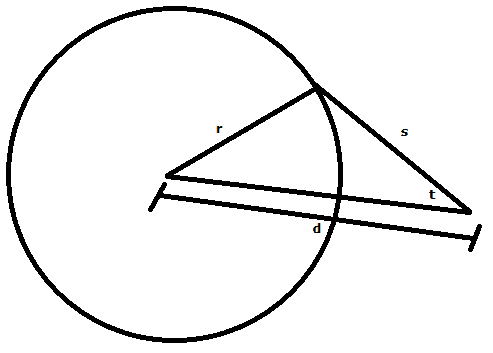
pg.png
 
Mathematics news on Phys.org
Can you elaborate? I was looking at the law of cosines prior to posting this thread, but I couldn't find a solution. I thought you need at least two angles? I only have one.
 
The sine rule requires 1 side and 2 angles, the cosine rule requires 2 sides an 1 angle.

[tex]c^2=a^2+b^2-2ab.cosC[/tex]

a, b, c are the side lengths of the triangle and C is an angle. The angle C is opposite the side c.

Now all you need to do is substitute C=t, c=r, and it's your choice whether a=d and b=s or the other way round. It doesn't matter. Now just manipulate the formula to have s=f(r,d,t).
 
The Law of Cosines requires two sides and the included angle, if I'm recalling this correctly. The Law of Sines can be used for one side and two angles or two sides and one angle.

You can use the Law of Sines to get the angle between r and s, after which you can get the third angle. Since the angle between r and s appears in your drawing to be oblique, you'll need to take that into account when you solve for it, using the identity sin(pi/2 + x) = sin(pi/2 - x).

After you have all three angles you can use the Law of Cosines or the Law of Sines to find the unknown side.
 
Mentallic said:
The sine rule requires 1 side and 2 angles, the cosine rule requires 2 sides an 1 angle.

[tex]c^2=a^2+b^2-2ab.cosC[/tex]

a, b, c are the side lengths of the triangle and C is an angle. The angle C is opposite the side c.

Now all you need to do is substitute C=t, c=r, and it's your choice whether a=d and b=s or the other way round. It doesn't matter. Now just manipulate the formula to have s=f(r,d,t).

Cool, that is the first thing I tried, however I was not able to isolate a:

[tex]b^2-c^2 = a^2 - 2ac cos t[/tex]
[tex]b^2-c^2 = a(a-2c cos t)[/tex]

And I have no idea where to proceed from here.
 
computerex said:
Cool, that is the first thing I tried, however I was not able to isolate a:

[tex]b^2-c^2 = a^2 - 2ac cos t[/tex]
[tex]b^2-c^2 = a(a-2c cos t)[/tex]

And I have no idea where to proceed from here.

In my opinion, you could treat the expression as a quadratic with variable "a", and then solve the quadratic using the quadratic formula or completing the square or whatever. That should work I think (and hope :p).
 
computerex said:
Cool, that is the first thing I tried, however I was not able to isolate a:

[tex]b^2-c^2 = a^2 - 2ac cos t[/tex]
[tex]b^2-c^2 = a(a-2c cos t)[/tex]

And I have no idea where to proceed from here.
As already noted, to use the Law of Cosines, you need two sides and the included angle. That's not what you have in this problem.


Series said:
In my opinion, you could treat the expression as a quadratic with variable "a", and then solve the quadratic using the quadratic formula or completing the square or whatever. That should work I think (and hope :p).
 
Yup, the quadratic formula will give you the two possible values of a (or s in the original figure). Then you'd have to know whether the angle between r and s is acute or obtuse, as Mark44 suggested earlier, in order to figure out which value of a (i.e. s) is the correct one.
 
  • #10
This seems like a physical collision kind of problem. That is, the line s cannot cut through the circle and connect to r where it touches the circle the second time. This means that the angle between s and r cannot be less than 90o since at 90o the vector s is tangential to the circle so of course by the angle sum of triangles, the other two angles are acute.

Mark, if you can show a way to use your method of going through the sine formula and then the cosine etc. which is easier than plugging straight into the cosine formula and solving that quadratic in s, I'd like to see it :smile:
 
  • #11
Mentallic said:
This seems like a physical collision kind of problem. That is, the line s cannot cut through the circle and connect to r where it touches the circle the second time.
Ah, good point.
Mark, if you can show a way to use your method of going through the sine formula and then the cosine etc. which is easier than plugging straight into the cosine formula and solving that quadratic in s, I'd like to see it :smile:
Note sure exactly how Mark was thinking, but one could follow this procedure:
1. Use the law of sines to find the angle opposite side d (must be ≥90°).
2. Use ∑angles=180° to find the angle opposite s.
3. Use the law of sines to find s.​
This may be less cumbersome than solving the quadratic obtained from the law of cosines.
 
  • #12
Redbelly98 said:
Ah, good point.

Note sure exactly how Mark was thinking, but one could follow this procedure:
1. Use the law of sines to find the angle opposite side d (must be ≥90°).
2. Use ∑angles=180° to find the angle opposite s.
3. Use the law of sines to find s.​
This may be less cumbersome than solving the quadratic obtained from the law of cosines.
This is pretty much what I laid out in an earlier post. In step 3 you can use either the Law of Sines or the Law of Cosines, with the latter being applicable because you now know all three angles, one of which is the included angle between the two given sides.
 
  • #13
Ahh ok using the sine rule after would be easier :smile: because I tried following your method and using the cosine rule, but there was just way too much trigonometric manipulating to deal with.
 

Similar threads

Replies
8
Views
2K
  • · Replies 29 ·
Replies
29
Views
3K
Replies
0
Views
1K
  • · Replies 12 ·
Replies
12
Views
3K
Replies
4
Views
1K
  • · Replies 6 ·
Replies
6
Views
3K
  • · Replies 1 ·
Replies
1
Views
2K
  • · Replies 13 ·
Replies
13
Views
2K
  • · Replies 7 ·
Replies
7
Views
3K
  • · Replies 1 ·
Replies
1
Views
2K