Distance between two nucleons

Click For Summary
SUMMARY

The equilibrium distance between nucleons is approximately 0.7 femtometers (fm), where the potential energy is minimized. However, the average distance between nucleons is observed to be around 1-2 fm, which correlates with an average nucleon density of 0.17 nucleons/fm³. This discrepancy arises because the physical dimensions of nucleons, approximately 1 fm, prevent them from approaching each other too closely. Additionally, the Coulomb potential's minimum at r = 0 does not dictate the average distance, indicating that multiple factors influence nucleon spacing.

PREREQUISITES
  • Understanding of nuclear physics concepts, particularly nucleon interactions.
  • Familiarity with potential energy graphs in particle physics.
  • Knowledge of nucleon density calculations and their implications.
  • Basic grasp of quantum mechanics, especially regarding particle dimensions.
NEXT STEPS
  • Research the implications of nucleon density on nuclear stability.
  • Study the role of the Coulomb potential in atomic structures.
  • Explore the effects of quantum mechanics on nucleon interactions.
  • Investigate advanced models of nucleon interactions beyond simple potential energy graphs.
USEFUL FOR

Students and professionals in nuclear physics, researchers studying particle interactions, and educators looking to enhance their understanding of nucleon behavior in atomic structures.

crick
Messages
39
Reaction score
4
The potential energy associated to the interaction between nucleons has its minimum (point of equilibrium) at ##r\sim 0.7 fm##, as showed in the following graph:
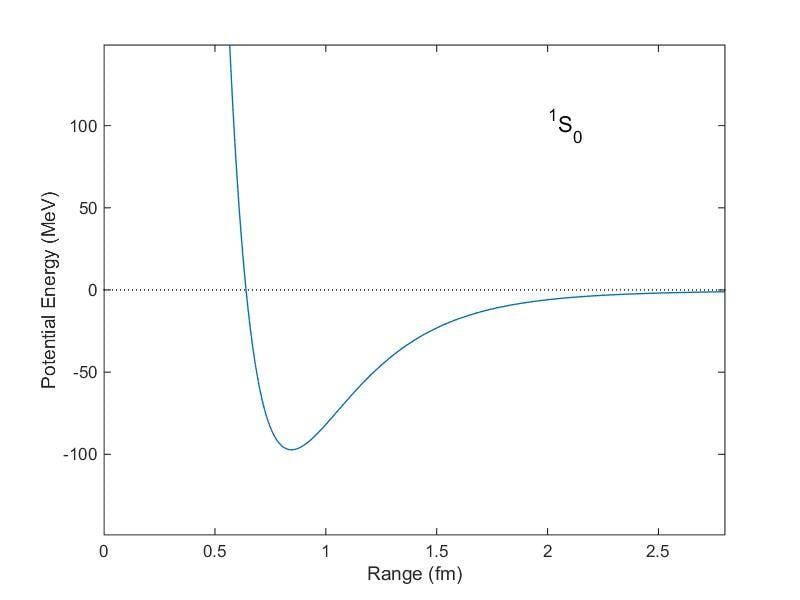
ReidPotential.jpg


Nevertheless, there are two facts that are, apparently, in contrast with this:

- The average distance between nucleons is ##\sim 1-2 fm##
- The average nucleon density is ##\sim 0.17\,\,\ \mathrm{nucleons /fm^3}##

(These two are related because from the second follows a volume of ##\sim 6 fm^2## per nucleon which is in agreement with the average distance between nucleons)

So why is the average distance between nucleons usually greater that the ##0.7 fm## where the potential energy is minimum?

I'm aware that the "dimension" of nucleon is ##\sim 1 fm##. But is this the reason why the distance between two of them cannot be much less?
 

Attachments

  • ReidPotential.jpg
    ReidPotential.jpg
    17.7 KB · Views: 1,064
Physics news on Phys.org
The Coulomb potential has its minimum at ##r = 0##, this does not mean that the average distance of the electron in a hydrogen atom is zero. There is no a priori reason to believe that the potential minimum should be at the same location as the average distance. There are more things that affect this.
 
  • Like
Likes   Reactions: crick

Similar threads

  • · Replies 14 ·
Replies
14
Views
4K
  • · Replies 29 ·
Replies
29
Views
6K
  • · Replies 2 ·
Replies
2
Views
10K
Replies
1
Views
791
  • · Replies 4 ·
Replies
4
Views
6K
  • · Replies 3 ·
Replies
3
Views
2K
  • · Replies 2 ·
Replies
2
Views
4K
  • · Replies 5 ·
Replies
5
Views
14K
  • · Replies 7 ·
Replies
7
Views
2K
  • · Replies 11 ·
Replies
11
Views
2K