Distribution of charges as a result of the Hall Effect

Join the discussion
Registration is free. Ask a follow-up in this thread, or start your own.
1 reply · 2K views
Blah God
Messages
1
Reaction score
0
TL;DR
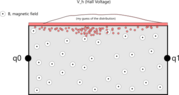
Arm chair physics: I can't afford to set up this experiment at the moment (I don't even own a multimeter), but I am curious about the distribution of charges as a result of the hall effect at the top of a piece of metal in a uniform B field.
hall-effect-distribution.png


Circuit runs from q0 to q1, some E field (our charge source/sink)

1. Is the current running from q0 to q1 impacted by the existence of the B field? For example, if there were no B field, current would flow from q0 to q1, let's call it I0. When we flip on the B field what effect is there on the current?

2. If I were to use a multimeter to measure the Hall Voltage, how much would the positioning of my lead matter? Specifically, what does the charge distribution look like as a result of the magnetic field?

I guessed in my picture above, but the longer I think about it the more the picture tends to change, hence why I am now consulting the experts.

Thank you for any help.
 
Attachments
  • hall-effect-distribution.png
    hall-effect-distribution.png
    6.3 KB · Views: 220
Last edited by a moderator:
Physics news on Phys.org
1. Due to Lorentz force electrons in the current take a path closer to the one side of the plate. This creates a voltage across the plate called the Hall voltage.
Here is an explanation for the Lorentz force: https://en.wikipedia.org/wiki/Lorentz_force

2. Yes the lead placement has to be very precise, they need to be exactly one across of another. In fact since the measured voltage is in micro volts it is impossible to get it right. To overcome this you need a potentiometer on one side to neutralize the voltage drop due to current passing through the plate.

Overall this experiment is very hard or even impossible to carry out at home. We've tried it at lab and it didn't work. Also the plate has to be very thin in order of nanometers.

I hope this helps. If you need any further explanation feel free to ask.