Distribution of nucleons in the nuclei

Click For Summary
SUMMARY

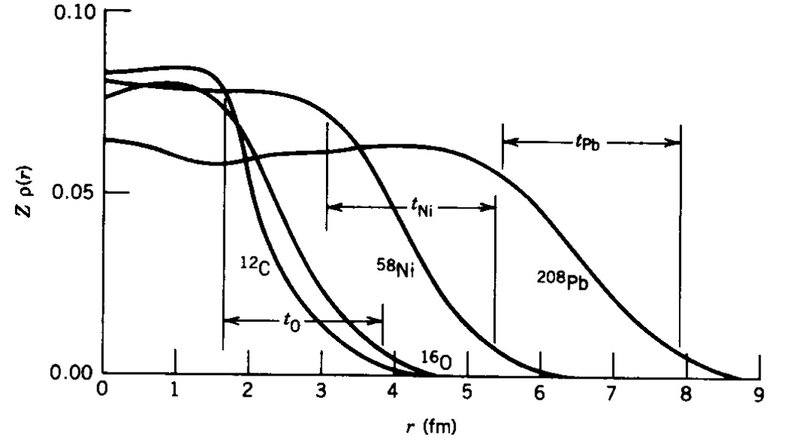
The discussion centers on the distribution of nucleons within atomic nuclei, referencing the diagram from "Krane Introductory Nuclear Physics." It is established that nucleons maintain a fairly constant distribution throughout the nucleus, with density tapering off gradually rather than sharply due to the limited range of the strong force. Smaller mass number nuclei exhibit a quicker tapering of nucleon density, while larger mass number nuclei demonstrate a slower tapering. Krane notes that the distance over which charge density decreases is largely independent of nucleus size, leading to a longer tapering distance for larger nuclei.

PREREQUISITES
  • Understanding of nuclear physics concepts, particularly nucleon behavior
  • Familiarity with the strong nuclear force and its implications
  • Knowledge of atomic structure and the concept of charge density
  • Basic grasp of mass number and its significance in nuclear stability
NEXT STEPS
  • Explore the strong nuclear force and its range in detail
  • Investigate the implications of nucleon distribution on nuclear stability
  • Study the relationship between mass number and nuclear properties in depth
  • Review Krane's "Introductory Nuclear Physics" for further insights on nucleon behavior
USEFUL FOR

This discussion is beneficial for nuclear physicists, students of nuclear physics, and educators looking to deepen their understanding of nucleon distribution and its effects on atomic structure.

says
Messages
585
Reaction score
12
What does this diagram tell us about the distribution of nucleons in the nuclei? - The diagram is from Krane Introductory Nuclear Physics

I know that nucleons don't congregate around a central part of a nucleus, but instead have a constant distribution throughout. i.e. The number of nucleons per unit of volume is fairly constant.

I'm not really sure why they all taper off the way they do though. Smaller mass number particles tend to taper off quicker, while larger mass number particles taper off slower. I'm not really sure why this is.

nuclear density.jpg
 

Attachments

  • nuclear density.jpg
    nuclear density.jpg
    24.3 KB · Views: 1,093
Physics news on Phys.org
says said:
I know that nucleons don't congregate around a central part of a nucleus, but instead have a constant distribution throughout. i.e. The number of nucleons per unit of volume is fairly constant
That would give horizontal lines in the diagram that drop to zero at some nucleus radius.
The densitties don't drop off sharply but taper out to zero because the nucleons are bound together by the strong force that has a very limited range (the 208Pb is the largest stable nucleus). So the nucles is a dense but but moving packing, meaning that just like with electron orbits around the nucleus, there is no sharp outer bound.
 
So the nucleons have a fairly constant distribution in the nucleus, but the distribution tapers off at the range of the strong force. For nuclei with larger mass number, A, this tapering off is a much longer tail?
 
Not much, considering the big difference in atomic number...
 
Nucleons have a fairly constant distribution but their charge densities drop off relatively slowly because there is no sharp outer boundary to the nucleus.

Krane says 'the distance over which the charge density drops is nearly independent of the size of the nucleus, and is usually taken to be constant.'

If the nucleus is large and there is no sharp outer boundary to it, then doesn't that mean the larger the nucleus the longer the distance over which the charge density drops?
 

Similar threads

  • · Replies 1 ·
Replies
1
Views
2K
  • · Replies 12 ·
Replies
12
Views
5K
  • · Replies 8 ·
Replies
8
Views
4K
  • · Replies 1 ·
Replies
1
Views
2K
  • · Replies 5 ·
Replies
5
Views
2K
  • · Replies 5 ·
Replies
5
Views
2K
  • · Replies 5 ·
Replies
5
Views
1K
  • · Replies 2 ·
Replies
2
Views
10K
  • · Replies 1 ·
Replies
1
Views
1K
  • · Replies 3 ·
Replies
3
Views
1K