Divergence/Convergence for Telescoping series

Click For Summary
SUMMARY

The discussion centers on the application of the divergence test to telescoping series, specifically addressing the conditions under which a telescoping series converges or diverges. Participants clarify that for a series to diverge, the limit of the terms, denoted as ##a_n##, must approach zero. The key takeaway is that the series ##\sum (b_{n+1}-b_n)## converges if and only if the sequence ##b_n## converges, emphasizing the importance of analyzing the sequence rather than solely the partial sums.

PREREQUISITES
  • Understanding of telescoping series
  • Familiarity with convergence tests in calculus
  • Knowledge of limits and sequences
  • Basic proficiency in mathematical notation and terminology
NEXT STEPS
  • Study the properties of telescoping series in detail
  • Learn about the divergence test and its applications
  • Explore convergence tests for sequences and series
  • Investigate examples of convergent and divergent telescoping series
USEFUL FOR

Students, educators, and mathematicians interested in series convergence, particularly those focusing on telescoping series and their properties.

Neon32
Messages
68
Reaction score
1
Can I use the divergence test on the partial sum of the telescoping series?
Lim n>infinity an if not equal zero then it diverges

The example below shows a telescoping series then I found the partial sum and took the limit of it. My question is shouldn't the solution be divergent? Since the result -1+cos 1 is not equal to 0? I'm confused.
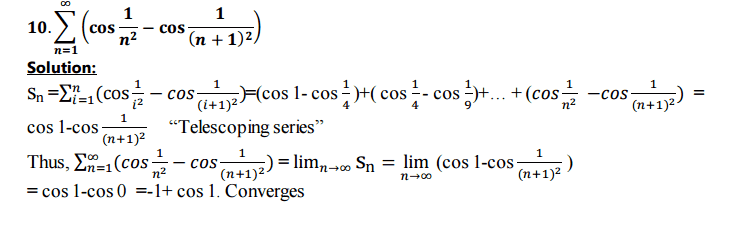
upload_2017-3-25_11-45-47.png
 
Physics news on Phys.org
that is right i guess
 
Neon32 said:
Lim n>infinity an if not equal zero then it diverges
it is ##a_n## must tend to zero, not the sum :)
 
zwierz said:
it is ##a_n## must tend to zero, not the sum :)

what's ##a_n##?
 
a term of the series
 
zwierz said:
a term of the series

How can I determine convergence/divergence for telescopinc series then?
 
you have already done this
 
zwierz said:
you have already done this
I haven't? the solution is above, however I don't quite understand. I want a general rule to detect convergence/divergence fore telescoping series.
 
The series ##\sum (b_{n+1}-b_n)## is convergent iff the sequence ##b_n## is convergent
 
  • #10
zwierz said:
The series ##\sum (b_{n+1}-b_n)## is convergent iff the sequence ##b_n## is convergent
but he didn't find the convergence of bn sepeartly in the solution above?
 
  • #11
He restored the proof of my proposition for this concrete example
 

Similar threads

  • · Replies 3 ·
Replies
3
Views
2K
  • · Replies 11 ·
Replies
11
Views
5K
  • · Replies 5 ·
Replies
5
Views
2K
  • · Replies 17 ·
Replies
17
Views
5K
  • · Replies 7 ·
Replies
7
Views
2K
  • · Replies 6 ·
Replies
6
Views
4K
Replies
1
Views
2K
  • · Replies 1 ·
Replies
1
Views
2K
  • · Replies 4 ·
Replies
4
Views
2K
Replies
3
Views
1K