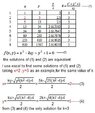
gven :$x,y\in N$
to prove :$\dfrac {x^2+y^2+1}{xy}=k(constant)\in N---(1)$
from (1) we have:
$x^2-kxy+y^2+1=0----(2)$
if $x<y$
for the same value of $k$ ,the soltions of (1)=the solutions of (2) will be :
$x \,\,\,\,\,\,\,\,\,\,\,\,\,\,\,\,\,\,\,\,\,\,\,\,\, \,\,\,\,\,\,\,\, y$
$a_1\,\,\,\,\,\,\,\,\,\,\,\,\,\,\,\,\,\,\,\,\,\,\,\,\,\,\,\,\,\,b_1$
$a_2=b_1\,\,\,\,\,\,\,\,\,\,\,\,\,\,\,\,b_2$
$a_3=b_2\,\,\,\,\,\,\,\,\,\,\,\,\,\,\,\,b_3$
-----
-----
$a_n=b_{n-1}\,\,\,\,\,\,\,\,\,b_n$
for $n=1,2,3------, a_n=b_{n-1}<b_n$
and :
$y=b_{n-1}=a_n=\dfrac{kx+\sqrt {k^2x^2-4(x^2+1)}}{2}-----(*)$
for the same value of $k$ (*) must be all satisfied,and then we can find $k$
 [/sp]
[/sp]