Do planets without a solid surface precess?

  • Context: High School 
  • Thread starter Thread starter metastable
  • Start date Start date
  • Tags Tags
    Black holes Holes
Click For Summary

Discussion Overview

The discussion revolves around the concept of precession in celestial bodies, specifically focusing on black holes and the potential for gaseous or liquid planets to exhibit similar behavior. Participants explore the mechanisms behind precession, including the role of angular momentum and external forces, while drawing comparisons between different astronomical objects.

Discussion Character

  • Exploratory, Technical explanation, Debate/contested

Main Points Raised

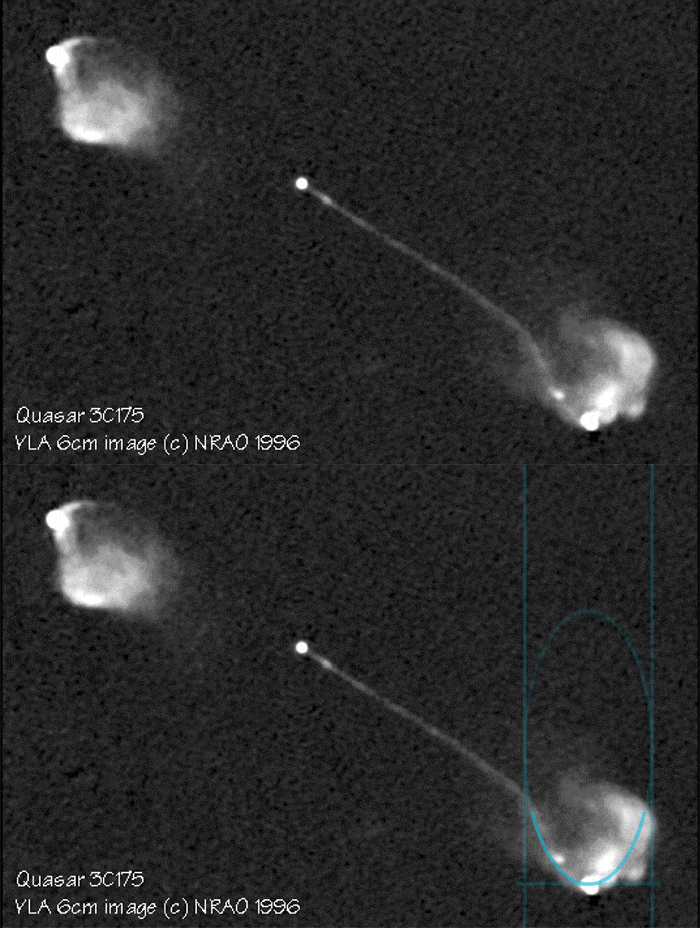
  • One participant questions whether the distortion of a jet from quasar 3c175 can be interpreted as evidence of black hole precession.
  • Another participant explains that precession occurs when an external force applies angular momentum to a spinning object misaligned with its spin axis, noting that accretion disks can exert torque on black holes, potentially leading to precession.
  • A participant references Earth's axial precession, suggesting that non-spherical asymmetry is necessary for precession and questions if black holes share this characteristic.
  • In response, it is stated that a spinning black hole is not spherically symmetric, while a non-rotating black hole is, and cautions against assuming that precession is related to forces in the context of general relativity.
  • A participant raises the question of whether gaseous or liquid planets could also precess, given their lack of a cohesive structure.

Areas of Agreement / Disagreement

The discussion contains multiple competing views regarding the mechanisms of precession, particularly in relation to black holes and the characteristics of different types of celestial bodies. There is no consensus on whether gaseous or liquid planets would precess in the same manner as solid bodies.

Contextual Notes

Participants express uncertainty about the relationship between precession and the structural characteristics of celestial bodies, as well as the implications of general relativity on the concept of forces.

metastable
Messages
514
Reaction score
53
Do black holes precess? I added some marks to a picture of quasar 3c175... can the highlighted distortion of the jet be interpreted as black hole precession?

3c175.gif
 
Astronomy news on Phys.org
Precession will occur when an external force applies angular momentum to a spinning object that is not aligned with that objects spin axis. Accretion disks are, in general, not aligned exactly with the black holes spin axis - but the material becomes aligned before it nears the even horizon.

This process was modeled in a study just released this month:
https://academic.oup.com/mnras/article/487/1/550/5420428
(suggest you skip to "RESULTS")

According to the authors, the acretion disk does "torque" the black hole. So it would seem inevitable that the black holes spin axis would precess.
 
Very interesting. I was reading about axial precession on the Earth:

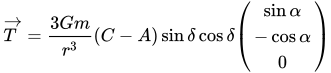
For precession, this tidal force can be grouped into two forces which only act on the equatorial bulge outside of a mean spherical radius. This couplecan be decomposed into two pairs of components, one pair parallel to Earth's equatorial plane toward and away from the perturbing body which cancel each other out, and another pair parallel to Earth's rotational axis, both toward the ecliptic plane.[20] The latter pair of forces creates the following torquevector on Earth's equatorial bulge:[4]

\overrightarrow {T}={\frac  {3Gm}{r^{3}}}(C-A)\sin \delta \cos \delta {\begin{pmatrix}\sin \alpha \\-\cos \alpha \\0\end{pmatrix}}

https://en.wikipedia.org/wiki/Axial_precession

If I understand correctly, the Earth requires non-spherical asymmetry for its precession to occur, is a black hole thought to be the same in this regard?
 
A spinning black hole is not spherically symmetric, no. A non-rotating one is.

Don't assume precession of a black hole has anything to do with forces, though. Gravity is not a force in general relativity.
 
Last edited:

Similar threads

  • · Replies 5 ·
Replies
5
Views
3K
  • · Replies 40 ·
2
Replies
40
Views
5K
  • · Replies 2 ·
Replies
2
Views
2K
  • · Replies 3 ·
Replies
3
Views
2K
  • · Replies 6 ·
Replies
6
Views
3K
  • · Replies 4 ·
Replies
4
Views
3K
  • · Replies 5 ·
Replies
5
Views
2K
  • · Replies 17 ·
Replies
17
Views
6K
  • · Replies 22 ·
Replies
22
Views
4K
  • · Replies 4 ·
Replies
4
Views
3K