member 731016
- Homework Statement
- Please see below
- Relevant Equations
- Please see below
For this,
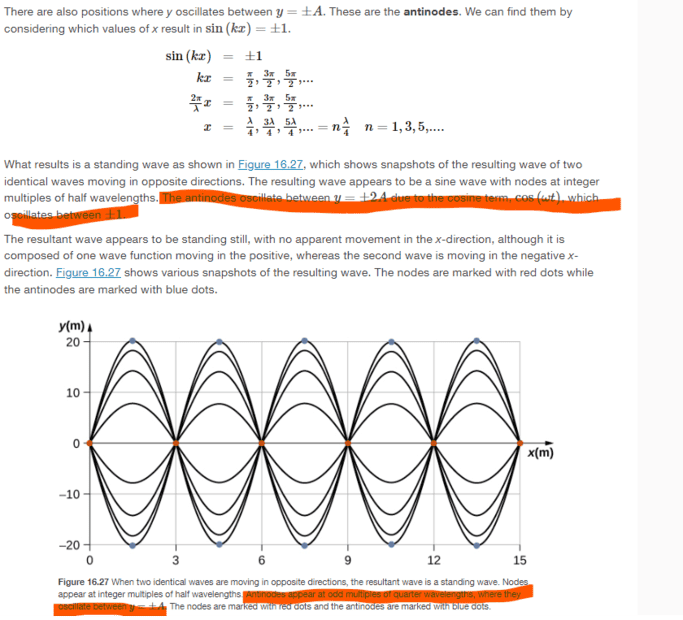
The two statements highlighted do not seem to agree. I think the first statement highlighted is referring to A as initial amplitude (which we can denote ##A_i##) of the traveling waves before there constructive interference to form antinodes with an amplitude 2A and nodes of an amplitude 0. Where I think the second highlighted statement is referring to when A is the resultant amplitude of standing wave which we can denote ##A_f = 2A_i##.
Is my understanding please correct?
Many thanks!