Do you solve the Riemann sum first then take the limit?

2 replies · 2K views · last reply
Nemo1
Messages
62
Reaction score
0
Hi Community,

I have the following question:
View attachment 5613

I have done basic solving of limits and also of Riemann sums but never had to do them in the same question.

Would I be correct in saying that I need to solve for the Riemann sum first then take the limit of the integral?

Cheers Nemo
 
Attachments
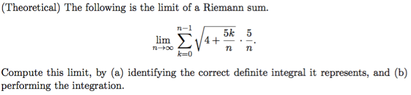
  • Printed problem: the limit as n approaches infinity of the sum from k=0 to n-1 of the square root of (4 + 5k/n) times 5/n, followed by the instruction to compute it by identifying the definite integral and evaluating it.
    Screen Shot 2016-05-22 at 4.32.23 PM.png
    14.7 KB · Views: 185
Nemo said:
Hi Community,

I have the following question:I have done basic solving of limits and also of Riemann sums but never had to do them in the same question.

Would I be correct in saying that I need to solve for the Riemann sum first then take the limit of the integral?

Cheers Nemo

No, this entire expression, which is a Riemann Sum, represents a definite integral. You need to figure out what the definite integral is, and then solve the definite integral. You aren't trying to solve this by taking the sum.
 
So after, quite a few days of working thru this one. I think I have it.

$$\lim_{{n}\to{\infty}}\sum_{k=0}^{n-1}\sqrt{4+\frac{5k}{n}}\cdot\frac{5}{n}$$

Using the formula:

$$\int_{a}^{b} f(x)\,dx = \lim_{{n}\to{\infty}}\sum_{i=1}^{n}f(xi)\Delta x$$

Using:

$$\Delta x = \frac{b-a}{n} = \frac{5}{n}$$

$$xi = 4+\frac{5k}{n}$$

$$a = 4$$

$$b = 9$ $from$ $b - 4 = 5$ $solve$ $for$ $b = 9$$

To then get:

$$\lim_{{n}\to{\infty}}\sum_{k=0}^{n-1}\sqrt{{xi}}$ $\Delta x =$$$$ \int_{4}^{9}\sqrt{{xi}} \,dx$$

$$ \int \sqrt{x} \,dx$$ $=$ $$ \int {x^{\frac{1}{2}}} \,dx$$- Power Rule - $$\int x^a$ $dx = \frac{x^{a+1}}{a+1}$ $Where$ $a\ne 1$$

To then get:

$$x^{\frac{1}{2}}\,dx$ $=$ $\frac{x^{\frac{1}{2}+1}}{{\frac{1}{2}}+1}$ $=$ $\frac{2x^{\frac{3}{2}}}{3}+c$$

Using the FTOC.

$$F(b)=\frac{2\cdot9^{\frac{3}{2}}}{3}=18$$ - $$F(a)=\frac{2\cdot4^{\frac{3}{2}}}{3}=\frac{16}{3}$$

To get:

$$\frac{38}{3}$ $\approx12.6667$$

Its been a bit of a long journey of learning but I got there.

Cheers Nemo.