Does Adding Detector D5 After BSa Affect the Interference Pattern at D0?

Click For Summary
SUMMARY

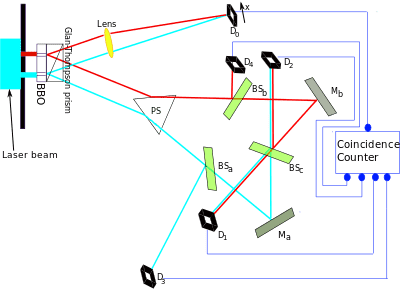
Adding a new detector, D5, immediately after the beam splitter BSa will prevent D0 from displaying an interference pattern for D5. This conclusion aligns with the results observed at detector D3, confirming that the presence of intermediate materials, such as beam splitters and mirrors, does not materially affect the interference results. The discussion emphasizes the importance of detector placement in quantum interference experiments.

PREREQUISITES
  • Understanding of quantum interference principles
  • Familiarity with beam splitters and their role in experiments
  • Knowledge of detector placement in quantum optics
  • Basic concepts of light behavior in quantum mechanics
NEXT STEPS
  • Research the role of beam splitters in quantum optics experiments
  • Study the effects of detector placement on interference patterns
  • Learn about the implications of intermediate materials in quantum experiments
  • Examine case studies involving multiple detectors in quantum interference
USEFUL FOR

Quantum physicists, optical engineers, and students studying quantum mechanics who are interested in the effects of detector placement on interference patterns.

or4cle
Messages
1
Reaction score
0
Hi, I have a simple question regarding this experiment:
dia%2Fcommons%2Fthumb%2F2%2F21%2FKim_EtAl_Quantum_Eraser.svg%2F401px-Kim_EtAl_Quantum_Eraser.svg.png

If we were to place a new detector, say D5, immediately after BSa, would it mean that D0 never shows an interference pattern for D5? I think so, as it would seem this should be no different than the result obtained at D3, but just want to confirm my understanding of the experiment (and try to convince myself that that the light traveling through or interacting with intermediate materials (e.g. beam splitters, mirrors, etc.) is not materially affecting the results).
 
Physics news on Phys.org
or4cle said:
If we were to place a new detector, say D5, immediately after BSa, would it mean that D0 never shows an interference pattern for D5? I think so, as it would seem this should be no different than the result obtained at D3
Yes, that's correct.
 

Similar threads

  • · Replies 2 ·
Replies
2
Views
2K
  • · Replies 8 ·
Replies
8
Views
2K
  • · Replies 3 ·
Replies
3
Views
5K
  • · Replies 1 ·
Replies
1
Views
2K
  • · Replies 6 ·
Replies
6
Views
3K
  • · Replies 38 ·
2
Replies
38
Views
6K
  • · Replies 1 ·
Replies
1
Views
2K
  • · Replies 12 ·
Replies
12
Views
4K
  • · Replies 9 ·
Replies
9
Views
2K
  • · Replies 4 ·
Replies
4
Views
2K