Does Earth's eccentricity change?

  • Context: Undergrad 
  • Thread starter Thread starter DaveC426913
  • Start date Start date
  • Tags Tags
    Change Eccentricity
Click For Summary
SUMMARY

The Earth's orbital eccentricity changes over time, fluctuating between approximately 0.0034 and 0.058 due to gravitational interactions with other planets. This variation occurs over cycles of 100,000 years, as part of the Milankovitch cycles, which also include precession of the equinoxes and changes in inclination. The current eccentricity is about 0.0167, and these changes significantly influence Earth's climate by affecting insolation levels. Tools like Gravity Simulator can be used to simulate these variations and analyze their effects on Earth's orbit.

PREREQUISITES
  • Understanding of Milankovitch cycles
  • Familiarity with orbital mechanics
  • Experience using Gravity Simulator software
  • Basic knowledge of insolation calculations
NEXT STEPS
  • Explore the Milankovitch cycles in detail
  • Learn how to use Gravity Simulator for orbital analysis
  • Investigate the relationship between eccentricity and climate change
  • Study the effects of planetary gravitational interactions on orbital elements
USEFUL FOR

Astronomers, climate scientists, educators, and anyone interested in understanding the dynamics of Earth's orbit and its impact on climate patterns.

DaveC426913
Gold Member
2025 Award
Messages
24,262
Reaction score
8,389
I've just been asked of the Earth's eccentricity or orbit changes over time. The idea is that, over a period of 100,000 years or so, the Earth's orbit changes from nearly circular to more elliptical.

I have never heard of such a thing. Can anyone confirm or refute?
 
Astronomy news on Phys.org
Hm. It would appear there is some truth to this:

http://en.wikipedia.org/wiki/Orbital_eccentricity
"The eccentricity of the Earth's orbit is currently about 0.0167. Over thousands of years, the eccentricity of the Earth's orbit varies from nearly 0.0034 to almost 0.058 as a result of gravitational attractions among the planets"

Indeed, the graph shows 7-8 peaks over 750,000 years:
http://www.museum.state.il.us/exhibits/ice_ages/eccentricity_graph.html
 
Nearly all aspects of Earth's orbital motion swing ever-so-lightly back and forth, and these changes--the "Milankovitch cycles"--cause Earth's climate to fluctuate periodically. Besides changes in eccentricity, there's also precession of the equinoxes, precession of the perihelion, and changes in inclination, all of which are also caused by the influences of other planets (and of the Moon).
 
BTW, I just found out the 100 000-year timescale is accurate. At least according to Wikipedia's article on the Milankovitch cycles:

"The major component of these variations occurs on a period of 413,000 years (eccentricity variation of ±0.012). A number of other terms vary between components 95,000 and 125,000 years (with a beat period 400 ka), and loosely combine into a 100,000-year cycle (variation of −0.03 to +0.02)."

Interestingly, the strongest periodicity in Earth's climate is a 100 000 year cycle, even though changes in eccentricity are small compared to the effects of precession. Go figure.
 
Seems you've found the answer. I know you've used Gravity Simulator before. If it's still installed on your computer, you can get the answer from there too, but it might take a while. Start with any simulation that uses JPL's numbers to produce an accurate solar system, using Earth/Moon barycenter, rather than Earth and Moon as separate objects. In the File menu, have it output a file containing the orbital elements of Earth and any planet. Run the simulation at a slow time step (64 seconds or less). If the program is left to run in the background for a few days, you might be able to get close to 1 million years of sim. Then use Excel to plot the data file. You'll find your eccentricity plot for Earth looks very similar to the one in your second link, with 100,000 year cycles on top of a larger 400,000 year cycle. Here's an example, but this one runs forwards in time, not in reverse as the one in your link.
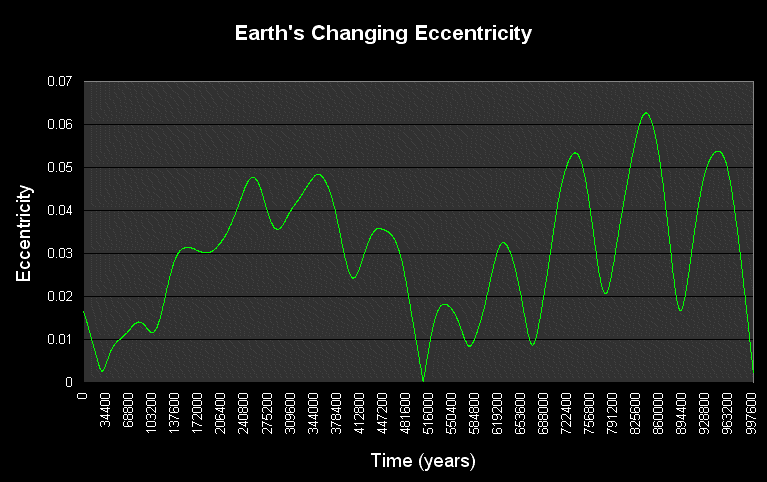
image026.png


If you did run Gravity Simulator backwards to recreate the graph you linked to, you'd probably find that the graph it creates is in good agreement with their graph up to a point. Beyond that, they diverge. The solar system is chaotic enough that going too far into the future with either method (their graph probably uses analytic perturbation theory) will give untrustable results. The overall patterns of 100,000 and 400,000 year cycles will remain, but the graphs will get out of phase.

Another interesting thing to try is to see how eccentricity changes insolation, the amount of solar flux received by Earth. For this, delete Earth, and recreate it with its minumum eccentricity. Run the sim for 1 year, saving a data file of its position vector once a day. Then in Excel, turn the position vector into a distance from the sun. Make a column for insolation (Solar Luminosity *4 * pi * distance^2), once for each day, and take the average of all 365 days. You'll find that planets in more eccentric orbits receive more insolation than less eccentric orbits. Our orbit is currently getting rounder, meaning we're receiving less sunlight per year. But the difference is not very significant. The big reason that changing eccentricity affects climate is that the Northern and Southern hemispheres are not equally efficient at absorbing/reflecting sunlight. With the Earth's current eccentricity, it receives about 7% more insolation at perihelion than at apihelion. Perihelion currently coinsides with Southern Hemisphere summer.

It's also neat to see how the other orbital elements change with time, for Earth and the other planets. Deleting Jupiter and comparing results shows that Jupiter is the main contributor to the oscillating orbital elements of all the planets.

It's strange to think that the Earth's orbit has inclination, as Earth's orbit defines the plane. But the plane is only defined for one instant (currently we use Jan 1, 2000 at 12 noon GMT). The Earth's inclination has since drifted a small bit from inc=0.
 
ideasrule said:
...the influences of other planets (and of the Moon).
Generally, Earth's orbital elements actually refer to the barycenter of the Earth/Moon system, negating the Moon's influence.
 
tony873004 said:
Generally, Earth's orbital elements actually refer to the barycenter of the Earth/Moon system, negating the Moon's influence.
.

The earth/moon system has a wobble to it due to the center of mass of this system. The center of mass is Aprox=4000km from Earth's center aligned with a line connecting to the centers of the two bodies This wobble is at an axial tilt of Aprox=23degrees, an inclination from the sun and let's the force of gravity of the sun pull the barycenter and Earth and moon centers in many different tangents not normal to an orbit sure the eccentricity should vary in an undulating way but also it may bring about a balance due to its repeating type nature.
 
Last edited:

Similar threads

  • · Replies 2 ·
Replies
2
Views
2K
  • · Replies 28 ·
Replies
28
Views
7K
  • · Replies 4 ·
Replies
4
Views
3K
  • · Replies 2 ·
Replies
2
Views
4K
  • · Replies 7 ·
Replies
7
Views
6K
  • · Replies 2 ·
Replies
2
Views
3K
  • · Replies 2 ·
Replies
2
Views
2K
  • · Replies 1 ·
Replies
1
Views
2K
  • · Replies 3 ·
Replies
3
Views
3K
  • · Replies 16 ·
Replies
16
Views
8K