Does induced drag theory include the Lift = Weight condition?

Click For Summary

Discussion Overview

The discussion revolves around the relationship between induced drag and the lift-to-weight condition in aerodynamics, particularly in the context of the Kutta–Joukowski theorem. Participants explore whether induced drag theory accounts for the condition where lift equals weight, and how changes in angle of attack (AoA) affect lift and drag in various flight scenarios.

Discussion Character

  • Exploratory
  • Technical explanation
  • Debate/contested

Main Points Raised

  • Some participants question if induced drag is zero when there is no effective airflow, suggesting that drag may only be zero under specific conditions.
  • There is a discussion about how changes in AoA affect the magnitude of lift and the resultant force (Fr), with some arguing that increasing AoA is necessary to maintain lift when downwash is considered.
  • One participant notes that symmetrical airfoils will naturally adopt a state of minimum drag and zero lift if left alone, raising questions about stability in airfoil designs.
  • Another participant emphasizes that the lift force can be manipulated through changes in velocity and AoA, but questions whether maintaining lift equal to weight is always desirable in practice.
  • Some participants express uncertainty about the implications of induced drag theory on lift calculations, particularly when considering downwash effects.
  • A later reply clarifies that while lift equals weight in level flight, this may not hold true in all flight conditions, such as during turns or maneuvers.

Areas of Agreement / Disagreement

Participants express multiple competing views regarding the relationship between induced drag and the lift-to-weight condition. There is no consensus on whether induced drag theory inherently includes the L=Weight condition or how it applies in various flight scenarios.

Contextual Notes

Participants highlight limitations in understanding how induced drag theory accounts for changes in lift due to downwash and AoA adjustments. There are unresolved questions about the stability of airfoil designs and the conditions under which lift equals weight.

Jurgen M
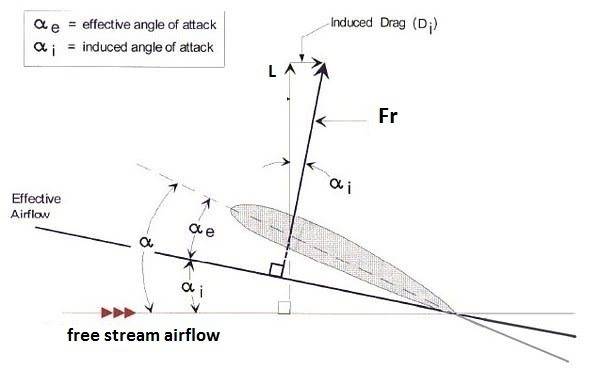
This is usual induced drag diagram.
I have 2 questions:

From Kutta–Joukowski theorem Fr is always perpendicular to effective airflow.

1. Does it mean for case without effective airflow(zero induced downward velocity), Fr is perpendicular to freestream airflow,so drag is zero?

When effective airflow reduce AoA, Fr magnitude must also be reduced(example:Fr at wing is smaller at 6° then on 10°), that mean lift also decrease. What then keep lift constant to satisfy L=Weight?

So we must pull yoke and inecrease AoA to keep lift the same, that will increase downwash so Fr will tilt even more back, and induced drag will rise even more.

2.Does this theory usualy inculde L=Weight condition or not, so is induced drag shown at pictures is for L=weight condition or without?
induceddrag_fuk80z.jpg
 
Last edited by a moderator:
Physics news on Phys.org
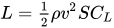
The equation for lift force shows us that there are two factors easily manipulable: velocity of airstream and coefficient of lift (via modification of AoA and/or camber of airfoil).

bec439cc0c6fe54210261ced30d3d9ac5c6a222b


In practice, lift force that equals weight is not always desired.
All symmetrical airfoils will naturally adopt the attitude of minimum drag and zero lift if left alone.

For example, when you pull the yoke to forcefully increase the AoA of the wings, you are actually increasing the camber and AoA of the tail of the aircraft (horizontal stabilizer) to induce a negative lift or drop there (force pushing downwards).
 
Last edited:
Lnewqban said:
All airfoils will naturally adopt the attitude of minimum drag and zero lift if left alone.
I didn't know that. Do you mean that all airfoil designs are inherently stable?
 
  • Like
Likes   Reactions: Lnewqban
Lnewqban said:
The equation for lift force shows us that there are two factors easily manipulable: velocity of airstream and coefficient of lift (via modification of AoA and/or camber of airfoil).

bec439cc0c6fe54210261ced30d3d9ac5c6a222b


In practice, lift force that equals weight is not always desired.
All airfoils will naturally adopt the attitude of minimum drag and zero lift if left alone.

For example, when you pull the yoke to forcefully increase the AoA of the wings, you are actually increasing the camber and AoA of the tail of the aircraft (horizontal stabilizer) to induce a negative lift or drop there (force pushing downwards).
Please try to answer specificly at 1. and 2.
 
anorlunda said:
I didn't know that. Do you mean that all airfoil designs are inherently stable?
Not really, I should have specified symmetrical airfoils.
Cambered airfoils will tend to roll forward.
I will edit my previous post, sorry.
 
Jurgen M said:
Please try to answer specificly at 1. and 2.
I believe I did.
Excuse me, it seems that I don’t understand those two questions.

I just want to leave this concept for you to consider:
The wing can be loaded or not.
If you do a FBD and all forces are in balance, the wing will fly straight.
If lift is greater than whatever opposite force, the wing will move up respect to airstream.
If less, the wing will move down.

While performing a vertical round loop, the amount of needed lift will be maximum at the bottom, almost zero at 3 and 9 o’clock, and negative at top.
As an aerobatic loop should be performed at constant velocity, the pilot only has the elevator to change it via changing the AoA.

+pilot+at+the+bottom+of+a+dive+can+be+quite+large..jpg


Load%20factor%20B787.png
 
@Lnewqban I understand your post..

My question 2. only ask is general induced theory keep L constant when drawn forces from AoA freestream(no downwash) to AoA effective(downwash)?

Because if you keep L constant,and after you include downwash(eff.AoA) then you must increase additionally AoA to compensate reduction in lift due to tilt back of resultant force,so you end up with even more induced drag compare if you didnt keep L constant.

Maybe I need called topic "Does induced drag theory keep lift constant during calculations?"
 
Last edited by a moderator:
Jurgen M said:
@Lnewqban I understand your post..

My question 2. only ask is general induced theory keep L constant when drawn forces from AoA freestream(no downwash) to AoA effective(downwash)?

Because if you keep L constant,and after you include downwash(eff.AoA) then you must increase additionally AoA to compensate reduction in lift due to tilt back of resultant force,so you end up with even more induced drag compare if you didnt keep L constant.

Maybe I need called topic "Does induced drag theory keep lift constant during calculations?"
Lift, and its associate lift-induced-drag, are a direct result of the AoA that certain section of the wing is “feeling”.
In this case, the diagram seems to show how the “felt” AoA varies for different sections of the wing.
Less AoA always results in less lift, as all the sections of one wing are moving at the same forward velocity.
 
As you can see in your diagram, the length of vectors L and Fr are different, as it should be.
A rectangular wing always creates more pressure differential (more lift) toward the root and middle section, while there is more pressure by-passing from bottom to top (less lift) toward the wingtip.

The peculiar upwash-downwash of the tip vortex reduces the AoA toward the wingtip, and changes the direction of the vector lift (increases drag), but also reduces its value (reduces drag).

Please, see:
https://link.springer.com/article/10.1007/s11012-020-01230-1

vitesses%20induites%20upwash%20downwash.png


downwash%20ligne%20portante.gif
 
  • #10
Fr dont change magnitude because circulation dont change with aoa,so my assumtpion is wrong in question

This is theory is invisicd ,it has lift but not drag in 2D section, that is reason why theory has aerodynamic force perpendicular to eff.airlfow(which is impossible in real fluid)
 
  • #11
Jurgen M said:
This is usual induced drag diagram.
I have 2 questions:

From Kutta–Joukowski theorem Fr is always perpendicular to effective airflow.

That's not from Kutta-Joukowski, that's just from how lift is defined. It also happens to be the angle of the resultant force if you assume the flow is inviscid. In any real flow, this won't be the actual force direction, since there will be a nonzero viscous drag component, but it's handy to split the force up into a component perpendicular to the incident flow (lift) and a component parallel to the incident flow (drag).

Jurgen M said:
1. Does it mean for case without effective airflow(zero induced downward velocity), Fr is perpendicular to freestream airflow,so drag is zero?

Well, in a case where you ignore viscous drag and also have zero induced velocity, yes, the drag is zero. In reality there is also always some viscous drag.

Jurgen M said:
When effective airflow reduce AoA, Fr magnitude must also be reduced(example:Fr at wing is smaller at 6° then on 10°), that mean lift also decrease. What then keep lift constant to satisfy L=Weight?

I think that you're imagining this a bit backwards here. The lift doesn't decrease because the wing never saw that "real" 10 degree angle of attack in the first place. As you pitch the wing up, the induced flow is also created, so as you pitch the wing from 0-10 degrees geometrically, the angle of the incident air smoothly goes from 0-6 degress (in your example), so there's a smooth increase in lift as you pitch up (it's just a shallower lift slope than you expect if you neglect to account for this factor).

You still end up with lift equal to weight, it just happens at a slightly higher angle of attack than you'd expect looking at the section polar alone.

Jurgen M said:
So we must pull yoke and inecrease AoA to keep lift the same, that will increase downwash so Fr will tilt even more back, and induced drag will rise even more.

Yes, but your lift still increases, so there's still an angle where everything balances out. In addition, for most real planes, this effect is quite small - induced drag is really pretty minimal unless you have an airplane with a very short aspect ratio.

Jurgen M said:
2.Does this theory usualy inculde L=Weight condition or not, so is induced drag shown at pictures is for L=weight condition or without?View attachment 317316

L=weight is only true in level, unaccelerated flight. This certainly applies in that situation, but it also applies in other situations, like turning flight (where a higher Cl is needed), or in a pushover (where lower Cl is needed). There's nothing inherent about this that necessitates that you're at a single flight condition, and as I said, if you actually plot out the lift and induced drag vs a range of geometric angles of attack, you'll find that you still have a smooth lift polar, it just has a slightly lower slope than it would if you had the behavior of a 2d section.

(Sorry for taking a while to respond - I've been very busy lately)
 
  • Like
Likes   Reactions: Lnewqban and russ_watters

Similar threads

  • · Replies 3 ·
Replies
3
Views
4K
  • · Replies 3 ·
Replies
3
Views
2K
  • · Replies 7 ·
Replies
7
Views
2K
  • · Replies 2 ·
Replies
2
Views
5K
  • · Replies 6 ·
Replies
6
Views
4K
  • · Replies 5 ·
Replies
5
Views
9K
  • · Replies 1 ·
Replies
1
Views
5K
  • · Replies 6 ·
Replies
6
Views
9K