Does the sequence converge or diverge? (2^n)/(2n)

  • Context: Undergrad 
  • Thread starter Thread starter Salman Ali
  • Start date Start date
  • Tags Tags
    Sequence
Click For Summary
SUMMARY

The discussion centers on determining the convergence or divergence of the sequence defined by the formula (2^n)/(2n). Participants emphasize the application of the ratio test as a straightforward method for analyzing convergence. They clarify the distinction between the convergence of a sequence and the convergence of a series, specifically highlighting that the nth term test is primarily useful for identifying divergence rather than convergence. The conversation underscores the importance of understanding these concepts in mathematical studies.

PREREQUISITES
  • Understanding of sequences and series in calculus
  • Familiarity with the ratio test for convergence
  • Knowledge of the nth term test for divergence
  • Basic factorial notation and operations
NEXT STEPS
  • Study the application of the ratio test in detail
  • Learn about the nth term test for divergence and its limitations
  • Explore other convergence tests such as the root test and comparison test
  • Practice problems involving sequences and series convergence
USEFUL FOR

Students and educators in calculus, mathematicians focusing on series convergence, and anyone seeking to deepen their understanding of convergence tests in mathematical analysis.

Salman Ali
Messages
13
Reaction score
1
TL;DR
Which method easier to solve such questions which involve factorials?
So there are two parts of the question:
a) does the sequence converge or diverge
b) use nth term on the Series
Now sybomlab calculator is saying to apply ratio test!
a)
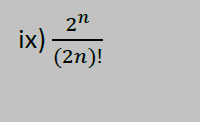
5.PNG


b)
So should I apply ratio test or is there any easy method? And what's the difference between these two questions and what methods differ?


Attachments

  • 5.1.PNG
    5.1.PNG
    1.3 KB · Views: 409
Physics news on Phys.org
Salman Ali said:
Summary: Which method easier to solve such questions which involve factorials?

So there are two parts of the question:
a) does the sequence converge or diverge
b) use nth term on the Series
Now sybomlab calculator is saying to apply ratio test!
a)View attachment 249006

b)
So should I apply ratio test or is there any easy method? And what's the difference between these two questions and what methods differ?
What could be easier than the ratio test?
 
You could factor out the 2 from the 2n and then the answer becomes obvious using the ratio test.

Be careful here to only factor out the 2’s that you need.
 
Salman Ali said:
And what's the difference between these two questions and what methods differ?
The first question asks whether the given sequence converges. That is, whether ##\{\frac 1 {0!}, \frac 2 {2!}, \frac 4 {4!}, \dots \}## converges.

The second question asks whether the series (the sum of the terms of the sequence above) converges. In other words, whether ##\{\frac 1 {0!} + \frac 2 {2!} + \frac 4 {4!} + \dots \}## converges. At this point in your studies it's important to understand the difference between these two words.
 
  • Like
Likes   Reactions: Delta2 and PeroK
Mark44 said:
The first question asks whether the given sequence converges. That is, whether ##\{\frac 1 {0!}, \frac 2 {2!}, \frac 4 {4!}, \dots \}## converges.

The second question asks whether the series (the sum of the terms of the sequence above) converges. In other words, whether ##\{\frac 1 {0!} + \frac 2 {2!} + \frac 4 {4!} + \dots \}## converges. At this point in your studies it's important to understand the difference between these two words.
Can you kindly explain how to solve both of them ?
 
Salman Ali said:
Can you kindly explain how to solve both of them ?

We can't do that. You need to post your best effort.
 
Salman Ali said:
Can you kindly explain how to solve both of them ?
The ratio test, which you already mentioned, is easy to use to determine whether the sequence converges.
Your textbook should have several tests you can use to determine whether a series converges, as well as examples of how to use them.

Salman Ali said:
b) use nth term on the Series
The nth term test is often not useful. It can be used to determine that a series diverges, but it doesn't tell you when a series converges.
The full name of the test is "nth term test for divergence."
 
PeroK said:
We can't do that. You need to post your best effort.
 

Attachments

  • WhatsApp Image 2019-09-02 at 6.43.37 PM.jpeg
    WhatsApp Image 2019-09-02 at 6.43.37 PM.jpeg
    41.9 KB · Views: 362
Mark44 said:
The ratio test, which you already mentioned, is easy to use to determine whether the sequence converges.
Your textbook should have several tests you can use to determine whether a series converges, as well as examples of how to use them.

The nth term test is often not useful. It can be used to determine that a series diverges, but it doesn't tell you when a series converges.
The full name of the test is "nth term test for divergence."
I am bound to use nth term for the second part. Its mentioned in the question. I'll give it a try.
 
  • #10
The ratio test determines whether a series converges.

What can you say about the sequence?
 

Similar threads

  • · Replies 17 ·
Replies
17
Views
5K
  • · Replies 3 ·
Replies
3
Views
2K
  • · Replies 6 ·
Replies
6
Views
4K
  • · Replies 11 ·
Replies
11
Views
5K
  • · Replies 5 ·
Replies
5
Views
2K
  • · Replies 7 ·
Replies
7
Views
3K
  • · Replies 3 ·
Replies
3
Views
3K
  • · Replies 3 ·
Replies
3
Views
2K
Replies
8
Views
1K
  • · Replies 3 ·
Replies
3
Views
2K