Does the sequence converge or diverge? (2^n)/(2n)

  • Context: Undergrad 
  • Thread starter Thread starter Salman Ali
  • Start date Start date
  • Tags Tags
    Sequence
Click For Summary

Discussion Overview

The discussion revolves around determining whether the sequence defined by the expression (2^n)/(2n) converges or diverges, as well as the application of the nth term test on the corresponding series. Participants explore various methods for analyzing convergence, including the ratio test and the nth term test, while seeking clarification on the differences between the two questions posed.

Discussion Character

  • Exploratory
  • Technical explanation
  • Debate/contested
  • Homework-related

Main Points Raised

  • Some participants suggest applying the ratio test to determine convergence, while others question if there are easier methods available.
  • One participant notes the importance of distinguishing between the convergence of the sequence and the convergence of the series formed by summing the sequence's terms.
  • There is a discussion about the usefulness of the nth term test, with some participants indicating it is often not helpful for establishing convergence.
  • Some participants express a need for clarification on how to solve both parts of the question, while others emphasize the necessity of demonstrating one's best effort before seeking help.

Areas of Agreement / Disagreement

Participants generally agree on the distinction between the convergence of the sequence and the series. However, there is no consensus on the best method to apply for determining convergence, as multiple approaches are discussed without a clear resolution.

Contextual Notes

Some participants mention the ratio test and nth term test, but there are unresolved questions regarding their applicability and effectiveness in this context. The discussion reflects varying levels of understanding and comfort with these concepts.

Who May Find This Useful

This discussion may be useful for students studying sequences and series in calculus, particularly those grappling with convergence tests and their applications.

Salman Ali
Messages
13
Reaction score
1
TL;DR
Which method easier to solve such questions which involve factorials?
So there are two parts of the question:
a) does the sequence converge or diverge
b) use nth term on the Series
Now sybomlab calculator is saying to apply ratio test!
a)
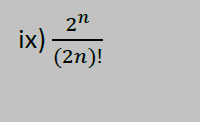
5.PNG


b)
So should I apply ratio test or is there any easy method? And what's the difference between these two questions and what methods differ?


Attachments

  • 5.1.PNG
    5.1.PNG
    1.3 KB · Views: 411
Physics news on Phys.org
Salman Ali said:
Summary: Which method easier to solve such questions which involve factorials?

So there are two parts of the question:
a) does the sequence converge or diverge
b) use nth term on the Series
Now sybomlab calculator is saying to apply ratio test!
a)View attachment 249006

b)
So should I apply ratio test or is there any easy method? And what's the difference between these two questions and what methods differ?
What could be easier than the ratio test?
 
You could factor out the 2 from the 2n and then the answer becomes obvious using the ratio test.

Be careful here to only factor out the 2’s that you need.
 
Salman Ali said:
And what's the difference between these two questions and what methods differ?
The first question asks whether the given sequence converges. That is, whether ##\{\frac 1 {0!}, \frac 2 {2!}, \frac 4 {4!}, \dots \}## converges.

The second question asks whether the series (the sum of the terms of the sequence above) converges. In other words, whether ##\{\frac 1 {0!} + \frac 2 {2!} + \frac 4 {4!} + \dots \}## converges. At this point in your studies it's important to understand the difference between these two words.
 
  • Like
Likes   Reactions: Delta2 and PeroK
Mark44 said:
The first question asks whether the given sequence converges. That is, whether ##\{\frac 1 {0!}, \frac 2 {2!}, \frac 4 {4!}, \dots \}## converges.

The second question asks whether the series (the sum of the terms of the sequence above) converges. In other words, whether ##\{\frac 1 {0!} + \frac 2 {2!} + \frac 4 {4!} + \dots \}## converges. At this point in your studies it's important to understand the difference between these two words.
Can you kindly explain how to solve both of them ?
 
Salman Ali said:
Can you kindly explain how to solve both of them ?

We can't do that. You need to post your best effort.
 
Salman Ali said:
Can you kindly explain how to solve both of them ?
The ratio test, which you already mentioned, is easy to use to determine whether the sequence converges.
Your textbook should have several tests you can use to determine whether a series converges, as well as examples of how to use them.

Salman Ali said:
b) use nth term on the Series
The nth term test is often not useful. It can be used to determine that a series diverges, but it doesn't tell you when a series converges.
The full name of the test is "nth term test for divergence."
 
PeroK said:
We can't do that. You need to post your best effort.
 

Attachments

  • WhatsApp Image 2019-09-02 at 6.43.37 PM.jpeg
    WhatsApp Image 2019-09-02 at 6.43.37 PM.jpeg
    41.9 KB · Views: 364
Mark44 said:
The ratio test, which you already mentioned, is easy to use to determine whether the sequence converges.
Your textbook should have several tests you can use to determine whether a series converges, as well as examples of how to use them.

The nth term test is often not useful. It can be used to determine that a series diverges, but it doesn't tell you when a series converges.
The full name of the test is "nth term test for divergence."
I am bound to use nth term for the second part. Its mentioned in the question. I'll give it a try.
 
  • #10
The ratio test determines whether a series converges.

What can you say about the sequence?
 

Similar threads

  • · Replies 17 ·
Replies
17
Views
5K
  • · Replies 3 ·
Replies
3
Views
2K
  • · Replies 6 ·
Replies
6
Views
4K
  • · Replies 11 ·
Replies
11
Views
5K
  • · Replies 5 ·
Replies
5
Views
2K
  • · Replies 7 ·
Replies
7
Views
3K
  • · Replies 3 ·
Replies
3
Views
4K
  • · Replies 3 ·
Replies
3
Views
2K
Replies
8
Views
1K
  • · Replies 3 ·
Replies
3
Views
2K