Domain Notation: Continuous Function

  • Context: High School 
  • Thread starter Thread starter Shaybay92
  • Start date Start date
  • Tags Tags
    Domain Notation
Click For Summary

Discussion Overview

The discussion revolves around how to properly express the domain of a function that is continuous, particularly focusing on the use of domain notation and interval notation. Participants explore the nuances of continuity, connectedness, and the appropriate mathematical language for describing sets related to functions.

Discussion Character

  • Debate/contested
  • Technical explanation
  • Conceptual clarification

Main Points Raised

  • Some participants suggest that interval notation is an accepted method for stating the domain of a function, particularly when the function is continuous over certain intervals.
  • Others argue that the term "domain" may not be appropriate, as the set of points where the function is continuous could be a union of multiple intervals rather than a single interval.
  • A participant points out that the function in question is continuous on three distinct intervals, proposing that the domain can be expressed as the union of these intervals.
  • There is a discussion about the correct interpretation of continuity at specific points, with some participants questioning whether certain intervals are indeed continuous or discontinuous at given endpoints.
  • Another participant emphasizes that while interval notation is correct for certain functions, it does not universally apply to all functions, as domains can be expressed in various ways.
  • Clarifications are made regarding the terminology used, with some participants noting that a function can be continuous on points within an interval, rather than the interval itself being continuous.

Areas of Agreement / Disagreement

Participants do not reach a consensus on the terminology and notation for expressing the domain of the function. There are multiple competing views regarding the use of interval notation and the interpretation of continuity at specific points.

Contextual Notes

Some participants express uncertainty about the definitions and interpretations of continuity and domain, highlighting that the discussion involves assumptions about the function's graph and the nature of its intervals.

Shaybay92
Messages
122
Reaction score
0
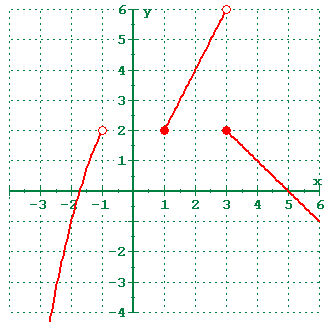
Just wondering how to write the domain of where a function similar to this is continuous:
piecewise1.gif


using proper domain notation.
 
Physics news on Phys.org
For stating a domain or range of a function, I'm pretty sure its accepted to use interval notation.
http://en.wikipedia.org/wiki/Interval_(mathematics)

And if a function is entirely continuous, I think it could be simply stated as

x| \Re
(x is continuous over the set of all real numbers)
 
Do you mean continuous or connected?
Your 'function', if it's the set of red lines' is not connected.
 
KrisOhn said:
For stating a domain or range of a function, I'm pretty sure its accepted to use interval notation.
http://en.wikipedia.org/wiki/Interval_(mathematics)
This makes no sense at all. The domain or range of a function need not be an interval.

The domain of a function is just a set. So any proper way to denote a set is a proper way to denote the domain.
 
Yes, but the set of points at which this particular function is continuous ("domain" is the wrong word) is the union of three intervals. Using interval notation to state that set is perfectly correct.

Since Shaybay92 said, in the original post, that interval notation was to be used in stating the answer, I have no idea what KrisOhn meant by saying " I'm pretty sure its accepted to use interval notation." Neither that nor his Wikipedia link to what an interval is contributes anything to the problem of determining what those intervals are.

Shaybay92, you should be able to see from the graph that this function is continuous on three intervals. The set can be written as the union of those three intervals:
(-\infty, a]\cup [b, c)\cup [d, \infty)

You should be able to see from the graph what a, b, c, and d are.
 
Last edited by a moderator:
Of course it is correct, but it's rather tautological: if a set you wish to denote is an interval, then writing down that interval is a correct way to do it.

But KrisOhn did not even refer to this particular function, which happens to have as domain (and set of points where it's continous) the union of intervals. He said that to denote the domain of an arbitrary function (well, he said "a function"), interval notation is used. This is obviously false.
 
Assuming HOI has the correct interpretation of the question, and that an open circle means an open interval and a filled in circle means a closed endpoint
I think only the first interval is continuous.

Is the second interval not discontinuous at b and the third at d?
 
An interval cannot be continuous, a function can be continuous on (points in) an interval.

The function is not continuous at -1, since -1 is not even in the domain.
The function is continuous at 1, since the limit as x approaches 1 is the same as the right limit; there is no left limit because there are no domain points to the left of 1 (sloppy language, but consider small open balls around x=1).
The function is not continuous at 3, because left and right limits do not coincide.

So the desired set is (-\infty,-1)\cup[1,3)\cup(3,\infty).
This is the same as D\backslash\{3\}, where D is the domain of the function.
 
Yes some sloppy Sunday terminology all round I whit.

But collectively we got there in the end.

I think the last offering by Landau to be correct.
 

Similar threads

  • · Replies 11 ·
Replies
11
Views
3K
  • · Replies 8 ·
Replies
8
Views
2K
  • · Replies 2 ·
Replies
2
Views
3K
  • · Replies 6 ·
Replies
6
Views
2K
  • · Replies 2 ·
Replies
2
Views
2K
  • · Replies 5 ·
Replies
5
Views
3K
  • · Replies 10 ·
Replies
10
Views
2K
  • · Replies 6 ·
Replies
6
Views
3K
  • · Replies 6 ·
Replies
6
Views
2K
  • · Replies 17 ·
Replies
17
Views
5K