Matthew Strasiotto
- 6
- 2
Hi all - This is pulled from a past paper -
I'm only going to state the components that I find challenging of this problem - The rest will be attached in my solution set.
Essentially - given an intrinsic semiconductor comprised of group II-VI elements.
Upon doping with group V, what's the resultant type of doping achieved?
My assumption - As will be seen in my uploaded solutions - is that I can approximate an "average" semiconductor group of halfway between 2 and 6, and dope this with group 5.
Additionally - I'd like to clarify my answer for 7ciii vs 7a, as they ask similar questions, and receive very similar answers by very similar methods.
It feels deceptively trivial reaching the answer I did for 7ciii, given I'd just applied nearly identical methodology in 7a.

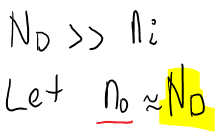
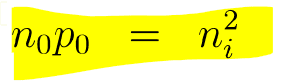
Taken from my annotated formula sheet - sorry about the hideousness
(OneNote version may be accessed as follows) https://www.physicsforums.com/onenote:https://d.docs.live.net/c82407cf764b2842/Documents/PHYS2213/Formula%20Sheets.one#SSD%20V2§ion-id={48CAF64B-A001-43B7-8221-48C2D0C1B5D7}&page-id={104A1659-065B-41FD-95B8-3984FF56372D}&end (Web view)
OneNote version: https://www.physicsforums.com/onenote:https://d.docs.live.net/c82407cf764b2842/Documents/PHYS2213/2016%20Exam.one#7a§ion-id={D5534116-5EA0-45C3-9F75-315FE37CE3C4}&page-id={5FEBB6D7-983C-4DD5-8868-ACB5948F4492}&end (Web view)
PDF attached.
If this is not compliant with the homework template in some way - Please let me know, and I can make relevant edits.
Homework Statement
I'm only going to state the components that I find challenging of this problem - The rest will be attached in my solution set.
Essentially - given an intrinsic semiconductor comprised of group II-VI elements.
Upon doping with group V, what's the resultant type of doping achieved?
My assumption - As will be seen in my uploaded solutions - is that I can approximate an "average" semiconductor group of halfway between 2 and 6, and dope this with group 5.
Additionally - I'd like to clarify my answer for 7ciii vs 7a, as they ask similar questions, and receive very similar answers by very similar methods.
It feels deceptively trivial reaching the answer I did for 7ciii, given I'd just applied nearly identical methodology in 7a.
Homework Equations
Taken from my annotated formula sheet - sorry about the hideousness
(OneNote version may be accessed as follows) https://www.physicsforums.com/onenote:https://d.docs.live.net/c82407cf764b2842/Documents/PHYS2213/Formula%20Sheets.one#SSD%20V2§ion-id={48CAF64B-A001-43B7-8221-48C2D0C1B5D7}&page-id={104A1659-065B-41FD-95B8-3984FF56372D}&end (Web view)
The Attempt at a Solution
OneNote version: https://www.physicsforums.com/onenote:https://d.docs.live.net/c82407cf764b2842/Documents/PHYS2213/2016%20Exam.one#7a§ion-id={D5534116-5EA0-45C3-9F75-315FE37CE3C4}&page-id={5FEBB6D7-983C-4DD5-8868-ACB5948F4492}&end (Web view)
PDF attached.
If this is not compliant with the homework template in some way - Please let me know, and I can make relevant edits.
Attachments
-
 upload_2018-12-1_16-4-49.png6.3 KB · Views: 466
 -
 upload_2018-12-1_16-6-16.png1.6 KB · Views: 461
 -
 upload_2018-12-1_16-6-39.png5.7 KB · Views: 464
 -
 upload_2018-12-1_16-7-12.png3.1 KB · Views: 448
 -
 upload_2018-12-1_16-7-27.png2.4 KB · Views: 457
 -
 upload_2018-12-1_16-7-39.png1.5 KB · Views: 446
 -
2016_Q7-8.pdf848.1 KB · Views: 371