Doppler Shift at Right Angles Confusion

racshot65
Messages
7
Reaction score
0
Hi,

I'm reading "The First Three Minutes" by Steven Weinberg

And am confused about this paragraph...

"Astronomers are able to measure the motion of a luminous body in a direction directly along the line of sight much more accurately than they can measure its motion at right angles to the line of sight. This technique makes use of the Doppler effect."

Now I did some research and this is what I understand currently

If the star is moving away like in this diagram you get Doppler shift

4pttsn.jpg


However if the star moves sideways like this there is no Doppler shift
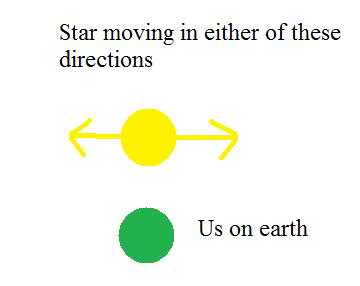
mt6xht.jpg


If my understanding is correct then my question is why does the sideways motion not produce a Doppler shift its still getting further away ?


Thank You
 
Astronomy news on Phys.org
racshot65 said:
If the star is moving away like in this diagram you get Doppler shift
OK.

However if the star moves sideways like this there is no Doppler shift
There will still be a Doppler shift due to time dilation (the transverse Doppler shift).

If my understanding is correct then my question is why does the sideways motion not produce a Doppler shift its still getting further away ?
Assuming the motion is exactly sideways to the line of sight, then at that point it's not getting further away.
 
Doc Al said:
Assuming the motion is exactly sideways to the line of sight, then at that point it's not getting further away.


I don't see how this is, consider this example


21cxdn4.jpg


If the star moves sideways 2cm it gets 0.4cm further away from us ?


What am I not understanding ?


Thanks :)
 
racshot65 said:
I don't see how this is, consider this example


21cxdn4.jpg


If the star moves sideways 2cm it gets 0.4cm further away from us ?


What am I not understanding ?


Thanks :)
Realize that the star will be gazillions of miles away. It's not going to change its position that drastically any time soon.

At the moment when the star is moving sideways to the line of sight (the first position in your diagram) it has no component of velocity in the radial direction: the instantaneous rate of change of its distance from us is zero. As the star continues to move in a straight line (let's say it does) and reaches some point where it is no longer moving sideways to the line of sight (the second position in your diagram), then it will have a component of velocity in the radial direction.
 
So just to confirm my understanding ...

At the initial moment it starts moving at a right angle to us sideways it has no velocity in that direction, hence it is no further away so there is no Doppler shift

However later on in time it gets further away from its initial position and is no longer moving at a right angle to us so does 'produce' Doppler shift
 
racshot65 said:
At the initial moment it starts moving at a right angle to us sideways it has no velocity in that direction,
It has no velocity component toward or away from us.
hence it is no further away so there is no Doppler shift
Even if the motion is completely sideways there will be a Doppler shift--this is called the transverse Doppler shift and is due to time dilation. (This transverse shift is generally smaller and more difficult to detect.)

However later on in time it gets further away from its initial position and is no longer moving at a right angle to us so does 'produce' Doppler shift
Right. (With the caveat that any motion will produce some kind of shift.)

If you ignore the transverse Doppler shift and only consider the longitudinal Doppler shift, then your understanding is perfectly correct.
 
The transverse Doppler effect is a relativistic phenomenon.
 
netheril96 said:
The transverse Doppler effect is a relativistic phenomenon.
Both the transverse and longitudinal Doppler shifts involve relativity, but the transverse shift is a purely relativistic effect.
 

Similar threads

  • · Replies 19 ·
Replies
19
Views
4K
  • · Replies 5 ·
Replies
5
Views
3K
  • · Replies 10 ·
Replies
10
Views
2K
  • · Replies 3 ·
Replies
3
Views
2K
  • · Replies 11 ·
Replies
11
Views
3K
  • · Replies 64 ·
3
Replies
64
Views
7K
  • · Replies 6 ·
Replies
6
Views
3K
Replies
5
Views
2K
  • · Replies 2 ·
Replies
2
Views
2K
  • · Replies 13 ·
Replies
13
Views
3K