Consider a point P on the rigid body. The position vector of the point P, ##\vec{r}_P##, is the sum of the position vector of the centre of mass ##\vec{R}## and the position vector from the centre of mass to P, ##\vec{r}_P'##: $$\vec{r}_P = \vec{R} + \vec{r}_{P}'$$Taking the time derivative, $$\vec{v}_P = \vec{V} + \vec{v}_P'$$Now ##\vec{v}_P'## is the velocity P w.r.t. the centre of mass. If the angular velocity of the rigid body is ##\vec{\omega}##, then
any two points on the rigid body rotate about each other at angular velocity ##\vec{\omega}##. So ##\vec{v}_P' = \vec{\omega} \times \vec{r}_{P}'##.
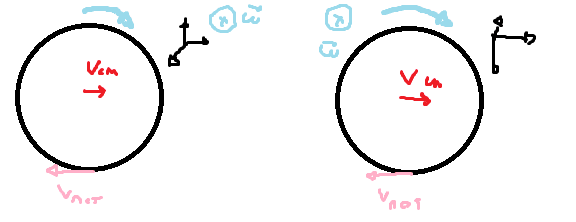
Now let's relate this to a rolling ball. Let ##P## be the point that is instantaneously at rest at the ball/ground interface, so ##\vec{v}_P = \vec{0}##. If the ##\hat{x}##, ##\hat{y}## and ##\hat{z}## axes point right, up and into the page respectively, then you have $$\vec{0} = \vec{V} + \omega_z \hat{z} \times (-r)\hat{y} = \vec{V} - \omega_z r \hat{x} = (V_x - \omega_z r)\hat{x}$$And this means that ##V_x = \omega_z r##, which is the rolling condition.
But we could have just as easily taken the ##\hat{z}## axis to point out of the page, in which case that cross product flips sign, and also ##\omega_z < 0##, and you would have ##V_x = -\omega_z r##. So really both of your answers could be correct (but ##\vec{\omega}## instead of ##\vec{\alpha}##), it depends how you define your coordinate system

. Specifically, whether you're using a right-handed or left-handed basis.
 .
.