Doubts in Calculating Nuclear Reactions

Click For Summary
SUMMARY

This discussion focuses on calculating nuclear reactions, specifically the fusion of isotopes such as deuterium into helium. Participants clarify that isotopes do not possess individual temperatures, as temperature is a collective property of a system. The Coulomb barrier, which represents the electric potential energy between two nuclei before they merge, is also discussed, along with the Gamow factor, which quantifies the likelihood of nuclear reactions occurring. Understanding these concepts is essential for anyone studying nuclear physics.

PREREQUISITES
  • Basic understanding of nuclear reactions and fusion processes
  • Familiarity with isotopes, particularly deuterium and helium
  • Knowledge of the Coulomb barrier and its implications in nuclear physics
  • Understanding of the Gamow factor in relation to nuclear reaction probabilities
NEXT STEPS
  • Study the mathematical calculations involved in nuclear fusion reactions
  • Research the properties and behaviors of isotopes in nuclear physics
  • Learn about the Coulomb barrier and its role in nuclear fusion
  • Explore the Gamow factor and its application in predicting nuclear reaction rates
USEFUL FOR

Students and enthusiasts of nuclear physics, researchers in nuclear energy, and anyone interested in the mechanics of atomic fusion and isotopic behavior.

NikolaTesla2
Messages
5
Reaction score
1
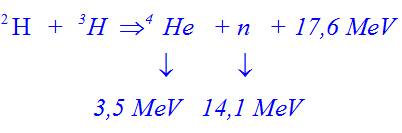
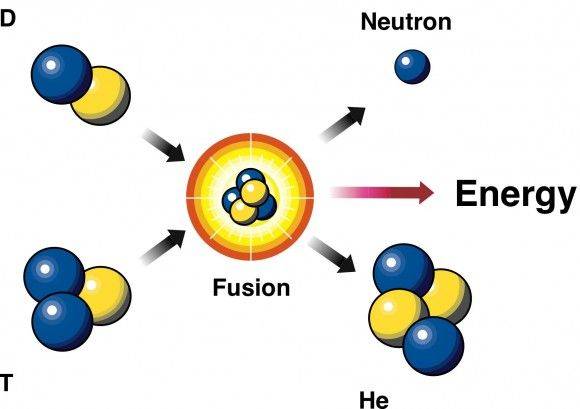
I am not talking about the reactions of simple atoms in chemistry, I am speaking, for example deuterium, heavy water, isotopes of hydrogen, oxygen, carbon, etc.I would like to know how to calculate when two atoms merge, to know mathematically what atom will form, example deuterium + deuterium = helium
c12e648d285664474e892f4cf77f7b29.jpg
fig03.jpg
Can someone explain me the calculations? I'm new to the forum, please!
 

Attachments

  • c12e648d285664474e892f4cf77f7b29.jpg
    c12e648d285664474e892f4cf77f7b29.jpg
    20 KB · Views: 494
  • fig03.jpg
    fig03.jpg
    6.5 KB · Views: 459
  • fig03.jpg
    fig03.jpg
    6.5 KB · Views: 448
Last edited:
Physics news on Phys.org
  • Like
Likes   Reactions: NikolaTesla2
termometro1-234x300.jpg
:nb)o0):mad::eek:o_OCalculation of the reaction temperature of two atomic nuclei......?I Now that I understand the calculation of the nuclear reaction, I want to understand the calculation of the temperature of each isotope ! understood ??do not see the need to create another topic if I have already created this one! I have a high school diploma, I have finished, I'm still not doing university! I'm talking about the temperature of each individual isotope, and not the temperature of the reaction, does that make sense to you? about the nuclear reaction, which was the topic of my first topic the friend Berkemam helped me, now the problem is this temperature ! I do not know if my question is relevant or not, but thanks to whoever is interested in answering my question!
 

Attachments

  • termometro1-234x300.jpg
    termometro1-234x300.jpg
    11.6 KB · Views: 545
Last edited:
Isotopes don't have temperatures.
Temperature is a property of a large collection of particles in a system. You can talk about the temperature of a gas of hydrogen, for example. You can also talk about the temperature of a large group of nuclei of some isotope - but then the temperature depends on how this group is prepared, and it is a property of the group only, not a property of the individual nuclei.
 
  • Like
Likes   Reactions: NikolaTesla2
mfb said:
Isotopes don't have temperatures.
Temperature is a property of a large collection of particles in a system. You can talk about the temperature of a gas of hydrogen, for example. You can also talk about the temperature of a large group of nuclei of some isotope - but then the temperature depends on how this group is prepared, and it is a property of the group only, not a property of the individual nuclei.
so it is a property of the individual nuclei, but I searched the internet talking about the coumlob barrier of each atom, if I am wrong correct me please, or it would be the barrier that each nucleus has, and the maximum temperature that is needed to happen the merger is confusing ! I am almost understanding this subject, I have much to learn because electronic study and not physical, but I find physics very interesting !:nb)o:)?:):mad:o_O:biggrin:
 
The Coulomb barrier is a property of a pair of nuclei. That is not a temperature. It is the electric potential energy the nuclei have just before "touching" (before the strong interaction pulls them together). While you can give the nuclei that much energy in an accelerator for example that is not done in fusion reactors. It is sufficient to get them close, they can tunnel through the remaining potential barrier. The Gamow factor can tell you how likely a reaction is.
 

Similar threads

  • · Replies 14 ·
Replies
14
Views
4K
  • · Replies 2 ·
Replies
2
Views
3K
  • · Replies 6 ·
Replies
6
Views
3K
  • · Replies 1 ·
Replies
1
Views
3K
  • · Replies 1 ·
Replies
1
Views
2K
  • · Replies 2 ·
Replies
2
Views
2K
  • · Replies 20 ·
Replies
20
Views
4K
  • · Replies 3 ·
Replies
3
Views
2K
  • · Replies 19 ·
Replies
19
Views
3K
  • · Replies 6 ·
Replies
6
Views
3K