Draw a rectangle that gives a visual representation of the problem

Join the discussion
Ask a follow-up here, or get your own question answered by working scientists, mathematicians and engineers — people, not an autocomplete.
Real named experts · corrections over time · the nuance an AI answer skips
14 replies · 2K views
nycmathguy
Homework Statement
1. Draw a rectangle.
2. Show that the width of a rectangle is
y = (520/3 - x and its area = x•)[(520/3) - x].
Relevant Equations
Area = length times width
A regulation NFL playing field of length x and width y has a perimeter of 346_2/3 or 1040/3 yards.

(a) Draw a rectangle that gives a visual representation of the problem. Use the specified variables to label the sides of the rectangle.

(b) Show that the width of the rectangle is y = (520/3) − x and its area is A = x[(520/3) − x)].

Question:

Before I try doing part (b), where did (520/3) come from?

See attachment for part (a).
 

Attachments
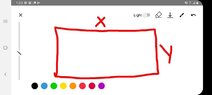
  • Screenshot_20210619-132304_Drawing Pad.jpg
    Screenshot_20210619-132304_Drawing Pad.jpg
    15.8 KB · Views: 256
Physics news on Phys.org
Write down the equation for the perimeter.
 
caz said:
Write down the equation for the perimeter.
Perimeter Equation:

P = 2x + 2y

Now what?
 
You were given a value for the perimeter. Substitute it in and solve for y.
 
  • Like
Likes   Reactions: nycmathguy
I would suggest that when you do not know what to do, write down what you know and play with it to see if something falls out. It’s what I do.
 
  • Like
Likes   Reactions: SammyS
caz said:
You were given a value for the perimeter. Substitute it in and solve for y.
I will use (1040/3) for the perimeter.

(1040/3) = 2x + 2y

(1040/3) - 2x = 2y

(1040 - 6x)/3 = 2y

2(1040 - 6x)/3 = 2y

2(520 - 3x)/3 = 2y

[2(520 - 3x)/3] ÷ 2 = y

[2(520 - 3x)/3] = y

(520 - 3x)/3 = y

(520/3) - (3x)/3 = y

(520/3 - x) = y

Hey, you're right!
 
I’ve deleted the incorrect steps.

(1040/3) = 2x + 2y

(1040/3) - 2x = 2y

(1040 - 6x)/3 = 2y

2(520 - 3x)/3 = 2y

[2(520 - 3x)/3] ÷ 2 = y

(520 - 3x)/3 = y

(520/3) - (3x)/3 = y

(520/3 - x) = y
 
  • Like
Likes   Reactions: nycmathguy
caz said:
I’ve deleted the incorrect steps.

(1040/3) = 2x + 2y

(1040/3) - 2x = 2y

(1040 - 6x)/3 = 2y

2(520 - 3x)/3 = 2y

[2(520 - 3x)/3] ÷ 2 = y

(520 - 3x)/3 = y

(520/3) - (3x)/3 = y

(520/3 - x) = y
What incorrect steps?
 
nycmathguy said:
What incorrect steps?

2(1040 - 6x)/3 = 2y

[2(520 - 3x)/3] = y

They both have an extra factor of 2 on the left hand side of the equation.
 
  • Like
Likes   Reactions: nycmathguy
caz said:
2(1040 - 6x)/3 = 2y

[2(520 - 3x)/3] = y

They both have an extra factor of 2 on the left hand side of the equation.
Yes, I see my error.
 
caz said:
Write down the equation for the perimeter.
I just proved that the width of this rectangle is
y = (520/3) - x.

(b) Show that the width of the rectangle is y = (520/3) − x and its area is A = x[(520/3) − x)].

A = L•W

The length is given to be x.

Let L = x.

The length is given to be y.
I found y to be (520/3) - x.

Let W = (520/3) - x.

A = x[(520/3) - x]

Question:

Without using calculus, how do I estimate the dimensions of the rectangle that yield a maximum area?
 
You need to use the properties that it is a quadratic equation.

Do you know how to complete the square?
 
caz said:
You need to use the properties that it is a quadratic equation.

Do you know how to complete the square?
Yes, I know how to complete the square. Can you set it up for me?
 
Write the area in the form
A = -(x-m)2 +n

Think about what m and n mean.
 
  • Like
Likes   Reactions: nycmathguy
caz said:
Write the area in the form
A = -(x-m)2 +n

Think about what m and n mean.
I will work it out on paper and return for further discussion if needed.
 
  • Like
Likes   Reactions: Frabjous