Driving bistable relays with a 74HC541

  • Thread starter Thread starter gnurf
  • Start date Start date
Click For Summary
SUMMARY

The discussion focuses on using the 74HC541 octal buffer/driver to control single-coil bistable 5V/250Ω relays, which activate at 3.75V. The proposed solution involves using one 74HC541 per four relays, with the assumption that grounding output pairs between pulses negates the need for kickback protection. However, experts caution against omitting protection diodes, as the absence of these diodes can lead to damage from transient currents when both buffers switch off. It is recommended to use fast diodes to protect the 74HC541 from potential damage.

PREREQUISITES
  • Understanding of 74HC541 octal buffer/driver specifications
  • Knowledge of bistable relay operation and characteristics
  • Familiarity with transient protection methods in electronic circuits
  • Experience with relay driving techniques and H-bridge configurations
NEXT STEPS
  • Research the implementation of protection diodes for relay drivers
  • Learn about fast diode options suitable for relay applications
  • Explore alternative relay driving solutions, including H-bridge designs
  • Investigate the electrical characteristics and limitations of the 74HC541
USEFUL FOR

Electronics engineers, hobbyists designing relay control circuits, and anyone interested in optimizing relay driving techniques with the 74HC541.

gnurf
Messages
370
Reaction score
8
I'm currently considering my options for driving a bunch of single-coil bistable (latching) 5V/250Ω relays which set and reset at 3.75V.

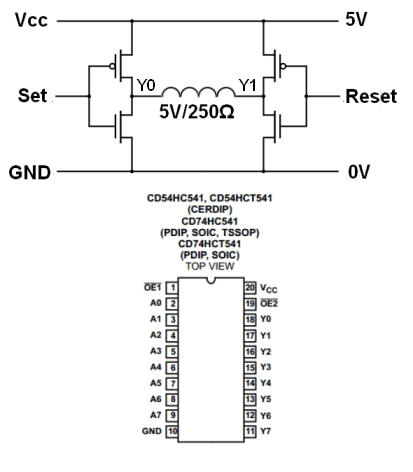
The solution I'm leaning on atm is one 74HC541 octal buffer/driver per four relays. The 74HC541 is rated at ±25mA per output, and if each output pair (four total) is grounded between pulses, I'm thinking there would be no need for any kickback protection either as the inductor would be shorted out at the end of the pulse.

Timing/speed is not really a factor—I'm just switching in/out some low-level stuff once in a while. I know H-bridges is normally the right tool for the job, but the lack of google hits for this particular solution made me wonder if I've missed something obvious here? Thanks.
4XqeuEn.png
 
Engineering news on Phys.org
I thought I posted an answer to this already ---- strange

There is nothing fundamentally wrong from building your own H bridge this way. But you are probably wrong about leaving off protection diodes (4 of them). Imagine what happens during any time when both buffers switch off while there is current in the coil, even for short transients. If both drivers turn off you will severly test the ESD diodes and anti-latchup protection of the chip (probably destroy it or progressively destroy it). There are faster versions that would have shorter transients.

The short delays matter, like the inverter that is probably between the inputs. One mistake and the chip is likely toast if there are no diodes. And they need to be fast diodes.
 

Similar threads

  • · Replies 5 ·
Replies
5
Views
5K
  • · Replies 7 ·
Replies
7
Views
19K
  • · Replies 4 ·
Replies
4
Views
9K
  • · Replies 1 ·
Replies
1
Views
3K
  • · Replies 13 ·
Replies
13
Views
7K
  • · Replies 1 ·
Replies
1
Views
17K
  • · Replies 1 ·
Replies
1
Views
7K