Easy Problems, but just cant figure it out Help

  • Thread starter Thread starter mlsbbe
  • Start date Start date
  • Tags Tags
    Figure
Click For Summary

Homework Help Overview

The discussion revolves around a problem involving accident rates and their relation to mileage and population. Participants express confusion over how to approach the calculations and the assumptions required for the problem.

Discussion Character

  • Exploratory, Assumption checking, Problem interpretation

Approaches and Questions Raised

  • Participants discuss the relationship between accident rates per mile and per time, questioning which statistic should be prioritized. There is uncertainty about how to apply the given values and what assumptions are necessary for the calculations.

Discussion Status

Some participants have offered insights into the nature of the problem, suggesting that the accident rate per mile may be the primary statistic to consider. However, there remains a lack of consensus on the best approach, and further clarification is sought.

Contextual Notes

Participants note the need for assumptions regarding the number of people and miles involved in the calculations, highlighting the ambiguity in the problem setup.

mlsbbe
Messages
24
Reaction score
0
Hi guys,

Need some help solving the following problems below..

For some reason, I cannot solve these darn problems..They should be really easy...

q1.jpg


q2.jpg
...
 
Last edited:
Physics news on Phys.org
hi mlsbbe! :wink:

show us what you've done, and where you're stuck, and then we'll know how to help! :smile:
 
stuck on everything...
don't even know how to approach the questions!

I don't think the questions make any sense at all...

For the first question:

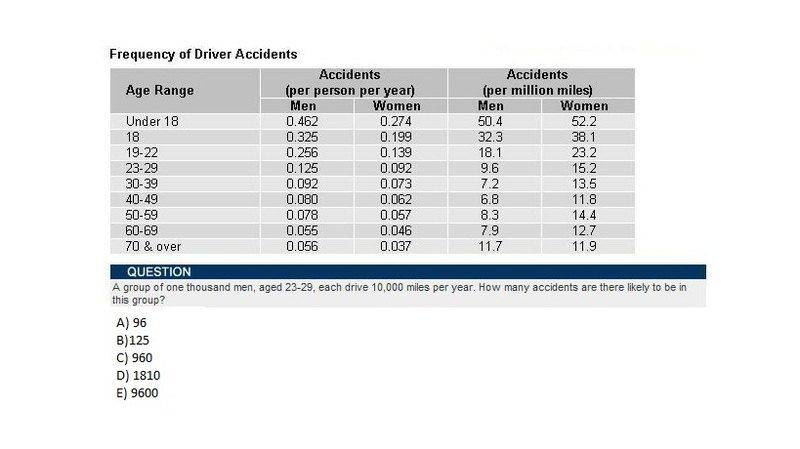
9.6*(10000/1000000)=0.096 will give the accidents for 10 000 miles. But will still need to solve for 1000 people.

How to do that? I can multiply the value in the first column by 1000, i.e. 0.125*1000=125, but this will give accidents per 1000 people per year.

You can't multiply or divide the above values because we don't know various things:

(1) For the first value (0.096), we don't know how many people
(2) For the second value (125), we don't know how many miles

Feeling really stupid...this is supposed to be solved in a minute...
 
Last edited:
hmmm … i see what you mean …

this group of 1,000 men drive 10,000 miles in one year …

so do we take the given accident rate per mileage (answer 96), or the given accident rate per time (answer 125)? :confused:

i'm going to ask around for some help on this :redface:
 
ok, I've had some help :biggrin:, and i think the answer is this …

the primary statistic is the number of accidents per mile, simply because, for any particular driver, we expect accidents to depend on mileage rather than on time …

assuming accidents are random, if you drive twice as far, you should have (roughly) twice as many accidents

(of course, there will be exceptions … for example, if someone is a very good driver, but has accidents when he gets drunk, then his accident rate will be proportional to the number of times he gets drunk, which presumably depends on time rather than on mileage … also, a lot of accidents happen very close to the beginning and end of a journey, so someone prone to those will have an accident rate proportional to the number of journeys, not to the length of the journeys … but i think the question expects you to assume that most accidents do depend on mileage)

in that case, the rate per mile is the primary statistic, and any observed rate per year will be a less reliable secondary statistic to be used only if you can't use the primary one

hmm … that doesn't entirely convince me :redface: … but I'm pretty sure it's what the examiners intended :smile:

(btw, what have you managed on the other question?)
 
hmm
thanks
really weird question..
seems like you need a lot of assumptions here...
 

Similar threads

  • · Replies 6 ·
Replies
6
Views
2K
  • · Replies 4 ·
Replies
4
Views
2K
Replies
2
Views
2K
  • · Replies 5 ·
Replies
5
Views
1K
  • · Replies 3 ·
Replies
3
Views
3K
Replies
13
Views
2K
  • · Replies 7 ·
Replies
7
Views
3K
  • · Replies 1 ·
Replies
1
Views
3K
  • · Replies 4 ·
Replies
4
Views
3K
Replies
10
Views
2K