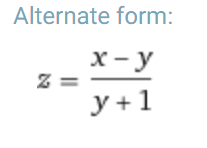
Why is this equation correct? (algebraic fraction simplification)

  • Thread starter Thread starter Anarcho
  • Start date Start date
  • Tags Tags
    Fraction
Click For Summary

Homework Help Overview

The discussion revolves around the simplification of an algebraic fraction and the reasoning behind transforming it into an alternate form. Participants are exploring the steps involved in this algebraic manipulation.

Discussion Character

  • Exploratory, Conceptual clarification, Mathematical reasoning

Approaches and Questions Raised

  • Participants discuss simplifying the fraction by dividing the numerator and denominator by a variable. Some express confusion about the process and seek clarification on specific steps, such as understanding why a number divided by itself equals one.

Discussion Status

There is an ongoing exploration of different interpretations of the problem. Some participants have offered hints and suggestions for simplification, while others express uncertainty about their understanding of the concepts involved.

Contextual Notes

Some participants mention reliance on external tools like WolframAlpha and personal notes, indicating a mix of resources being used to approach the problem. There is also acknowledgment of mistakes made in reasoning, which contributes to the learning process.

Anarcho
Messages
5
Reaction score
0
Homework Statement
Rearranging equation
Relevant Equations
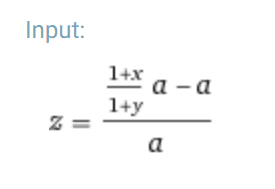
z=((1+x)/(1+y)*a-a)/a)
Hi all,

I cannot figure out how I get to the alternate form. I really do need help here.
241576
241577

Not sure how this is done.
Thank you
 
Physics news on Phys.org
First you simplify the fraction by dividing numerator and denominator by ##a##. Then you add the fraction to what's left in the numerator.
 
I have the same problem. But both wolframalpha as well as my notes get to the same conclussion. (scratching my head)
 
Anarcho said:
I have the same problem. But both wolframalpha as well as my notes get to the same conclussion. (scratching my head)
Have you tried it? Start by trying to simplify out the ##a##.
 
DrClaude said:
No, this is not what you get.
You're right. I'm going to delete my post. Bonehead mistake on my part...
 
Mark44 said:
You're right. I'm going to delete my post. Bonehead mistake on my part...
It happens even to the best of us :smile:
 
Anarcho said:
I have the same problem. But both wolframalpha as well as my notes get to the same conclussion. (scratching my head)
I have deleted my earlier post, since my thinking was incorrect. Follow the hints given by @kuruman and @DrClaude.
 
DrClaude said:
Have you tried it? Start by trying to simplify out the aa.

I get ##((x+1)/(y+1))−1##
 
Anarcho said:
I get (x+1)/(y+1)-1
Simplify some more. Hint: ##-1 = -\frac{y+1}{y+1}.##
 
  • #10
And why is that? This might be the problem I don't understand it
 
  • #11
Anarcho said:
And why is that? This might be the problem I don't understand it
Are you saying you don't understand why a number divided by itself is equal to ##1##?
 
  • #12
:sorry::sorry::sorry: I must look like an idot. Now I get it.
 
  • #13
Anarcho said:
:sorry::sorry::sorry: I must look like an idot. Now I get it.
We all have our blind spots here and there. :oldsmile:
 
  • #14
Anarcho said:
I get ##((x+1)/(y+1))−1##
Have you ever heard the term "reducing to a common denominator?"
 

Similar threads

  • · Replies 21 ·
Replies
21
Views
2K
  • · Replies 10 ·
Replies
10
Views
3K
Replies
2
Views
2K
  • · Replies 5 ·
Replies
5
Views
2K
  • · Replies 11 ·
Replies
11
Views
4K
  • · Replies 5 ·
Replies
5
Views
1K
  • · Replies 3 ·
Replies
3
Views
2K
  • · Replies 3 ·
Replies
3
Views
3K
  • · Replies 14 ·
Replies
14
Views
3K
  • · Replies 1 ·
Replies
1
Views
948