Easy Statics Problem: Solving Tension in a Continuous Wire with Eccentric COG

  • Thread starter Thread starter lidstrompl
  • Start date Start date
  • Tags Tags
    Statics
Click For Summary
SUMMARY

The discussion focuses on calculating the tension in a continuous wire connected to a load with an eccentric center of gravity (COG) and passing through a frictionless pulley. It is established that the tension in the wire remains constant; however, the system cannot achieve equilibrium due to the inability to balance horizontal forces at the pulley. The load will translate and rotate until the angle of the rope aligns with the vertical line of action of the COG weight force, ensuring stability in the system.

PREREQUISITES
  • Understanding of statics principles, particularly tension in cables.
  • Familiarity with free body diagrams (FBD) for analyzing forces.
  • Knowledge of equilibrium conditions in mechanical systems.
  • Basic concepts of center of gravity (COG) and its implications on load stability.
NEXT STEPS
  • Study the principles of tension in continuous cables and their applications in mechanics.
  • Learn about free body diagram (FBD) techniques for complex systems.
  • Research the conditions for equilibrium in mechanical systems with eccentric loads.
  • Explore the effects of pulley systems on force distribution and load stability.
USEFUL FOR

Mechanical engineers, physics students, and anyone involved in analyzing static systems with pulleys and eccentric loads will benefit from this discussion.

lidstrompl
Messages
6
Reaction score
0
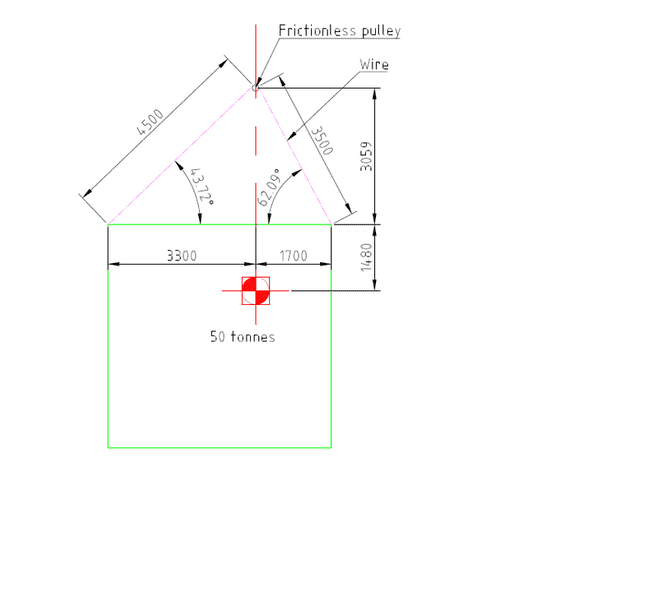
I have (what is seems to me) and easy statics problem to solve. I simply need to work out the tension in a single continuous wire connected to the load (with eccentric COG) on two ends - as shown, and passing through a frictionless pulley on top.

I know that the tension in the wire must be the same, however I could not visualise it entirely, because to me it seems that it would be possible for the load to rotate around the centre of gravity (in the current configuration). The reason I am saying that is that if the tension is the same in the wires (does not matter what the weight is) then the balance of moments about COG (after drawing my FBD) does not balance out...

Any help with this one would be greatly appreciated.

Thank you
problem.png
 
Engineering news on Phys.org
lidstrompl said:
I have (what is seems to me) and easy statics problem to solve. I simply need to work out the tension in a single continuous wire connected to the load (with eccentric COG) on two ends - as shown, and passing through a frictionless pulley on top.

I know that the tension in the wire must be the same, however I could not visualise it entirely, because to me it seems that it would be possible for the load to rotate around the centre of gravity (in the current configuration). The reason I am saying that is that if the tension is the same in the wires (does not matter what the weight is) then the balance of moments about COG (after drawing my FBD) does not balance out...

Any help with this one would be u appreciated.

Thank you

problem.png
you are quite correct, the system cannot be in equilibrium in the position shown because there is no way to balance the horizontal force at the pulley as caused by the unequal horizontal components of the equal tensions. Thus, the system must translate and rotate until the bisector of the new line angle of the rope at the pulley lines up with the vertical line of action of the CG weight force. Note that the CG does not move horizontally.
 

Similar threads

  • · Replies 5 ·
Replies
5
Views
2K
  • · Replies 12 ·
Replies
12
Views
5K
  • · Replies 10 ·
Replies
10
Views
3K
Replies
1
Views
2K
  • · Replies 6 ·
Replies
6
Views
2K
  • · Replies 13 ·
Replies
13
Views
16K
Replies
8
Views
3K
Replies
1
Views
4K
  • · Replies 1 ·
Replies
1
Views
7K