Effect of doping level on the width of the depletion layer

Click For Summary

Homework Help Overview

The discussion revolves around the effect of doping levels on the width of the depletion layer in p-n junctions. Participants explore the relationship between doping concentration and the resulting charge distribution within the depletion region.

Discussion Character

  • Conceptual clarification, Assumption checking

Approaches and Questions Raised

  • One participant attempts to explain the behavior of electrons and holes in relation to doping levels and their impact on the depletion layer width. Another participant introduces equations related to charge concentrations and voltage differences, suggesting that increased doping leads to a decrease in depletion width. Questions arise regarding the nature of charges in the depletion region and the role of fixed ions versus mobile carriers.

Discussion Status

Participants are actively engaging with each other's reasoning, with some providing references to external resources for clarification. There is a mix of interpretations regarding the effects of doping on the depletion layer, and while some participants express agreement on certain points, there is no explicit consensus on the final conclusions.

Contextual Notes

Participants are navigating assumptions about charge neutrality and the definitions of mobile versus fixed charges in the depletion region, which may influence their understanding of the problem.

Pushoam
Messages
961
Reaction score
53

Homework Statement


upload_2017-9-14_22-35-12.png


Homework Equations

The Attempt at a Solution


I think before getting the steady state, after doping there are more electrons in n-region and there are more holes in p-region, so the more electrons go towards the p-region and more holes go toward the n - region. Consequently the charges on the two sides of the depletion layer gets increased because of the doping.
After reaching the steady state, for an electron from n region going towards p-region, the negative charge at the starting of the p-region repels it and the positive charge at the n-region attracts the electron.
The resultant force on the electron due to these two source of charges in both type of p-n junction( doped and pure) should remain same.
Since, in case of doped p-n junction, the charges is comparatively more,the distance between the two sources of charges should get increased. Consequently, the width of the depletion layer should get increased.
The correct option is (iii). Right?
 
Physics news on Phys.org
For a p–n junction,
e63bc61ba4e6917a0cacc1a3b28846f01cabf43e
and
c9ef770751a0c0854d9fdc2596b092f46a12bd26
be the concentrations of acceptor and donor atoms respectively, and letting
854feabfdd4ef4c7274b417d7a40fa77ff387bda
and
9dec6d93e328ff3fa0a5f362f2c7e441bbcc5a9b
be the equilibrium concentrations of electrons and holes respectively.
letting
e85ff03cbe0c7341af6b982e47e9f90d235c66ab
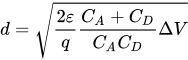
be the total width of the depletion region, we get
cc00ef1d52e41b557e7c8cd635110b8bc567e85d
...................(1)
aa0ec3d68205fb7f4452de096cb34a50f661111e
can be written as
401f4ac62f2144949af75333e3837f728b432ce6
, where we have broken up the voltage difference into the equilibrium plus external components.
q is the magnitude of charge of electron.
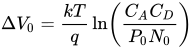
bb6288f840ebe4420eaca247aa9d3fb99d81dc9b
....................(2)

In eqn. (2) , it is noted that if we increase doping level, ##\Delta V_0 ## increases logarithmically.
While in eqn.(1), we see that if we increase doping level ##\frac{C_A +C_D}{C_A C_D} ## decreases faster than increase in ##\Delta V_0 ##. So, as a result, d decreases when the doping level is increased.
Thus, the correct option is (ii). Right?

After joining p-type and n-type semiconductors, electrons from the n region near the p–n interface tend to diffuse into the p region leaving behind positively charged ions in the n region and being recombined with holes, forming negatively charged ions in the p region. Likewise, holes from the p-type region near the p–n interface begin to diffuse into the n-type region, leaving behind negatively charged ions in the p region and recombining with electrons, forming positive ions in the n region https://en.wikipedia.org/w/index.php?title=Template:Explain_holes_move%3F&action=edit&redlink=1. The regions near the p–n interface lose their neutrality and most of their mobile carriers, forming the space charge region or depletion layer (see figure A).

Charges in the depletion region is due to the fixed ions, not mobile electrons. Right?
 
Pushoam said:
Thus, the correct option is (ii). Right?

Right!

Charges in the depletion region is due to the fixed ions, not mobile electrons. Right?

Correct. There are no mobile carriers in the depletion region. It is "depleted" of mobile carriers, which is why it is called the depletion region. The mobile carriers are swept out of the depletion region by the large electric field.
 
phyzguy said:
Right!
Thank you for helping me.
 

Attachments

  • upload_2017-9-15_10-19-12.png
    upload_2017-9-15_10-19-12.png
    35.3 KB · Views: 606

Similar threads

  • · Replies 4 ·
Replies
4
Views
11K
  • · Replies 9 ·
Replies
9
Views
2K
  • · Replies 18 ·
Replies
18
Views
3K
  • · Replies 8 ·
Replies
8
Views
17K
Replies
3
Views
2K
Replies
1
Views
2K
  • · Replies 1 ·
Replies
1
Views
2K
  • · Replies 1 ·
Replies
1
Views
1K
  • · Replies 3 ·
Replies
3
Views
1K
Replies
3
Views
6K