SUMMARY
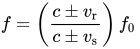
The discussion centers on the impact of general and special relativity on the acceleration of a laser sail, particularly when it reaches speeds close to the speed of light (c). At 0.2c, the incoming laser beam experiences a 20% reduction in power due to redshift, resulting in a 4% decrease in acceleration. As the speed increases to 0.9c, the power received drops by 90% due to redshift alone. The calculations involve the Lorentz factor (γ) and the Doppler effect, with the proper acceleration of the sail being influenced by both relativistic effects and the angle of incidence of the laser light.
PREREQUISITES
- Understanding of special relativity, including Lorentz transformations
- Familiarity with the Doppler effect in the context of light
- Basic knowledge of laser propulsion systems
- Ability to perform calculations involving relativistic physics
NEXT STEPS
- Study the Lorentz factor (γ) and its implications in relativistic physics
- Learn about the relativistic Doppler effect and its mathematical formulation
- Research laser propulsion technologies and their efficiency at relativistic speeds
- Explore the relativistic rocket equation and its applications in space travel
USEFUL FOR
Physicists, aerospace engineers, and anyone interested in advanced propulsion systems or the effects of relativity on high-speed travel will benefit from this discussion.