Oomph!
- 55
- 0
Hello.
1. Homework Statement
I have to find formula for effective cross-section (σ) of catching a comet with the Sun. I know mass of the Sun (M), radious of the Sun (R) and initial velocity (v) of the comet (at a big distance from the Sun).
σ=πb^2, where b is on the picture (b>R)It is the biggest distance when the Sun still catch the comet.
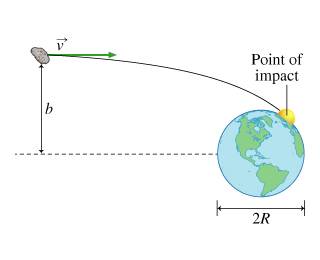
I really don't know how to work with the b. It is semi-minor axis in in an elliptical trajectory of the comet. However, I don't know semi-major axis or linear eccentricity...
I just know the initial velocity v of the comet. I think I sould work with energy or angular momentum at the beginning and near the catching. However, I still have there some distances which I don't know.
Please, could you give me an advice?
Thank you.
1. Homework Statement
I have to find formula for effective cross-section (σ) of catching a comet with the Sun. I know mass of the Sun (M), radious of the Sun (R) and initial velocity (v) of the comet (at a big distance from the Sun).
Homework Equations
σ=πb^2, where b is on the picture (b>R)It is the biggest distance when the Sun still catch the comet.
The Attempt at a Solution
I really don't know how to work with the b. It is semi-minor axis in in an elliptical trajectory of the comet. However, I don't know semi-major axis or linear eccentricity...
I just know the initial velocity v of the comet. I think I sould work with energy or angular momentum at the beginning and near the catching. However, I still have there some distances which I don't know.
Please, could you give me an advice?
Thank you.