Undergrad Eigenkets belonging to a range of eigenvalues

  • Thread starter Thread starter Spin One
  • Start date Start date
  • Tags Tags
    eigenvalues range
Click For Summary
SUMMARY

This discussion focuses on the representation of a general ket in quantum mechanics using eigenkets associated with a continuous range of eigenvalues, specifically from a to b. The integral of these kets is analogous to a sum for discrete eigenvalues, with each vector multiplied by an infinitesimal change near its corresponding eigenvalue. The transition from discrete to continuous bases involves changes in normalization conventions, where the new kets are defined as ##|\lambda_n\rangle \equiv \frac{1}{\sqrt{(\Delta \lambda)_n}} |n\rangle##. Understanding this relationship requires a grasp of Distribution Theory and the implications of normalization in quantum mechanics.

PREREQUISITES
  • Quantum mechanics fundamentals
  • Understanding of eigenvalues and eigenstates
  • Familiarity with normalization conventions in quantum mechanics
  • Basic knowledge of Distribution Theory
NEXT STEPS
  • Study the implications of normalization in continuous quantum states
  • Learn about Distribution Theory and its applications in quantum mechanics
  • Explore the concept of rigged Hilbert spaces in quantum theory
  • Investigate the relationship between discrete and continuous bases in quantum mechanics
USEFUL FOR

Quantum physicists, graduate students in physics, and researchers exploring the mathematical foundations of quantum mechanics.

Spin One
Messages
4
Reaction score
0
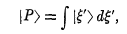
When one wants to represent a general ket in a basis consisting of eigenkets each attributed to an eigenvalue in a range, say from a to b, why does one take the integral of said kets from a to b w.r.t. the eigenvalues?
upload_2018-6-25_13-3-42.png

I understand that the integral here plays a role analogous to a sum in the case where a general ket is expressed in terms of eigenkets belonging to discrete eigenvalues, but I don't understand why each vector is multiplied by an infinitesimal change near the eigenvalue it belongs to. Interpreting this integral as the limit of a sum we get:
[P>=Σ[ξ>Δξ (lim.Δξ→0)
where I do not understand the role of Δξ.
 

Attachments

  • upload_2018-6-25_13-3-42.png
    upload_2018-6-25_13-3-42.png
    657 bytes · Views: 825
Physics news on Phys.org
I looked over the thread about Rigged Hilbert Spaces, and I'm not sure that it completely explained the relationship between continuous and discrete bases.

In a non-rigorous way, you can think of the continuous basis as a limiting case of the discrete basis. However, in going from discrete to continuous, the normalization convention for basis elements changes.

Let me illustrate. Suppose you have an operator ##\Lambda## with discrete eigenvalues ##\lambda_j##. I think in order for the continuum limit to make sense int the most straightforward way, you need to assume that ##\lambda_{j+1} > \lambda_j##, and that there are infinitely many ##\lambda_j##, and that the corresponding eigenstates ##|n\rangle## form a complete orthonormal basis. That means that
  1. If ##n \neq m##, then ##\langle n|m\rangle = 0##
  2. ##\langle n|n\rangle = 1##
  3. If ##|\psi\rangle## is a properly normalized state, then ##|\psi\rangle = \sum_n \langle n|\psi\rangle |n\rangle##
  4. ##\sum_n |\langle n|\psi\rangle|^2 = 1##
Now, if the coefficients ##\langle n|\psi\rangle## change slowly with ##n## (and maybe we also have to assume that ##(\Delta \lambda)_n \equiv \lambda_{n+1} - \lambda_n## remains bounded? I'm not sure...) then we can define a new ket with a different normalization:

##|\lambda_n\rangle \equiv \frac{1}{\sqrt{(\Delta \lambda)_n}} |n\rangle##

In terms of the ##|\lambda_n\rangle##, we have:

##|\psi\rangle = \sum_n (\Delta \lambda)_n \langle \lambda_n |\psi\rangle |\lambda_n\rangle##

The kets ##|\lambda_n\rangle## have a different normalization:

  • ##\langle \lambda_n | \lambda_m \rangle = 0## (if ##m \neq n##)
  • ##\langle \lambda_n | \lambda_n \rangle = \frac{1}{(\Delta \lambda)_n}##
If the states ##|\lambda_n\rangle## change smoothly with ##n##, then this can be approximated by an integral:

##|\psi\rangle = \int d\lambda \langle \lambda |\psi\rangle |\lambda\rangle##
 
Last edited:
So dλ is introduced to make the product between each eigenket and dλ finite, since the eigenkets will be of "infinite length" in the sense of lim.Δλ→0[1/Δλ]. That makes sense. In that case, will the coefficients <λIΨ> be infinitesimal? Otherwise the integral would diverge, even over a finite range.
 
Spin One said:
So dλ is introduced to make the product between each eigenket and dλ finite, since the eigenkets will be of "infinite length" in the sense of lim.Δλ→0[1/Δλ]. That makes sense. In that case, will the coefficients <λIΨ> be infinitesimal? Otherwise the integral would diverge, even over a finite range.

Yes - but unless you want to get into non-standard analysis infinitesimals are a load of the proverbial, although used every now and then when speaking informally. I do it but shouldn't really.

There is no way to understand it properly unless you study the references in my link.

Start with Distribution Theory.

Thanks
Bill
 
Time reversal invariant Hamiltonians must satisfy ##[H,\Theta]=0## where ##\Theta## is time reversal operator. However, in some texts (for example see Many-body Quantum Theory in Condensed Matter Physics an introduction, HENRIK BRUUS and KARSTEN FLENSBERG, Corrected version: 14 January 2016, section 7.1.4) the time reversal invariant condition is introduced as ##H=H^*##. How these two conditions are identical?

Similar threads

Replies
8
Views
4K
  • · Replies 9 ·
Replies
9
Views
2K
  • · Replies 13 ·
Replies
13
Views
2K
  • · Replies 5 ·
Replies
5
Views
3K
  • · Replies 9 ·
Replies
9
Views
3K
  • · Replies 1 ·
Replies
1
Views
2K
  • · Replies 19 ·
Replies
19
Views
5K
  • · Replies 2 ·
Replies
2
Views
2K
Replies
2
Views
3K
  • · Replies 2 ·
Replies
2
Views
1K