Elastic and inelastic collision problems

Click For Summary
SUMMARY

This discussion focuses on understanding elastic and inelastic collision problems, particularly the application of conservation of momentum and energy equations. The key takeaway is that in elastic collisions, the difference in velocities before and after the collision is equal and opposite, which can be visualized from the center of mass perspective. The coefficient of restitution formula, e = (v'₂ - v'₁) / (v₁ - v₂), is also highlighted, where e = 1 for elastic collisions and e = 0 for perfectly inelastic collisions. The discussion provides a clear method for calculating velocities in both types of collisions.

PREREQUISITES
  • Understanding of conservation of momentum principles
  • Familiarity with conservation of energy equations
  • Knowledge of the coefficient of restitution in collision theory
  • Basic algebra for solving equations related to motion
NEXT STEPS
  • Study the derivation and application of the coefficient of restitution formula
  • Learn about the differences between elastic and inelastic collisions in detail
  • Explore examples of collision problems using conservation of momentum and energy
  • Investigate real-world applications of collision theory in physics and engineering
USEFUL FOR

Students preparing for technical interviews, physics enthusiasts, and educators looking to deepen their understanding of collision mechanics and related equations.

Bernoulli19
Messages
2
Reaction score
0
Hey everyone,
Reviewing material for a technical interview and I have stumbled into some problems that I sadly have issues with. Old review for me :D. Any help would be appreciated.
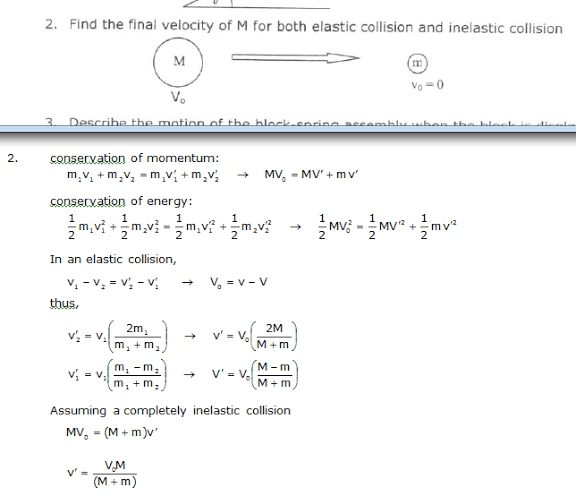
Capture.PNG


I can follow up through the conservation of energy equation. However at the in an elastic collision line, I do not know why those are being subtracted. That would not seem to follow the conservation of momentum since the masses are not the same.

assuming i can get that part, the Vo = v - V is just substituted into the simplified conservation of momentum equation? Is nothing done with the conservation of energy equation?
 
Physics news on Phys.org
Bernoulli19 said:
Hey everyone,
Reviewing material for a technical interview and I have stumbled into some problems that I sadly have issues with. Old review for me :D. Any help would be appreciated.

Capture.PNG


I can follow up through the conservation of energy equation. However at the in an elastic collision line, I do not know why those are being subtracted. That would not seem to follow the conservation of momentum since the masses are not the same.

assuming i can get that part, the Vo = v - V is just substituted into the simplified conservation of momentum equation? Is nothing done with the conservation of energy equation?

That velocity arrangement is actually true. It is saying that the difference in velocity before collision is the reverse of the difference in velocity after. If you visualise the collision from the point of view of the centre of mass - you would see both masses approach the C of M at a certain speed, then bounce off at the same speed [but opposite direction].

I will demonstrate:

The way I work these problems is as follows.

If you calculate as if for an inelastic collision [totally - the masses stick together] in the first instance, you can note how much the velocity of each body changes for that to happen.
When the collision is actually elastic, the velocities change by that much again.

eg if M = 10, m = 1 and the initial vel of M was 11 m/s

During collision, at the point when the masses are traveling at the same velocity, that common velocity will be 10m/s [conservation of momentum will get you that - I chose figures wisely to avoid decimals]

If the collision was inelastic, you have finished

If the collision is elastic we look at the changes.
VM reduced by 1 - from 11 to 10.
Vm increased by 10 - from 0 to 10

They will change by that much again!

So afterwards:
VM = 9 [reduced by another 1]
and
Vm = 20 [increased by another 10]

before collision, M was traveling 11 m/s faster than m
after collision, m is traveling 11 m/s faster than M

NOTE: The Centre of Mass of this system has been traveling at a constant 10 m/s.

Before, M was doing 11 m/s, so approaching the CofM at 1 m/s, afterwards it was moving away at 1 m/s [or traveling at 9 m/s relative to a stationary observer]
Before, m was approaching at 10 m/s [some would say the CofM was approaching it at 10 m/s], afterwards it was moving away from the CofM at 10 m/s - [or traveling at 20 m/s relative to a stationary observer]
 
Thank you for the quick reply. I am going on a quick trip in the morning but i read this a few times and will work on it at the airport and let you know wednesdayish. Thanks!
 
Another way to look at this is to see that those equations can be derived from the coefficient of restitution formula:
e = \frac{v^{'}_{2} - v^{'}_{1}}{v_{1} - v_{2}}
Where e = 1 in an elastic collision, and e = 0 in a perfectly inelastic collision. All other inelastic collisions range in between.
 

Similar threads

  • · Replies 47 ·
2
Replies
47
Views
4K
  • · Replies 18 ·
Replies
18
Views
2K
  • · Replies 41 ·
2
Replies
41
Views
2K
Replies
10
Views
3K
  • · Replies 6 ·
Replies
6
Views
2K
  • · Replies 2 ·
Replies
2
Views
3K
  • · Replies 4 ·
Replies
4
Views
928
  • · Replies 16 ·
Replies
16
Views
4K
  • · Replies 13 ·
Replies
13
Views
1K
  • · Replies 6 ·
Replies
6
Views
3K