Electric Fields through dielectrics

Click For Summary
SUMMARY

The discussion centers on the capacitance of capacitors with different dielectrics, specifically comparing two examples where one capacitor has a dielectric that does not extend the entire distance between the conductors. Participants clarify that while both examples may appear similar, the dielectric constant is the critical factor influencing capacitance. The dielectric constant of the materials directly affects the electric field and, consequently, the capacitance, with the understanding that air's dielectric properties modify the overall capacitance. Ultimately, the consensus is that the capacitor with a higher dielectric constant will exhibit greater capacitance, regardless of dielectric thickness.

PREREQUISITES
  • Understanding of capacitance and its formulas
  • Knowledge of dielectric materials and their properties
  • Familiarity with electric fields and their behavior in dielectrics
  • Basic grasp of capacitor configurations, including series and parallel arrangements
NEXT STEPS
  • Research the impact of dielectric constant on capacitor performance
  • Explore the relationship between dielectric thickness and capacitance
  • Learn about the mathematical models for calculating capacitance in different configurations
  • Investigate the effects of various dielectric materials on electric field strength
USEFUL FOR

Electrical engineers, physics students, and anyone involved in capacitor design or analysis will benefit from this discussion, particularly those interested in the effects of dielectrics on capacitance.

Samson4
Messages
242
Reaction score
15
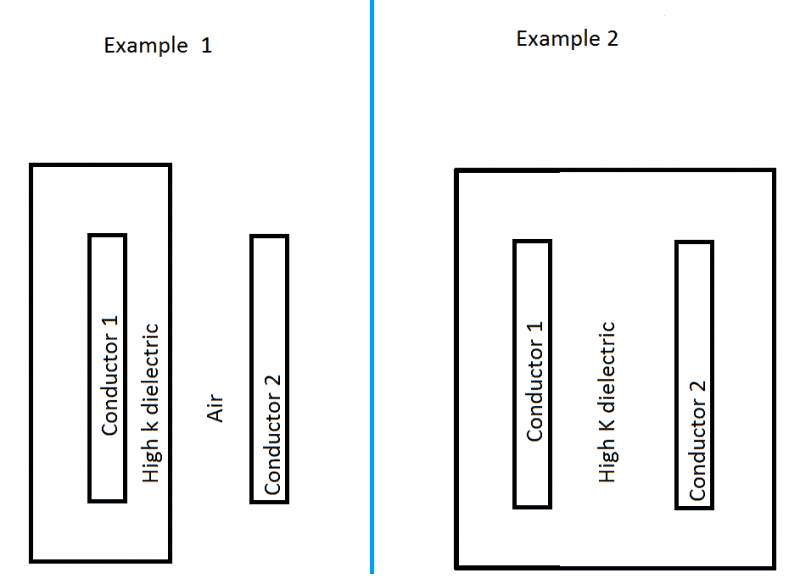
My question is simple; yet, I can not find the answer. In the picture below, all variables are identical; the plate separations, surface area, etc. The only difference is the fact that example 1 has 2 different dielectrics. Better yet, it has a dielectric that doesn't extend the entire distance between the two conductors.

1.Does example 1 and 2 have the same capacitance?

My understanding: conventional physics explains that the dielectric opposes the electric field. With that in mind, both should have the same capacitance.

2. Does that mean the dielectric is actually creating an electric field that permeates another dielectric? This being air in example 1.

3. If air has a dielectric strength slightly higher than vacuum, shouldn't it oppose the field from conductor 1 and the field from the high k dielectric? This would mean example 1 has a higher capacitance, correct?

dielectrics.png
 
Physics news on Phys.org
the dielectric generates an opposing electric field. as a consecquence, electric field is lesser than with vacuum, which is the best dielectric. equivalently, the capacitance of a filledcapacitor is lesser than the one with vacuum. the word in spanish is "apantallar", i don't remember the word in english
 
What?

If the electric field is "lesser", the capacitance is higher. I also think you are confusing dielectric strength and dielectric constant.
 
yes, i got confused, capacity is higher. and dielectric strength is irrelevant for low fields. what's relevant is dielectric constant. so, if dielectric constant of k is greater than the air, the capacitance of 2 will be greater.
 
Both capacitors have a high k dielectric, why does capacitor 2 have a higher capacitance? Dielectric thickness is not apart of capacitance formulas, so is it not irrelevant? From my understanding, conductors and dielectrics react to electric fields in very 2 dimensional ways.

I still think they are equal or example 1 has higher capacitance. This is so confusing.
 
See, no mention of thickness. Since the materials atomic structure defines it's dielectric constant, would that mean it doesn't have to expand the entire gap between the conductors?
 
Samson4 said:
See, no mention of thickness. Since the materials atomic structure defines it's dielectric constant, would that mean it doesn't have to expand the entire gap between the conductors?

Unless the air gap is at the same scale of the polar molecules gap the air dielectric will modify the physical capacitance of the circuit.

http://web.mit.edu/8.02t/www/materials/StudyGuide/guide05.pdf
Example 5.6 and
5.9.2 Capacitor with Dielectrics
 
Last edited:
How does the electric field gain strength once it has left the polar molecules?

That would also mean the field the polar molecules are making are only internal, when they must be external by definition.
 
  • #11
What are you talking about? How is that related?
 
  • #12
In example 1 you have two capacitors in series, one with dielectric εK and one with dielectric ε0. In example 2, you have just one capacitor, with dielectric εK. Do you need the formula for calculating the capacitance?
 
  • #13
There is one capacitor in example one. For there to be two I would need at least another conductor.
 
  • #14
Samson4 said:
There is one capacitor in example one. For there to be two I would need at least another conductor.

No. You can calculate the capacitance between any two elements. I just used the border between the high k dielectric and air as one (virtual) plate.

If you want to, imagine a very thin plate at this border and let the thickness →0.
 
  • Like
Likes   Reactions: Samson4
  • #15
Its equivalent, it's a conductor of length zero
 
  • Like
Likes   Reactions: Samson4
  • #16
Hell yes, now I see it. The effective distance of the plate separation changes. Thank you guys so much.
 

Similar threads

  • · Replies 4 ·
Replies
4
Views
1K
  • · Replies 4 ·
Replies
4
Views
3K
Replies
5
Views
2K
  • · Replies 4 ·
Replies
4
Views
4K
  • · Replies 3 ·
Replies
3
Views
2K
  • · Replies 1 ·
Replies
1
Views
2K
  • · Replies 6 ·
Replies
6
Views
1K
  • · Replies 2 ·
Replies
2
Views
1K
  • · Replies 2 ·
Replies
2
Views
4K
  • · Replies 6 ·
Replies
6
Views
897