Electromagnetics:boundary condition for steady current density

Click For Summary
SUMMARY

The discussion centers on the boundary conditions for steady current density in electromagnetics, specifically addressing the relationship between electric field direction and current density (J) in conductors with differing conductivities. It is established that while the electric field direction aligns with the applied potential across two conducting media, variations in conductivity can lead to changes in the magnitude of J. The user expresses confusion regarding the directional consistency of electric fields and current densities when subjected to the same potential source across different conductors.

PREREQUISITES
  • Understanding of electromagnetics principles, particularly steady current density.
  • Familiarity with boundary conditions in electrical engineering.
  • Knowledge of conductivity and its effects on electric fields.
  • Basic grasp of electric potential and its application in circuits.
NEXT STEPS
  • Study the derivation of boundary conditions for steady current density in electromagnetics.
  • Explore the relationship between electric field direction and current density in different conductive materials.
  • Investigate the effects of varying conductivity on electric field distribution.
  • Learn about the application of Maxwell's equations in analyzing electric fields and currents.
USEFUL FOR

Electrical engineers, physics students, and professionals involved in electromagnetics who seek to deepen their understanding of current density behavior in conductive materials.

mai fouad
Messages
4
Reaction score
0
Although I understand the derivation of boundary condition in case of steady electric current but I did not understand, that the electric field which is in direction of J current density which is generated from permanent potential to have a current in a conductors that is applied between two conducting medium so that the direction of the electric field should be the same as the potential applied is the same on both conductors and the value of J change due to different value of conductivity bet medium while the direction should still the same.


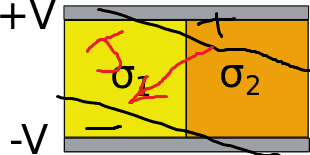
so i did not under stand how electric field and current density change direction although the source that applied on two conductors is the same ?
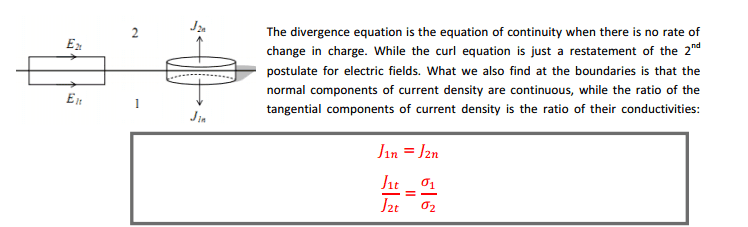
Untitled1.png


my question what if the field like i draw why the direction of current change although the same source should make the current,electric field in both conductors in the same direction
wSAJu.png
 
Last edited:
Engineering news on Phys.org
Most likely this can only be answered by an "old timer". I am making measurements on an uA709 op amp (metal can). I would like to calculate the frequency rolloff curves (I can measure them). I assume the compensation is via the miller effect. To do the calculations I would need to know the gain of the transistors and the effective resistance seen at the compensation terminals, not including the values I put there. Anyone know those values?

Similar threads

  • · Replies 3 ·
Replies
3
Views
2K
  • · Replies 1 ·
Replies
1
Views
2K
  • · Replies 4 ·
Replies
4
Views
2K
Replies
8
Views
4K
  • · Replies 10 ·
Replies
10
Views
2K
Replies
8
Views
2K
  • · Replies 7 ·
Replies
7
Views
2K
Replies
44
Views
4K
  • · Replies 9 ·
Replies
9
Views
3K
  • · Replies 7 ·
Replies
7
Views
2K