Electron capture and heavy nuclei

Click For Summary
SUMMARY

The discussion centers on the relationship between atomic number (Z) and half-life in heavy nuclei undergoing electron capture. It is established that heavy atoms, despite having inner electrons closer to the nucleus, do not exhibit a consistent decrease in half-life compared to lighter nuclei, as observed in the plotted data from the National Nuclear Data Center (NNDC). The participants highlight the influence of other decay processes, such as alpha decay, which complicates the expected trend. The need for a more nuanced analysis, including categorization by neutrino energy, is emphasized to better understand the observed half-life behavior.

PREREQUISITES
  • Understanding of nuclear decay processes, particularly electron capture and alpha decay.
  • Familiarity with atomic structure and the significance of atomic number (Z).
  • Ability to interpret nuclear data from sources like the National Nuclear Data Center (NNDC).
  • Basic knowledge of statistical analysis and data visualization techniques.
NEXT STEPS
  • Explore the concept of neutrino energy and its impact on electron capture decay rates.
  • Learn how to analyze and visualize nuclear decay data using tools like Python's Matplotlib.
  • Investigate the decay modes of heavy nuclei, focusing on those that decay by both electron capture and alpha emission.
  • Review the latest findings on nuclear decay from the NNDC and other reputable nuclear physics databases.
USEFUL FOR

Nuclear physicists, researchers in particle physics, and students studying atomic decay processes will benefit from this discussion, particularly those interested in the complexities of heavy nuclei decay mechanisms.

pamputt
Messages
9
Reaction score
0
Hi, is it true that the heavy atoms decaying only by electron capture should have globally a half-life shorter than ligher nuclei (decaying also only by electron capture)? This assumption comes from the fact heavy atoms have inner electron "closer" to their nucleus than the lighter ones and so a probability of finding electron inside the nucleus higher than for the ligher atoms (because their inner electrons are "further" from the nucleus).

If this is true, why is it not what we observe:
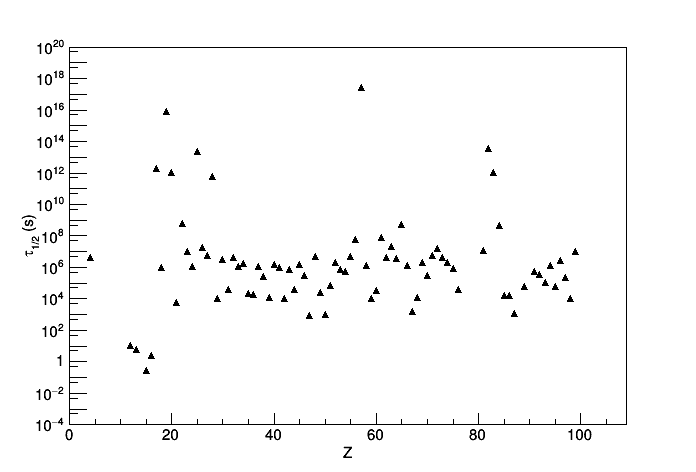
tlzKwRES.gif

On this picture, I plotted the half-life of all the nuclei decaying only by electron capture as a function of their atomic number Z. Data come from NNDC. I just plotted naively th whole data so maybe there is a smarter way to do but basically I expected to see a general decrease of the half-life with respect to the Z. However, it looks rather flat.
Do you have any explanation?
 
Last edited by a moderator:
Physics news on Phys.org
For such a global trend, all other things would have to be equal. They are not.

You introduce a bias by the requirement of only electron capture, for example. For small atoms, this means beta+ decays are missing between ~0 and ~1 MeV to be available. For heavier atoms this value is lower - electron capture happens mainly from the innermost shells where the electrons have a lower energy. You might see some trend if you make categories for the neutrino energy.

Also, how exactly do you get the data points? The whole 83+ group can decay via alpha decay, for example. Did you use the partial widths for the points?
 
Oh yeah, you are right. So if I understood correctly, if nuclei would decay only by electron capture, lifetime of heavy nuclei should be smaller than the one of the lighter nuclei? Right? And still if I understood correctly, it is possible to observe a trend if we plot data as a function of Z because other decay process play a role.

I will try to plot the same figure including all the nuclei decaying by electron capture (even if they decay also by other processes), just to see what happen.

About the data, I do not remember how did I download them but basically I got a text file where I extract lifetime of nuclei decaying by electron capture. For nuclei with Z>=83, as I said I extracted only nuclei decaying only by electron capture. Most of the Z>=83 nuclei decay by alpha emission but few of them, such as http://www.nndc.bnl.gov/chart/decaysearchdirect.jsp?nuc=232NP&unc=nds are know, for now, to decay only by electron capture. However, I did not consider only nuclei decaying only by electron capture (probably because my database was not up-to-date) because for example I included http://www.nndc.bnl.gov/chart/decaysearchdirect.jsp?nuc=251FM&unc=nds that decays by alpha emission with a probability of 1.80% (the rest by electron capture)

DIT:I found back where I got the data. They come from this Web page. Select the decay mode, a range in Z, and check "Formatted File".
 
Last edited:

Similar threads

  • · Replies 8 ·
Replies
8
Views
3K
  • · Replies 5 ·
Replies
5
Views
2K
  • · Replies 15 ·
Replies
15
Views
4K
  • · Replies 4 ·
Replies
4
Views
3K
  • · Replies 6 ·
Replies
6
Views
3K
  • · Replies 10 ·
Replies
10
Views
2K
  • · Replies 8 ·
Replies
8
Views
4K
  • · Replies 24 ·
Replies
24
Views
4K
  • · Replies 5 ·
Replies
5
Views
3K
Replies
13
Views
3K