Graduate Electron frequency components during orbital tunneling

Click For Summary
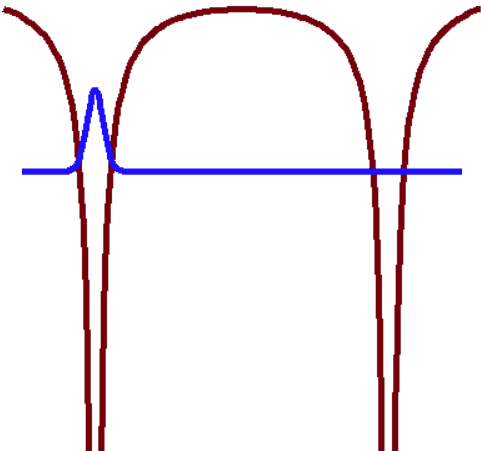
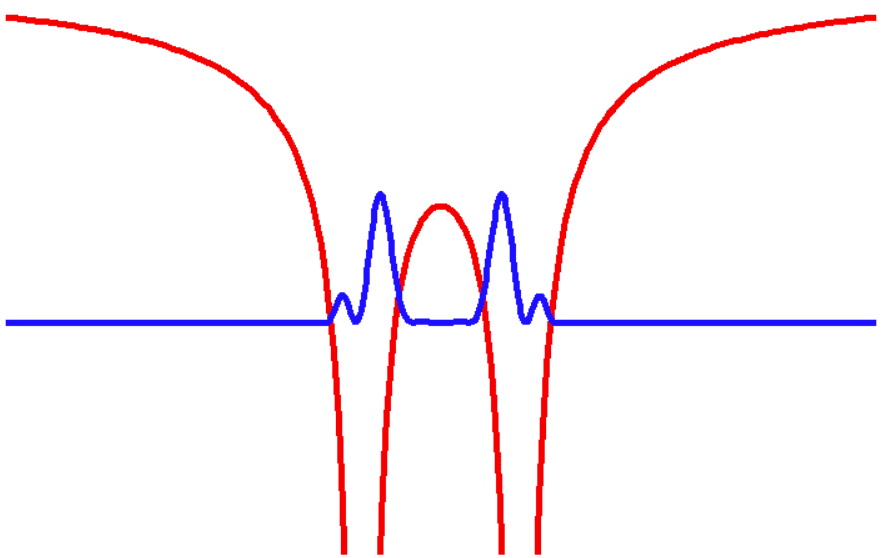
The discussion focuses on the behavior of an electron transitioning between two approaching potential wells. Initially confined in one well, the electron's wave function is characterized by limited allowed frequencies. As the electron begins to tunnel toward the second well, it cannot maintain a single frequency due to the need for additional frequencies to form a coherent wave packet. This transition complicates the wave function, as the frequencies required for tunneling are not permitted in the original well. The time-dependent nature of the potential necessitates the use of the Schrödinger equation for accurate modeling of the wave function's evolution.
jhonnyS
Messages
2
Reaction score
0
TL;DR
what is the real time process for the wave function when an electron is living in a potential well, and an other is aproaching?
For example, we have this two potencial wells approaching, the electron is confined in one.
1582712365288.png

the final appearance will be like this:
1582712528582.png

THEN, if we know a wave packet is formed by many frequencies, but in a potencial well there are just few frequencies allowed, energy levels, so let's say, one frequency adapted to... the form of the potential.

In the point when the electron begins to overstep to the other potential, and the wave "don't know there is a well that will confine it later" so cannot mantain this unic frequency component because there were the posibility to extend indefinitely. NEEDs more frequencies to form a "wave packet" to contain itself BUT this frequencies, at same time, are not allowed for the part of wave function that remains confined in the initial potential well.

thank you
 
Physics news on Phys.org
jhonnyS said:
Summary:: what is the real time process for the wave function when an electron is living in a potential well, and an other is aproaching?

For example, we have this two potencial wells approaching, the electron is confined in one.
View attachment 257708
the final appearance will be like this:
View attachment 257709
THEN, if we know a wave packet is formed by many frequencies, but in a potencial well there are just few frequencies allowed, energy levels, so let's say, one frequency adapted to... the form of the potential.

In the point when the electron begins to overstep to the other potential, and the wave "don't know there is a well that will confine it later" so cannot mantain this unic frequency component because there were the posibility to extend indefinitely. NEEDs more frequencies to form a "wave packet" to contain itself BUT this frequencies, at same time, are not allowed for the part of wave function that remains confined in the initial potential well.

thank you
I'm not sure whether this answers your question, but you have a time dependent potential here. At any time where the second well becomes non negligible you no longer have purely a single well wave function.
 
The time evolution of that wave function is just described by the Schrödinger equation or equivalently the time evolution operator, you could investigate it with numerical integration.
 
Time reversal invariant Hamiltonians must satisfy ##[H,\Theta]=0## where ##\Theta## is time reversal operator. However, in some texts (for example see Many-body Quantum Theory in Condensed Matter Physics an introduction, HENRIK BRUUS and KARSTEN FLENSBERG, Corrected version: 14 January 2016, section 7.1.4) the time reversal invariant condition is introduced as ##H=H^*##. How these two conditions are identical?

Similar threads

  • · Replies 36 ·
2
Replies
36
Views
5K
  • · Replies 36 ·
2
Replies
36
Views
8K
  • · Replies 4 ·
Replies
4
Views
2K
  • · Replies 7 ·
Replies
7
Views
2K
  • · Replies 7 ·
Replies
7
Views
2K
  • · Replies 17 ·
Replies
17
Views
3K
  • · Replies 0 ·
Replies
0
Views
2K
Replies
7
Views
4K
Replies
6
Views
2K
  • · Replies 7 ·
Replies
7
Views
4K