jasonpatel
- 32
- 0
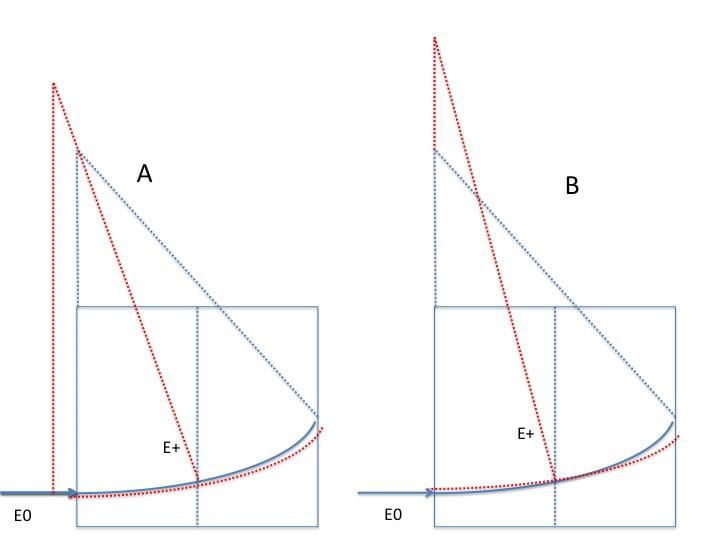
So I wanted to get some second opinions on this situation I have thinking about.Lets say an electron enters, normally, a section of bfield that is perpendicular to its motion such that the electron will undergo circular motion. This is the simple part and is labeled as "E0" in the picture attached below (in both case A and B).
Lets say that at the midpoint of the electrons journey it absorbs a photon and now has a new energy of "E+" (as dipicted in the red in the picture below). Now, there are two options in my head for the trajectory:
A. The radius of the electron at the midpoint immediately increases to a larger radius. But the radius extends ALONG the original "E0" radius and the electron follows a trajectory that is somewhat concentric( http://www.powerframeworks.com/series/SG/034/sg022-and-sg034-differences.jpg ), but larger radius, with that of the "E0" trajectory at exactly the midpoint where the photon was absorbed.
B. The radius of the electron at the midpoint immediately increases to a larger radius. But the radius is measured with respect to the entrance of the bfield section just as the radius of the "E0" is measured, the only difference is that it is longer now.
So, which one is correct? Well, we know that the electrons trajectory should be continuous. Thereofre, the x position and the angle of the electron (x') should be continuous before and after the photon is absorbed; boundary conditions. It is in my opinion that this is only satisfied in case A with the concentric trajectories.
Any thoughts? Disagreements?
Lets say that at the midpoint of the electrons journey it absorbs a photon and now has a new energy of "E+" (as dipicted in the red in the picture below). Now, there are two options in my head for the trajectory:
A. The radius of the electron at the midpoint immediately increases to a larger radius. But the radius extends ALONG the original "E0" radius and the electron follows a trajectory that is somewhat concentric( http://www.powerframeworks.com/series/SG/034/sg022-and-sg034-differences.jpg ), but larger radius, with that of the "E0" trajectory at exactly the midpoint where the photon was absorbed.
B. The radius of the electron at the midpoint immediately increases to a larger radius. But the radius is measured with respect to the entrance of the bfield section just as the radius of the "E0" is measured, the only difference is that it is longer now.
So, which one is correct? Well, we know that the electrons trajectory should be continuous. Thereofre, the x position and the angle of the electron (x') should be continuous before and after the photon is absorbed; boundary conditions. It is in my opinion that this is only satisfied in case A with the concentric trajectories.
Any thoughts? Disagreements?