Electrostatics, infinite concentric cylindric conductors

Click For Summary
SUMMARY

This discussion focuses on solving electrostatic problems involving infinite concentric cylindrical conductors. The key steps include deriving the electric field and potential difference between the cylinders using Gauss's law and Poisson's equation. The correct expression for the potential is V(r) = ΔV (ln(b/r) / ln(b/a)), where ΔV is the potential difference. The surface charge densities are calculated as σ_a = (ε₀ ΔV) / (a ln(b/a)) for the inner cylinder and σ_b = -(ε₀ ΔV) / (b ln(b/a)) for the outer cylinder.

PREREQUISITES
  • Understanding of Gauss's law in electrostatics
  • Familiarity with Poisson's equation and its applications
  • Knowledge of electric field and potential concepts
  • Basic grasp of cylindrical coordinates in physics
NEXT STEPS
  • Study the derivation of electric fields using Gauss's law in cylindrical symmetry
  • Explore the applications of Poisson's equation in electrostatics
  • Learn about surface charge density calculations in different geometries
  • Investigate the concept of capacitance in cylindrical systems
USEFUL FOR

Students and professionals in physics, electrical engineering, and anyone involved in electrostatics and field theory, particularly those working with cylindrical geometries.

Telemachus
Messages
820
Reaction score
30
Hi. I have this problem, and when I tried to solve it, some doubts and questions emerged, I need some help with this. The problem says:

The figure shows two concentric cylindrical conductors with infinite length. We'll suppose that between them there's a known potential difference.

a. Find an expression for the family of equipotential surfaces for the interior of the configuration.
b. Get the expressions for the density surface charge in each cylinder.

Fig. 1
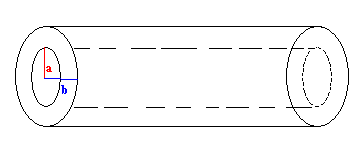
attachment.php?attachmentid=39747&stc=1&d=1318107212.png


Well, I tried to get the electric field, and then the expression for the potential. I think that what I did is actually wrong. I considered a charge Q distributed over the inner surface. Then considered the surface charge distribution.
\frac{Q}{2\pi l a}=\sigma \rightarrow Q=\sigma l 2\pi a

Gauss:
E 2\pi r l=\frac{\sigma l 2\pi a}{\epsilon_0}
E=\frac{\sigma a}{\epsilon_0 r}\vec{r}

V(r)=-\int_a^r E \dot dr=-\frac{\sigma a}{\epsilon_0} \int_a^r \frac{dr}{r}=-\frac{\sigma a}{\epsilon_0} \ln \left (\frac{r}{a} \right), a<r<b

The doubts that emerged were with respect to if it was necessary to consider the charge to get the difference in the potential between the cylinders. And in the other hand if I shouldn't consider an other field due to the induced surface charge over the cylinder at radii b (its a conductor, so there should be an induced image charge on it).

Thanks for your help in advance :)
 

Attachments

  • cyl.PNG
    cyl.PNG
    750 bytes · Views: 633
Last edited:
Physics news on Phys.org
What I meant (unless tried to) at the end of the message before with the charge I considered, is that I considered a charge Q over the inner cylinder to get the potential difference, I don't know if this is right, I'm not sure of it. In the other hand I'm not getting any effect from the outer cylinder (with radius b).

Is there anyway to work this, let's say considering V(a)=V_0,V(b)=V_1,V(a)-V(b)=\Delta V? would that be useful? would it give the same answer? I see I could use capacitance, right? but would that change anything? I think that would only give the variation on V, but not the equipotential surfaces I was looking for, right?

If there is some misspelling, or something that is not clear, some syntax or grammar error, please let me know. Anyway the problem wasn't quiet clear to me, and I actually translated it to english, so there could be many errors and confusions (my english is not good).
 
You have expressed it correctly. In order to calculate a value for V, you would need to be given sigma. In this kind of problem you need to to choose the Gaussian surface appropriately, which you have done. Choosing a cylinder with r> b would result in zero electric field since the enclosed charge is then net zero. The point is that using the integral form of Maxwell's equation allows you to consider only the charge enclosed within the surface -- you don't need to worry then about the charge on the outer cylinder so long as your Gaussian cylinder has radius between a and b. Does that clear the doubt?
 
Sorry further on this, it seems you are given V, so since you have derived an expression connecting V and sigma you can get sigma in terms for V. You have done this for the inner cylinder, you can then use sigma for the inner cylinder to calculate the sigma for the out one by invoking a simple principle (the outer sigma will be different, will leave it to you to show)
 
Hi Telemachus,

I believe you are right to doubt your procedure, since you are obtaining the potential by positing a surface charge, whereas actually the question is to determine the surface charge from the field.

My approach would be as follows. First, solve for the potential V(r) using the fact that the voltage difference between the two cylinders is \Delta V. Since the actual value of the voltage is immaterial, I will assume here that V(a)=\Delta V \qquad \mbox{and} \qquad V(b)=0. Now, in the area between the cylinders there is no charge, so the potential obeys Poisson's equation: \nabla^2 V=0. In cylindrical coordinates, this becomes \frac{1}{r}\frac{\partial}{\partial r} \left(r \frac{\partial V}{\partial r} \right)=0 with general solution V(r)=C_1 \ln(r) + C_2, where C_1 and C_2 are undetermined constants. Using the boundary conditions above to determine these constants, I find V(r)=\Delta V \frac{\ln(b/r)}{\ln(b/a)}. Next, to find the surface charges, I used the following formula (formula (2.49) from H.D. Griffiths, Introduction to Electrodyamics, 3rd ed.): \sigma=-\epsilon_0 \frac{\partial V}{\partial n}, where \partial V / \partial n is the normal derivative of V at the surface and \epsilon_0 is the permittivity of free space. At the inner cylinder, the normal points in the r direction, and I obtain \sigma_a=\frac{\epsilon_0 \Delta V}{a\ln(b/a) }. Conversely, at the outer surface the normal points in the negative r-direction, so \sigma_b=-\frac{\epsilon_0 \Delta V}{b\ln(b/a) }. I hope this helps!

Cheers,
Kurt
 
Thank you both. Very nice Kurt. So as I thought my approach was wrong, there is no need to considere a charge Q over the surface to get the variation on the potential, and there are no image charges. My answer was wrong then? or as the potential could be arbitrarily set both answer are correct? I see that in the expression I get I got V(a)=0, and V(v)=something else.
 
Last edited:

Similar threads

  • · Replies 4 ·
Replies
4
Views
2K
Replies
2
Views
2K
  • · Replies 5 ·
Replies
5
Views
2K
  • · Replies 5 ·
Replies
5
Views
745
  • · Replies 6 ·
Replies
6
Views
2K
  • · Replies 2 ·
Replies
2
Views
4K
  • · Replies 10 ·
Replies
10
Views
5K
  • · Replies 1 ·
Replies
1
Views
1K
Replies
10
Views
3K
  • · Replies 3 ·
Replies
3
Views
2K