Elimination Reaction: OH & H Removal Explained

Click For Summary
SUMMARY

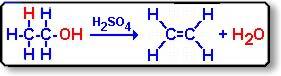
The elimination reaction of ethanol primarily involves the removal of the hydroxyl (OH) group and a hydrogen (H) atom, resulting in the formation of a double bond. This process is classified as an E1 elimination mechanism, where sulfuric acid protonates the hydroxyl oxygen, facilitating its departure as a leaving group and forming a carbocation. Subsequently, a water molecule deprotonates a neighboring carbon, leading to the migration of electrons and the establishment of a double bond.

PREREQUISITES
  • Understanding of E1 elimination mechanisms
  • Knowledge of protonation and leaving groups in organic chemistry
  • Familiarity with carbocation stability and formation
  • Basic concepts of tautomerization in organic compounds
NEXT STEPS
  • Study the detailed mechanism of E1 eliminations in organic chemistry
  • Explore the role of sulfuric acid in protonation reactions
  • Investigate carbocation stability and its influence on reaction pathways
  • Learn about tautomerization and its applications in organic synthesis
USEFUL FOR

Chemistry students, organic chemists, and anyone interested in understanding elimination reactions and their mechanisms in organic synthesis.

DespicableMe
Messages
40
Reaction score
0
For the elimination reaction of ethanol:
elimination1.jpg


How come only the OH and H get taken out? I understand that you have to take out one atom from each carbon, so how come we can't take out, for example, one H from the left carbon and one H from the right carbon to get?

Or is it mandatory to take out the hydroxyl from an alcohol?
 
Last edited:
Physics news on Phys.org
There's probably some reaction that can convert ethanol to vinyl alcohol (ethenol), which would subsequently tautomerize to acetaldehyde... BUT that's not what is happening here. The answer lies in the mechanism.

This is an E1 elimination. First step is the hydroxyl oxygen gets protonated by the rather strong acid present (sulfuric), which is then a pretty darn good leaving group and like a good leaving group does, it leaves (and forms a carbocation)! Next, a water molecule comes in and deprotonates the neighboring carbon, the electrons migrate between the two carbons, and whammo: double bond.
 

Similar threads

Replies
1
Views
2K
Replies
13
Views
3K
Replies
7
Views
2K
  • · Replies 3 ·
Replies
3
Views
2K
  • · Replies 6 ·
Replies
6
Views
3K
  • · Replies 25 ·
Replies
25
Views
5K
  • · Replies 28 ·
Replies
28
Views
5K
  • · Replies 2 ·
Replies
2
Views
2K
  • · Replies 8 ·
Replies
8
Views
2K
  • · Replies 4 ·
Replies
4
Views
3K