zenterix
- 774
- 84
- Homework Statement
- How exactly does the chemical reaction
$$\mathrm{CO_2+2OH^-\leftrightharpoons HCO_3^-+OH^-\leftrightharpoons CO_3^{2-}+H_2O}\tag{1}$$
happen?
- Relevant Equations
- I am learning about what an acidic oxide is and this example is given in Wikipedia.
The way I understand it is that we have an aqueous solution of something that produces hydroxide ions.
If there are carbon dioxide gas molecules in the solution then from the book I am reading it seems that the following definitely happens
1) One hydroxide acts as a Lewis base (donates electron pair to ##\mathrm{CO_2}## and also acts as a Bronsted acid (donates a proton) to another hydroxide.
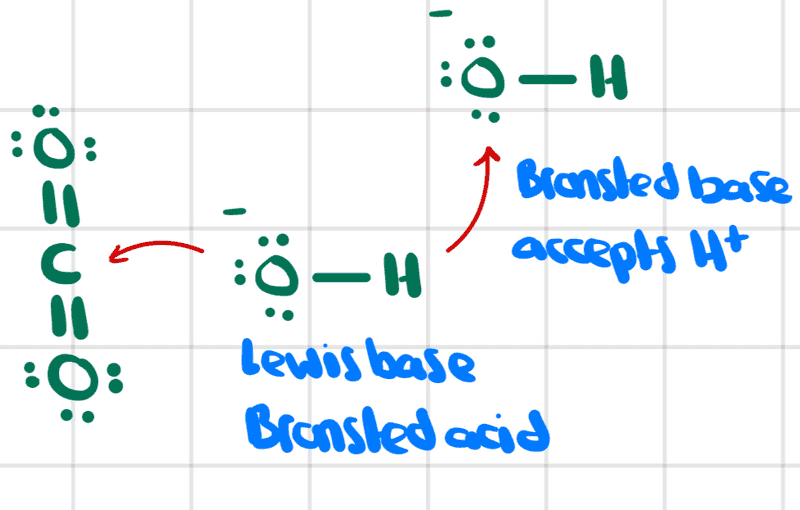
The end result seems to be

though I am not sure exactly what is happening here.
For example, how exactly did the oxygen anion attach to the carbon and what happened to the double bond with the other oxygen?
2) So it seems we need to get from the last picture above to ##\mathrm{H_2CO_3}##.
This seems to result from two protons attaching to the oxygens with negative charge.

Do the protons come from water molecules?
In equation (1), the ##\mathrm{H_2CO_3}## is not explicitly stated. Why?
If there are carbon dioxide gas molecules in the solution then from the book I am reading it seems that the following definitely happens
1) One hydroxide acts as a Lewis base (donates electron pair to ##\mathrm{CO_2}## and also acts as a Bronsted acid (donates a proton) to another hydroxide.
The end result seems to be
though I am not sure exactly what is happening here.
For example, how exactly did the oxygen anion attach to the carbon and what happened to the double bond with the other oxygen?
2) So it seems we need to get from the last picture above to ##\mathrm{H_2CO_3}##.
This seems to result from two protons attaching to the oxygens with negative charge.
Do the protons come from water molecules?
In equation (1), the ##\mathrm{H_2CO_3}## is not explicitly stated. Why?
Last edited: