Endothermic and Threshold reactions - Are they Equivalent?

Click For Summary
SUMMARY

The discussion clarifies the distinction between endothermic and threshold reactions, asserting that they are not equivalent. The reaction 10B(n,2α)T is identified as a threshold reaction that is exothermic, with a Q-value of approximately 0.335 MeV. The confusion arises from the interpretation of reaction cross-sections and energy requirements, particularly regarding the threshold energy of 1.2 MeV. The consensus is that endothermic reactions require energy to proceed, while threshold reactions specifically refer to those with a negative Q-value.

PREREQUISITES
  • Understanding of nuclear reactions and terminology
  • Familiarity with Q-value calculations in nuclear physics
  • Knowledge of reaction cross-sections and their significance
  • Basic principles of quantum mechanics related to nuclear interactions
NEXT STEPS
  • Study the concept of Q-value in nuclear reactions and its implications
  • Research the relationship between reaction cross-sections and threshold energies
  • Explore the differences between exothermic and endothermic reactions in nuclear physics
  • Investigate the role of kinetic energy in threshold reactions and their laboratory frame analysis
USEFUL FOR

Nuclear physicists, students of nuclear chemistry, and anyone interested in the mechanics of nuclear reactions and energy requirements.

Michal Kovac
Messages
3
Reaction score
2
Hi,

up to this day I thought that endothermic and threshold reactions are equivalent. I mean each endothermic reaction must be threshold and each threshold reactions must be endothermic. But I think I was wrong.
Here is example (from this source Q-value):

10B(n,2*alpha)T

This threshold reaction of fast neutron with an isotope 10B is the main way, how radioactive tritium in primary circuit of all PWRs is generated. 10B is the principal source of radioactive tritium in primary circuit of all PWRs (which use boric acid as a chemical shim).

direct-nuclear-reaction.png


So, this is a threshold reaction and at the same time it is the exothermic reaction, because:

Using the mass-energy equivalence, the Q-value of this reaction is:

Q = {(10.0129+1.00866) [amu] – (3.01604+2 x 4.0026) [amu]} x 931.481 [MeV/amu]

= 0.00036 x 931.481 = 0.335 MeV

Is this consideration right?

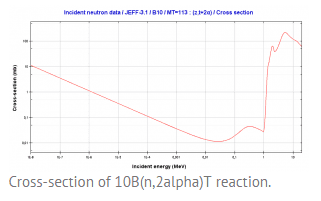
I think this reaction is considered to be threshold because of its cross-section:

Figure of reaction cross-section.
upload_2016-9-14_19-35-1.png


But does anybody know, why the reaction cross-section have a threshold at 1.2 MeV??
Can it be derived from some reaction kinematics or it is "simply" some quantum behaviour of 10B nucleus??
 
Engineering news on Phys.org
Michal Kovac said:
But does anybody know, why the reaction cross-section have a threshold at 1.2 MeV??
Can it be derived from some reaction kinematics or it is "simply" some quantum behaviour of 10B nucleus??
Look at the reaction cross-section and energy for 10B(n,α)7Li and also the binding energy of 7Li <-> T + α.

What energy is necessary to dissociate 7Li into T + α?

It's a QM thing. There is both total energy (kinetic and rest mass) and momentum to consider.
 
I happened to stumble across this (old) question and, since the premise of the question is incorrect, I thought I should comment.

The reaction ##^{10}B(n,\alpha)^7Li## has a positive ##Q##-value (of about 2.8 MeV). This means it is exoergic (or, as it's sometimes written, exothermic -- I think either is OK). And therefore it is not a "threshold reaction," by which we universally mean that the reaction has a negative ##Q##-value. For reactions with ##Q<0## one must supply (kinetic) energy to the particles in the initial state to get the reaction to 'go.'
 
sirapwm said:
I happened to stumble across this (old) question and, since the premise of the question is incorrect, I thought I should comment.

The reaction ##^{10}B(n,\alpha)^7Li## has a positive ##Q##-value (of about 2.8 MeV). This means it is exoergic (or, as it's sometimes written, exothermic -- I think either is OK). And therefore it is not a "threshold reaction," by which we universally mean that the reaction has a negative ##Q##-value. For reactions with ##Q<0## one must supply (kinetic) energy to the particles in the initial state to get the reaction to 'go.'
This comment was not well constructed originally by me. The original question was about the equivalence of the terms "endothermic" and "threshold reaction" using the reaction ##^{10}B(n,2\alpha)^3H## as an example. And then I muddied the waters by using a different reaction, ##^{10}B(n,\alpha)^7Li## as an example. Sorry about this.

The answer is, "yes" -- endothermic and threshold reaction are completely equivalent. They are each statements of the fact that the reaction requires energy to proceed. Endothermic refers to the (non-zero, positive) amount of energy required in the center of mass frame. "Threshold reaction" is the same statement but the implicit, perhaps, assumption is that we're talking about the projectile energy in the lab frame.

For the reaction ##a + A \to b + B##, the center of mass energy for the threshold reaction "to go" is: ##E_c > Q##, where ##Q = m_a + m_A - (m_b + m_B)##. In the laboratory frame, where the target "A" is at rest, the projectile energy must be: $$E_a = \frac{-Q(2m_{aA} + (-Q))}{2m_A}.$$ Here, ##m_{aA} = m_a + m_A##.

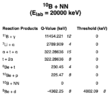
I'm not sure where the figure in the OP with "##E_k > 1.2 MeV##" comes from but it is incorrect if we assume that ##E_k## is the energy of the neutron in the lab frame (with the ##^{10}B## at rest). The attachment generated here) shows that the correct value for ##Q_{^{10}B(n,2\alpha)^3H} \approx 0.322## MeV > 0, meaning it is both exothermic and not a threshold reaction.
 

Attachments

  • Screen Shot 2024-05-21 at 9.59.37 AM.png
    Screen Shot 2024-05-21 at 9.59.37 AM.png
    8.1 KB · Views: 96

Similar threads

  • · Replies 5 ·
Replies
5
Views
4K
  • · Replies 50 ·
2
Replies
50
Views
10K