Energy bands from the Kronig-Penney model

  • Thread starter Thread starter mrneglect
  • Start date Start date
  • Tags Tags
    Energy Model
Click For Summary
SUMMARY

The discussion centers on the application of the Kronig-Penney model to determine energy bands in solid-state physics. A user calculated alpha as 4.78x10^9 and is attempting to plot the energy (E) versus wavenumber (k) graph, specifically focusing on the first energy band. The conversation highlights the importance of ensuring the left-hand side of the equation remains within the bounds of -1 and 1, as indicated by the shaded regions in the plot. A reference link to a relevant figure in the Kronig-Penney model is provided for further clarification.

PREREQUISITES
  • Understanding of the Kronig-Penney model
  • Familiarity with energy band theory in solid-state physics
  • Proficiency in MATLAB for plotting functions
  • Knowledge of periodic potentials and delta functions
NEXT STEPS
  • Study the derivation of energy bands using the Kronig-Penney model
  • Learn how to implement MATLAB for plotting energy versus wavenumber graphs
  • Explore the implications of periodic potentials on electron behavior
  • Review the mathematical conditions for valid solutions in energy band calculations
USEFUL FOR

Students preparing for exams in solid-state physics, researchers interested in energy band structures, and anyone looking to deepen their understanding of the Kronig-Penney model and its applications in materials science.

mrneglect
Messages
11
Reaction score
0
I've got an exam tomorrow, and this is one of the topics I can't get my head around. Any help would be much appreciated.
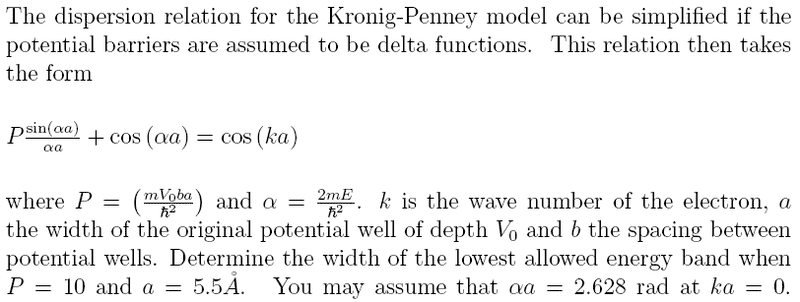
Homework Statement


Question.png


Homework Equations


The Attempt at a Solution


I've calculated that alpha=4.78x10^9. I understand that a Delta function is a periodic potential much like this one...
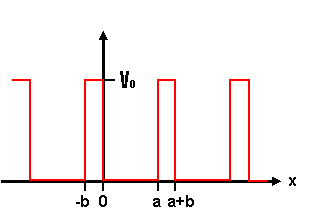
Delta.png


...EXCEPT that V0 --> infinity, b --> 0, but bV0 still has a finite area.

I can see that plotting the left-hand-side of the equation given in the question against (alpha x a) will result in this graph:
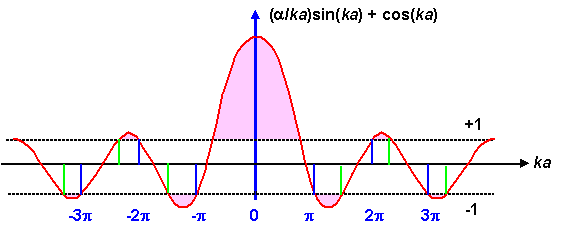
Cosine.png


And I understand that for the equation to hold true, the left-hand-side cannot go above 1 or below -1, hence the regions shaded pink in the above plot are invalid solutions of the equation in the question.

I understand that what I am looking for is the energy band marked here:
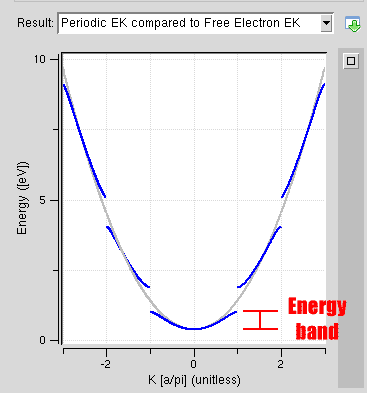
EK.png


But I just don't know how to get it.

I understand what the question is asking, what the concepts mean, but I'm just lost in the mathematics.

As I said, any help would be greatly appreciated. :smile:

Cheers.
 
Physics news on Phys.org
For the delta 'function' periodic potential, the Energy(E) versus Wavenumber(k) lies above the free particle parabola. So, the first band stretches from the global minimum of E(k) to the first intersection of E(k) with the parabola. You have all the information you need to work this out now.

This link might be useful to you:

http://webphysics.davidson.edu/faculty/thg/320_files/kronig-penney/kronig-penney.htm

Specifically, refer to Figure 8.13(a).
 
Last edited by a moderator:
i'm having similar problem but this time in plotting the figure 8.13(a). I'm using MatLab and I'm not getting it... is it possible to plot it without the eigenstates matrix? So I'm working with E versus (q*a) and I've searched for Matlab codes everywhere but all i got was more confused... i'v managed to plot the cos(q*a) versus (k*a) graphic (attachment) but not quite getting this one...
thx in advance
 

Attachments

  • 1.jpg
    1.jpg
    17.3 KB · Views: 2,943
Last edited:

Similar threads

Replies
3
Views
3K
Replies
1
Views
8K
  • · Replies 1 ·
Replies
1
Views
4K
  • · Replies 3 ·
Replies
3
Views
6K
  • · Replies 1 ·
Replies
1
Views
6K
Replies
3
Views
3K
  • · Replies 1 ·
Replies
1
Views
1K
  • · Replies 1 ·
Replies
1
Views
3K
  • · Replies 1 ·
Replies
1
Views
1K
  • · Replies 1 ·
Replies
1
Views
1K