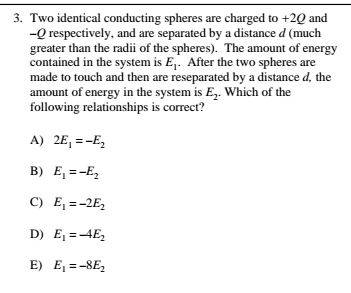
Energy in system of two conducting spheres

Click For Summary
SUMMARY

The discussion focuses on calculating the potential energy in a system of two conducting spheres with charges -Q and +2Q, and later with charges of 0.5*Q each. The participants emphasize the importance of using the law of conservation of charge and integrating the electric field to find potential energy. The initial potential energy is derived using the formula U = q * V, where V is obtained from the integral of the electric field. The final energies calculated yield a ratio of -8:1, which is close to the expected answer of 1:-8, indicating a misunderstanding in the sign convention or calculation process.

PREREQUISITES
  • Understanding of electric potential energy and its relation to charge and distance.
  • Familiarity with the law of conservation of charge.
  • Knowledge of electric fields and their integration.
  • Basic principles of electrostatics, including the behavior of conducting spheres.
NEXT STEPS
  • Study the derivation of electric potential energy between point charges.
  • Learn about the integration of electric fields in electrostatics.
  • Review the concept of equipotential surfaces and their implications in electrostatics.
  • Examine the effects of charge distribution on potential energy in multi-charge systems.
USEFUL FOR

Students and educators in physics, particularly those focusing on electrostatics, as well as anyone involved in solving problems related to electric potential energy and charge interactions.

RoboNerd
Messages
410
Reaction score
11
1. Homework Statement
Question 2..JPG


Hi everyone. I am having trouble figuring out how to solve this problem. The right answer is E

Homework Equations


Well, we do have the law of conservation of charge.
I also know that Work by a conservative force = - change in potential energy

The Attempt at a Solution


So I am having trouble figuring out a general approach.
First things first, when I have two of these spheres touch, they are going to become equipotential spheres. I thus have a charge of 0.5*Q on each of them. Then I said that one of these spheres is fixed and we are moving the other one out and out while the electric field from the first is doing work on it.

This could change its electric potential energy.

How is my approach so far?

Thanks in advance for the help and being willing to help.
 
Physics news on Phys.org
You are almost there! Have you been taught an expression for potential energy between charges? How about an expression for force that you could integrate?
 
RoboNerd said:
Work by a conservative force = - change in potential energy

No need to worry about forces here, this is all about energy. Forces would get very messy over the range where the spheres are close.
What is the initial PE in terms of Q and d?
 
Well... I do remember that electric potential is going to be equal to the negative integral of the electric field (bringing in a force from infinity to its final position)

Cutter Ketch said:
Have you been taught an expression for potential energy between charges?
Voltage = - (Integral) [E dot dl]
Yes.

I think that the electric field could be derived for one of the spheres, and then saying that the second sphere is like that point charge that is brought from infinity to the final position. The problem is that the point charge (or this sphere) is not being brought in from infinity to its final position but rather pulled away from the first sphere to its final position.

haruspex said:
What is the initial PE in terms of Q and d?
In response to this, I would say that the initial potential energy for each of the spheres is going to be equal to:

1/(4*pi*e0) * charge on it / radius sphere^2

The problem with this approach is that the radius of the sphere is not "d."

As you may see I am getting a little confused. Please advise me on how to proceed. Thanks for being willing to help, and make it a great day!
 
RoboNerd said:
the initial potential energy for each of the spheres
You are told that d is much greater than the radius of the spheres. That means the PE of the pair of spheres, in regard to their attraction to each other, dwarfs the PEs of the individual spheres. I.e., treat them as point particles.
 
  • Like
Likes   Reactions: RoboNerd
Thanks for the input.

Here is what I did now.

For the initial situation where one sphere has -Q and the other +2Q charge, I made one charge stationary, and then I did the integration of E dot dl to get its potential.
Then I multiplied it by the charge of the stationary sphere as per the relationship U = q * Voltage

Thus for Initial Situation:

U = q*V = 2Q * [negative integral from infinity to d of E dot dl].
The electric field E in this case is -Q/(4*pi*e0*r^2).

Doing this gave me Energy #1 = -2*Q^2/(4*pi*e0*d)

OK... now for the second situation where each sphere has a 1/2*Q charge. Same approach.

U = q*V = (1/2)*Q * [negative integral from infinity to d of E dot dl].
The electric field E in this case is (1/2)*Q/(4*pi*e0*r^2).

Doing this gave me
Energy #2= (0.25) * Q^2 / (4*pi*e0*d)

OK. Setting energies #1 and #2 in both of these in a ration of E1 : E1 gives me -8 : 1.

Very similar to the right answer, but in the right answer, the numbers in the ration are 1 : -8, opposite of what I have.

What did I do wrong here?
Thanks for being willing to help.
 

Similar threads

Replies
12
Views
1K
  • · Replies 2 ·
Replies
2
Views
1K
Replies
11
Views
2K
  • · Replies 21 ·
Replies
21
Views
5K
Replies
23
Views
4K
  • · Replies 1 ·
Replies
1
Views
2K
Replies
25
Views
2K
  • · Replies 11 ·
Replies
11
Views
2K
Replies
6
Views
2K