Energy resolution of triple-axis spectrometer

Click For Summary

Discussion Overview

The discussion revolves around the energy resolution of a neutron triple-axis spectrometer, focusing on the derivation of the energy resolution equation and the numerical calculations involved. Participants seek clarification on the underlying principles and literature related to this topic, which has not been covered in their solid state physics lectures.

Discussion Character

  • Exploratory
  • Technical explanation
  • Debate/contested
  • Mathematical reasoning

Main Points Raised

  • One participant expresses confusion regarding the source of the energy resolution equation and the numerical results, indicating discrepancies in their calculations.
  • Another participant suggests that the total resolution arises from the wavelength distribution of incoming neutrons and the accuracy of the analyzer, proposing a quadratic sum for uncertainties instead of a linear sum.
  • A participant references the propagation of uncertainty and discusses how the prefactor of 2 might relate to a conservative convention, while also questioning the origin of a specific energy value (5 meV) mentioned in the context of inelastic neutron scattering.
  • There is a discussion about the correct formulation for error propagation, with one participant providing a mathematical expression for the relationship between energy and wavelength, while acknowledging the potential for errors in their reasoning due to personal circumstances.
  • Another participant agrees with the suggestion to use a quadratic sum for error propagation and acknowledges the explanation for the factor of 2 in the calculations.

Areas of Agreement / Disagreement

Participants exhibit a mix of agreement and disagreement regarding the methods for calculating energy resolution and error propagation. While some participants agree on the use of a quadratic sum, others challenge the assumptions and specific values presented, indicating that the discussion remains unresolved.

Contextual Notes

There are unresolved questions regarding the assumptions made in the calculations, particularly concerning the correlation between uncertain parameters and the application of the quadratic sum in this context.

revbrapok
Messages
1
Reaction score
0
Hi,
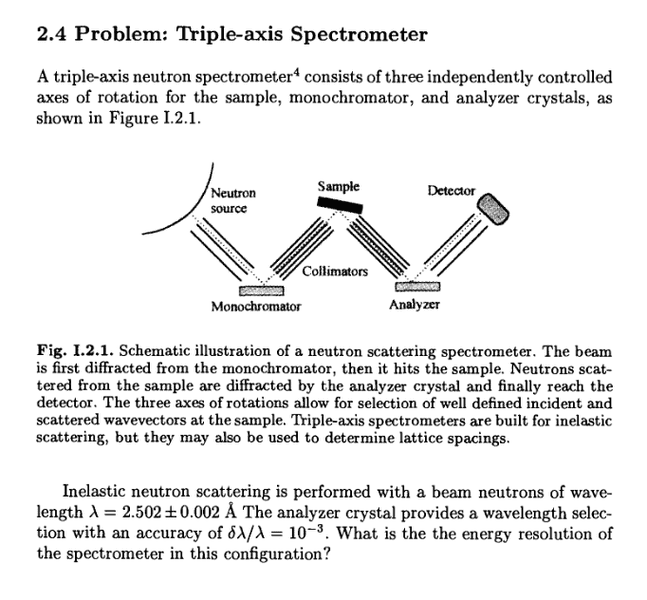
I have encountered the problem of energy resolution of neutron triple-axis spectrometer, which we haven't covered during our solid state physics lectures.
11tts8n.jpg

262mdcg.jpg

I don't know where do we get the equation for the energy resolution from and even the numerical calculations in the solution seem odd to me as I am unable to get the same results. Can someone give me an insight into this or better suggest me some literature covering this problem?
 
Physics news on Phys.org
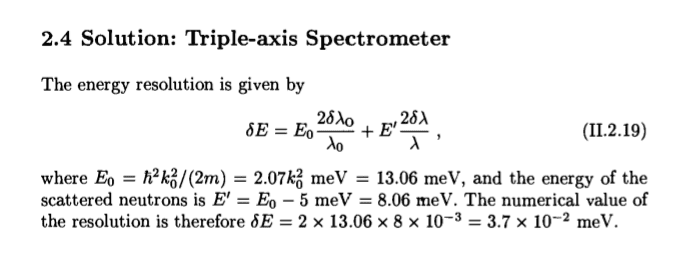
The total resolution comes from the wavelength distribution of the incoming neutrons together with the accurary of the analyzer - that looks fine. The given uncertainties are relative values, so the energy uncertainty gets multiplied with the corresponding energy.
I would expect a quadratic sum (##\sqrt{a^2+b^2}## instead of a+b) and I don't understand the prefactors of 2, but that could be some (conservative) convention.

I can confirm the neutron energy, I have no idea where the 5 meV come from.
The intermediate step in the final calculation looks completely wrong, but the result of 37µeV agrees with the formula.
 
http://en.wikipedia.org/wiki/Propagation_of_uncertainty, look at sections "Simplification" and "Example". With this you should be able to figure out where the "2" comes from.

The intermediate step should probably read 2 x (13.06 + 8.06) x 10^-3, using the simplification that delta lambda/lambda is pretty much the same for the monochromator and the analyzer.

I agree with mfb that one should probably use a quadratic sum.

The 5 meV is just an example of the excitation one might measure with this inelastic neutron scattering experiment.
 
M Quack said:
http://en.wikipedia.org/wiki/Propagation_of_uncertainty, look at sections "Simplification" and "Example". With this you should be able to figure out where the "2" comes from.
The only "2" I see there is related to a correlation between two uncertain parameters, something we do not have here. And we don't have squared parameters either.
 
E is quadratic in k and thus lambda, and the error propagation is (or should be)

(delta E)^2 = (delta lambda_0)^2 (d E_0/d lambda_0)^2 + ...

= (delta lambda_0)^2 (-2 hbar^2 /(2m lambda_0^3)^2 + ...

= (delta lambda_0/lambda_0 2 E_0)^2 + ...

correct me if I am wrong. (I have 1/2 bottle of wine as excuse :-))
 
Oh right...
Okay, that explains the factor of 2.
 

Similar threads

Replies
7
Views
3K
  • · Replies 7 ·
Replies
7
Views
2K
  • · Replies 1 ·
Replies
1
Views
2K
  • · Replies 5 ·
Replies
5
Views
2K
  • · Replies 1 ·
Replies
1
Views
4K
  • · Replies 21 ·
Replies
21
Views
3K
  • · Replies 138 ·
5
Replies
138
Views
9K
Replies
22
Views
3K
  • · Replies 5 ·
Replies
5
Views
3K
  • · Replies 1 ·
Replies
1
Views
2K