Why does the logic of negative acceleration not always indicate negative work?

Click For Summary
SUMMARY

The discussion clarifies that negative acceleration does not inherently indicate negative work. It emphasizes that work is determined by the relationship between force and displacement, and that acceleration is a vector that can be positive or negative based on the defined coordinate axes. Key points include that when velocity and acceleration align, work is positive; when they oppose, work is negative; and when acceleration is zero, no work is done. The conversation revolves around understanding these dynamics through the analysis of velocity vs. time graphs.

PREREQUISITES
  • Understanding of vector quantities, specifically acceleration and velocity.
  • Familiarity with the concepts of work and energy in physics.
  • Knowledge of coordinate systems and their impact on vector direction.
  • Ability to interpret velocity vs. time graphs.
NEXT STEPS
  • Study the relationship between force, displacement, and work in classical mechanics.
  • Learn about vector decomposition and its application in physics.
  • Explore the implications of constant vs. variable acceleration on work done.
  • Examine real-world examples of negative work in various physical systems.
USEFUL FOR

Students of physics, educators teaching mechanics, and anyone interested in the principles of motion and work-energy relationships.

Altoid
Messages
4
Reaction score
1
Homework Statement
A cart is constrained to move along a straight line. A
varying net force along the direction of motion is exerted on
the cart. The cart’s velocity v as a function of time tis
shown in the graph above. The five labeled points divide
the graph into four sections.
During some part of the motion, the work done on the cart
is negative. What feature of the motion indicates this?
A. Speed is increasing
B. Speed is decreasing
C. Acceleration is increasing
D. Acceleration is decreasing (INCCORECT)
Relevant Equations
W = (f)(d)(cos(theta))
Knowing that negative work occurs when the force applied to an object opposes the direction of displacement, and that the direction of acceleration vector should align with the force vector, I assumed the correct answer was that the indication of negative work comes from negative acceleration, however this is incorrect, does anyone know why this logic is faulty/doesn't work?
This is the graph btw:
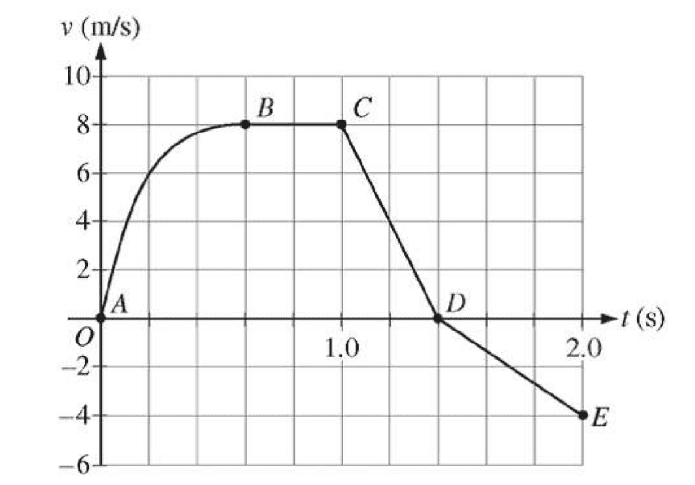
1681079253896.png
 
Physics news on Phys.org
Consider the segment between B and C. The velocity of the cart is constant, so acceleration is zero. No work is being performed there. Next consider the segment between C and D. What happens there? Is acceleration increasing, decreasing, or constant?
 
gneill said:
Consider the segment between B and C. The velocity of the cart is constant, so acceleration is zero. No work is being performed there. Next consider the segment between C and D. What happens there? Is acceleration increasing, decreasing, or constant?
Acceleration is constant, and negative
 
So, by your own words, "Acceleration is decreasing" is not correct, yes?
 
gneill said:
So, by your own words, "Acceleration is decreasing" is not correct, yes?
OHHHH, Acceleration is not decreasing, speed is decreasing because their is a negative acceleration.
 
Yes!
 
gneill said:
Yes!
Thanks!
 
  • Like
Likes   Reactions: gneill
Altoid said:
Acceleration is constant, and negative
Altoid said:
OHHHH, Acceleration is not decreasing, speed is decreasing because their is a negative acceleration.
You have to be careful with "negative" acceleration. Acceleration is a vector and can be positive or negative depending on how you define your coordinate axes. The same is true about velocity. So "positive" and "negative" don't mean much because speed and work are scalar quantities that do not depend on the choice of coordinate axes. Here is a summary of how to look at it.

In one dimension, once you have defined the axes,
  1. If the velocity and the acceleration are in the same direction (positive or negative) the speed is increasing and the work done on the moving object is positive.
  2. If the velocity and the acceleration are in opposite directions (one positive and one negative) the speed is decreasing and the work done on the moving object is negative.
  3. If the acceleration is zero, the direction of the velocity does not matter, the speed stays constant and the work done on the moving object is zero.
With this in mind, it should be easy to look at any velocity vs. time graph and figure out over what interval the external force does positive and negative work.
 

Similar threads

  • · Replies 19 ·
Replies
19
Views
1K
  • · Replies 4 ·
Replies
4
Views
3K
  • · Replies 11 ·
Replies
11
Views
2K
  • · Replies 56 ·
2
Replies
56
Views
4K
  • · Replies 22 ·
Replies
22
Views
4K
Replies
17
Views
2K
  • · Replies 8 ·
Replies
8
Views
2K
Replies
4
Views
3K
Replies
5
Views
2K
Replies
4
Views
2K