Equation Derivation in QFT book by D.MacMahonhow?

  • Context: Graduate 
  • Thread starter Thread starter Abolaban
  • Start date Start date
  • Tags Tags
    Book Derivation Qft
Click For Summary

Discussion Overview

The discussion revolves around an equation found in D. MacMahon's book "QFT Demystified," specifically addressing the notation and steps involved in its derivation. Participants explore the implications of using certain indices in the context of quantum field theory (QFT), focusing on the correctness of the notation and the mathematical steps taken in the derivation process.

Discussion Character

  • Technical explanation
  • Debate/contested
  • Mathematical reasoning

Main Points Raised

  • Abolaban questions the appearance of a sum in the middle of an equation and seeks clarification on the notation used.
  • Orodruin critiques the notational form used by MacMahon, arguing that the same index should not be used for both free indices and summation indices in the Lagrangian.
  • Some participants suggest that understanding index notation is crucial for following the derivation correctly.
  • There is a discussion about the potential confusion arising from the use of subscripts and superscripts in MacMahon's notation.
  • Orodruin provides a corrected form of the derivative, emphasizing the importance of proper index handling.
  • Participants express uncertainty about the clarity of the derivation steps and seek recommendations for resources to better understand tensor notation.
  • There is a mention of the product rule in the context of derivatives and how it relates to the equation in question.
  • Some participants note that while the end result of the equation is correct, the middle steps are flawed or unclear.

Areas of Agreement / Disagreement

Participants generally agree that the notation used in the equation is problematic and that the middle step is incorrect. However, there is no consensus on the best way to address these issues or on the resources that would best clarify the concepts involved.

Contextual Notes

Participants highlight the limitations of MacMahon's notation and the potential for confusion when dealing with tensor analysis and derivatives. There is an acknowledgment that different interpretations of the notation may lead to varying understandings of the derivation process.

Who May Find This Useful

This discussion may be useful for students and practitioners of quantum field theory, particularly those interested in the nuances of tensor notation and the mathematical foundations of the subject.

Abolaban
Messages
13
Reaction score
0
Hello,

I have encountered an equation in page 33 in the book of D.MacMahon titled QFT demystefied.

It is the third equation from the top...how did the sum appear as a middle step of the equation?
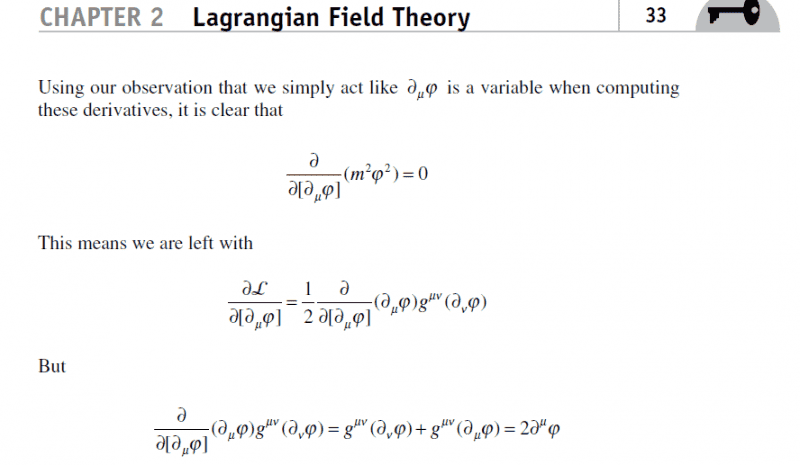
upload_2015-1-28_22-44-14.png


best regards.

Abolaban
 
Physics news on Phys.org
Ok, so this is very bad notational form. He is using ##\mu## as the index of the ##\partial_\mu## at the same time as he is using it as a summation index in the Lagrangian. The middle step is simply wrong - you can never (ever ever) have an expression where you sum two terms with different free indices!

What should have been done is to pick a different summation index for the Lagrangian (or why not differentiate with respect to ##\partial_\rho\varphi##?). You can then apply the rules for a derivative of a product and note that ##\partial(\partial_\mu \varphi)/\partial(\partial_\rho \varphi) = \delta_\mu^\rho##.

Edit: To be clear, the end result is correct, the middle step is not.
 
  • Like
Likes   Reactions: vanhees71
Thank you "Orodruin" for your answer...

where can one correctly learn about the usuage of such notations?
 
Abolaban said:
where can one correctly learn about the usuage of such notations?

I don't know any book that would go into showing calculations as Demystified... In most of cases you have to be very careful yourself of the writer's steps and what he is actually doing... eg if you did the same calculation yourself, you wouldn't use same-indices with the derivatives.
 
Orodruin said:
Edit: To be clear, the end result is correct, the middle step is not.

:D Correct by luck...
 
If you are familiar with tensor notation, there really is not much more to it other than seeing ##\partial_\mu \varphi## for different values of ##\mu## as independent arguments of the Lagrangian. It should then be rather obvious that, for example, ##\partial(\partial_1\varphi)/\partial(\partial_1\varphi) = 1## and that ##\partial(\partial_1\varphi)/\partial(\partial_2\varphi) = 0##, etc.
 
ChrisVer said:
:D Correct by luck...

The best (i.e., worst) way of being correct. Although I think it is rather a case of "IknowwhatIshouldgetsoIwillbesloppyinthemiddlesteps"-syndrome.
 
thanks "Oroduin" for your comment...

I have the following books, however, it is hard to recognize which could match the QFT tensor analysis...what do you recommend among them?

-Daniel Fleisch: A Student's Guide to Vectors and Tensors

-Derek F.Lawden: An Introduction to Tensor Calcul

-J.A.Schouten:Tensor Analysis for Physicists

-Mikhail Itskov: Tensor Algebra and Tensor Analysi

-Nadir Jeevanjee: An Introduction to Tensors

-Nazrul Islam: Tensors and their applicationsAbolaban
 
It is mainly a matter of understanding index notation, if you do that, you should be able to follow - of course assuming derivation is corrected to:
$$
\frac{\partial \mathcal L}{\partial(\partial_\rho\varphi)} = \frac{\partial}{\partial(\partial_\rho\varphi)} g^{\mu\nu}(\partial_\mu\varphi)(\partial_\nu\varphi)
= g^{\mu\nu}[ \delta_\mu^\rho \partial_\nu\varphi + \delta_\nu^\rho\partial_\mu\varphi] = 2\partial^\rho\varphi
$$
 
  • Like
Likes   Reactions: vanhees71
  • #10
"Orodruin" thanks for your further clarification...

I went through "Tensor analysis" in Math Meth for Physicists by Arfken and Weber pages 133 and beyond but I could not recognize how did you split that term into summation!?
 
  • #11
Abolaban said:
"Orodruin" thanks for your further clarification...

I went through "Tensor analysis" in Math Meth for Physicists by Arfken and Weber pages 133 and beyond but I could not recognize how did you split that term into summation!?

Do you understand the following result for ordinary derivatives of functions of one variable?
$$
\frac{d}{dx}f(x) g(x) = f'(x) g(x) + f(x) g'(x)
$$
 
  • #12
Abolaban said:
I went through "Tensor analysis" in Math Meth for Physicists by Arfken and Weber pages 133 and beyond but I could not recognize how did you split that term into summation!?

there will be more that look similar to this, but this is straightforward to see... equation 2.130b he uses the same "summation" thing, generally called the product rule...
 
  • #13
thanks for your replies...

yeah...you use this from vector analysis...dealing with tensors carry special flavours...so the tast might sometimes mix in one's tongue.

--equation 2.130b seems to carry different flavour...namely by Christoffel
 
  • #14
Abolaban said:
--equation 2.130b seems to carry different flavour...namely by Christoffel

flavour?

Well what he did was write \textbf{V} = V^i e_i
and take the derivative \frac{d}{dq^j} \textbf{V} =\frac{d}{dq^j} (V^i e_i) =\frac{dV^i}{dq^j} e_i + V^i \frac{de_i}{dq^j}

Especially at this point, it is just vector-analysis...
 
  • #15
yeah...you are correct...it is the same...however using sub and super scripts while dealing with McMahon's notation is sometimes confusing...
 
  • #16
He is using for both subscripts because he is taking the derivative with respect to the \partial_\mu \phi (see the subsript).
The kinetic term can as well be written by using the metric:
(\partial_{\mu} \phi) g^{\mu \nu} (\partial_\nu \phi) = (\partial_\mu \phi) (\partial^\mu \phi ) =(\partial^\mu \phi ) (\partial_\mu \phi)

But using just the metric he can easily use the:
\frac{\partial (\partial_{\nu} \phi) }{\partial (\partial_\mu \phi)} = \delta_{\nu}^\mu.

instead of having:

\frac{\partial (\partial^{\nu} \phi) }{\partial (\partial_\mu \phi)} = g^{\nu \rho} \delta_{\rho}^\mu.
 
  • #17
ok...now it is clear...thank you "ChrisVer"
 

Similar threads

  • · Replies 2 ·
Replies
2
Views
2K
  • · Replies 2 ·
Replies
2
Views
2K
  • · Replies 1 ·
Replies
1
Views
3K
  • · Replies 6 ·
Replies
6
Views
3K
  • · Replies 2 ·
Replies
2
Views
2K
  • · Replies 1 ·
Replies
1
Views
2K
  • · Replies 3 ·
Replies
3
Views
2K
  • · Replies 5 ·
Replies
5
Views
2K
  • · Replies 3 ·
Replies
3
Views
2K
  • · Replies 10 ·
Replies
10
Views
2K