Equation of line bisecting two others

  • Thread starter Thread starter ps098
  • Start date Start date
  • Tags Tags
    Line
Click For Summary
SUMMARY

The discussion focuses on deriving the equation of a line that bisects two tangent lines fitted to experimental data. The first tangent line has a slope denoted as m1, while the second has a slope m2. The angles of these lines are calculated using the arctangent function, with adjustments made for orientation. The bisecting line's slope, mb, is determined by averaging the angles of the two lines, and it is crucial to ensure that the arctan function correctly handles negative slopes to avoid vertical bisecting lines.

PREREQUISITES
  • Understanding of basic calculus, specifically derivatives and slopes
  • Familiarity with trigonometric functions, particularly arctan
  • Knowledge of linear equations and their graphical representations
  • Experience with plotting data and interpreting graphs
NEXT STEPS
  • Explore the two-argument form of the arctangent function for improved angle calculations
  • Research methods for fitting tangent lines to experimental data
  • Learn about the implications of negative slopes in linear equations
  • Investigate graphical software tools for visualizing tangent lines and bisectors
USEFUL FOR

Students and researchers in mathematics, physics, or engineering who are working with experimental data and require assistance in deriving equations for bisecting lines between tangents.

ps098
Messages
2
Reaction score
0
Hi everyone, this will probably be very easy for someone but I'm really struggling to get this to work. I have experimental data whose baseline and peak midpoints I have fitted tangents to, and I have found the points where they intersect. I now want to find the red line which bisects these two tangents, but whatever I do the plot comes out at completely the wrong angle. I have included an example, with my beautiful handwritten workings (lol).
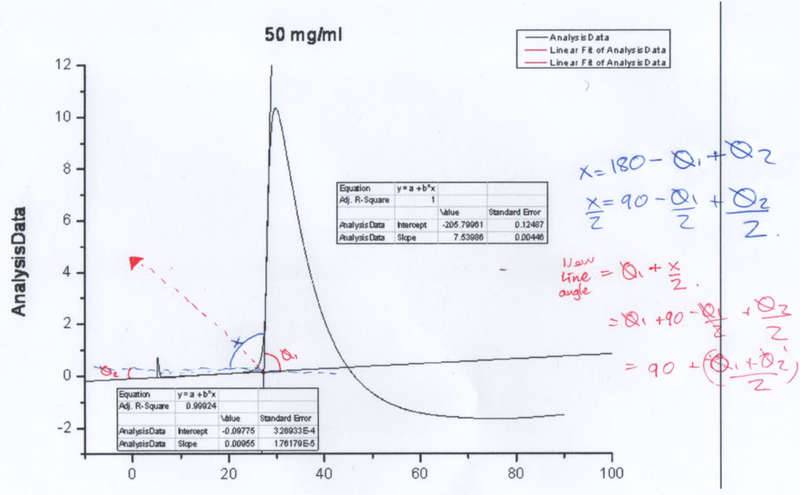
graphjpg.jpg


If anyone can help, I'd really appreaciate it, my MSc will be all the better for it :D

Cheers
 
Mathematics news on Phys.org
Well. Let's say your first line has slope m1, and your second m2 (both positive in the example graph). A line with slope m1 is slanted at angle arctan(m1) to the horizontal. You, however, want to think of this first line as heading down and left, so you should add pi radians or 180 degrees to it. Your two lines, then, are at angles

<br /> \begin{eqnarray*}<br /> \theta_1 &amp; = &amp; \arctan{(m_1)}+180 \\<br /> \theta_2 &amp; = &amp; \arctan{(m_2)}<br /> \end{eqnarray*}<br />

The line you wants heads at an angle halfway inbetween

<br /> \theta_b = \frac{\theta_1+\theta_2}{2}<br />

and its slope is m_b=\tan(\theta_b), which will be negative. Find a line with that slope that goes through the intersection point.
 
Thanks ever so much for that, I've been staring at the thing for literally hours trying to figure out what was wrong with my equation - always good to get a fresh brain on the problem!

One thing I can't figure out, will this formula still apply if the baseline is at a negative slope?
 
ps098 said:
One thing I can't figure out, will this formula still apply if the baseline is at a negative slope?
As long as your arctan function returns a negative angle for a negative argument (and I've never met one that doesn't), it should work. I guess you could in theory run into a problem in which the bisecting line is vertical and has infinite slope. That would take very bad luck.

Another possibility, which I just advised someone else to try, would to be use the two-argument form of the arc tangent function, \theta_1=\arctan(-1,-m_1). Then you don't have to add 180.
 

Similar threads

  • · Replies 1 ·
Replies
1
Views
4K
Replies
7
Views
4K
  • · Replies 4 ·
Replies
4
Views
3K
Replies
24
Views
2K
  • · Replies 3 ·
Replies
3
Views
5K
  • · Replies 7 ·
Replies
7
Views
3K
  • · Replies 6 ·
Replies
6
Views
2K
Replies
8
Views
3K
Replies
1
Views
4K
  • · Replies 4 ·
Replies
4
Views
4K