Equations for three inductors connected together

Click For Summary
SUMMARY

The discussion focuses on deriving state equations for a system of three inductors connected at a common point, with independent voltage sources V1, V2, and V3. The goal is to eliminate the intermediary variable VT from the equations. Participants confirmed that using Kirchhoff's Current Law (KCL), specifically the relation i1 = i2 + i3, allows for the successful elimination of VT, resulting in equations expressed solely in terms of V1, V2, V3, I1, and I2. The integration of KCL proved effective in achieving the desired state space form.

PREREQUISITES
  • Understanding of state space representation in control systems
  • Familiarity with Kirchhoff's Current Law (KCL)
  • Basic knowledge of inductors and their behavior in electrical circuits
  • Proficiency in differential equations for analyzing circuit dynamics
NEXT STEPS
  • Study state space modeling techniques for electrical circuits
  • Learn advanced applications of Kirchhoff's laws in circuit analysis
  • Explore the integration of differential equations in circuit dynamics
  • Investigate the use of simulation tools like MATLAB for circuit analysis
USEFUL FOR

Electrical engineers, circuit designers, and students studying control systems who are looking to deepen their understanding of inductor dynamics and state space representations.

anon6912
Messages
21
Reaction score
3
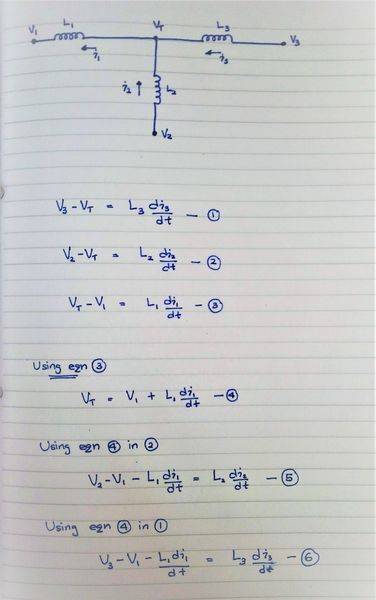
I have a system with three inductors connected together at a common point.
The unconnected ends of each inductor is connected to an independent voltage source.

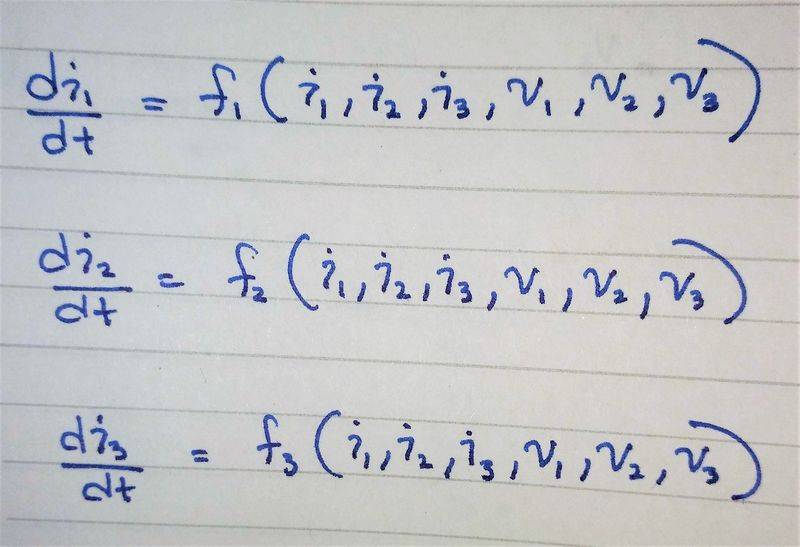
Basically I want to get three expressions for the dynamics of the currents with V1, V2 and V3 as inputs.
i.e. i need to eliminate the intermediary variable VT.

I want to write the state equations for the system in the following format (state space form):
dSvnAJf.jpg


The system and, how far i got is below:
tQ4QVt2.jpg


I don't know how to proceed from here.
Or is it impossible to get it into the format I want?
 

Attachments

  • dSvnAJf.jpg
    dSvnAJf.jpg
    46.1 KB · Views: 607
  • tQ4QVt2.jpg
    tQ4QVt2.jpg
    24.2 KB · Views: 549
Engineering news on Phys.org
anon6912 said:
i.e. i need to eliminate the intermediary variable VT.

anon6912 said:
The system and, how far i got is below:
tq4qvt2-jpg.jpg

Here you removed ##V_{T}## from all the equations. You have di/dt (for 1, 2 and 3) in terms of V1,V2... etc without ##VT##.

Maybe I didn't understand your question correctly.
 

Attachments

  • tq4qvt2-jpg.jpg
    tq4qvt2-jpg.jpg
    24.2 KB · Views: 525
You are missing an equation. Using the sign conventions from your drawing, i1=i2+i3. That is Kirchoff's Current Law.
 
  • Like
Likes   Reactions: Fisherman199
Phylosopher said:
Here you removed ##V_{T}## from all the equations. You have di/dt (for 1, 2 and 3) in terms of V1,V2... etc without ##VT##.

Maybe I didn't understand your question correctly.

At the time I was asking this question I don't think I had grasped the question correctly even myself.

What I initially wanted was to eliminate V_T.
But as a consequence of doing this I found out I had to/ could write I_1 in terms of I2 and I3.
I wasn't sure if this second part of replacing I1 with !2 and I3 was correct because I felt like it would eliminate a state from the system if I did that.
But I think it is correct and can be done.

So now I have a system with VT eliminated and the equations written in terms of V1 V2 V3 and I1 and I2 :)
 
  • Like
Likes   Reactions: Phylosopher
anorlunda said:
You are missing an equation. Using the sign conventions from your drawing, i1=i2+i3. That is Kirchoff's Current Law.
Thanks. I ended up integrating kirchhoff law and it worked :)
 

Similar threads

  • · Replies 4 ·
Replies
4
Views
2K
Replies
9
Views
2K
  • · Replies 1 ·
Replies
1
Views
2K
Replies
2
Views
2K
Replies
8
Views
4K
Replies
4
Views
2K
  • · Replies 3 ·
Replies
3
Views
3K
Replies
2
Views
2K
  • · Replies 12 ·
Replies
12
Views
2K
  • · Replies 1 ·
Replies
1
Views
3K