Estimate induced emf in the coil

Click For Summary

Homework Help Overview

The discussion revolves around estimating the induced electromotive force (emf) in a single-loop coil based on given magnetic flux values at specific times. The context is algebra-based physics, focusing on the application of the emf equation and the interpretation of flux changes over time.

Discussion Character

  • Exploratory, Assumption checking, Problem interpretation

Approaches and Questions Raised

  • Participants discuss various methods for estimating the induced emf, including using specific time points and evaluating changes in flux. Some question the appropriateness of using differentiation in an algebra-based context, while others suggest alternative estimation techniques.

Discussion Status

The conversation includes attempts to clarify the correct approach to estimating emf, with some participants noting discrepancies between their calculations and textbook answers. There is an ongoing exploration of methods, with no clear consensus on the best approach yet.

Contextual Notes

Participants express confusion regarding the use of calculus in a problem that is meant to be solved algebraically, highlighting a potential misunderstanding of the assignment's requirements. There are references to specific values from the textbook that do not align with participants' calculations.

Cade
Messages
90
Reaction score
0
[Solved] Estimate induced emf in the coil

Homework Statement


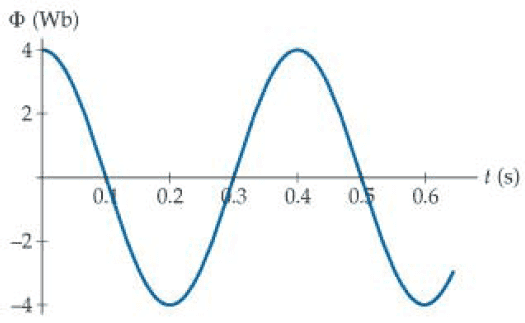
Consider a single-loop coil whose magnetic flux is given by this image:
xjz8c.png

Estimate the induced emf in the coil at times near t = 0.3s, t = 0.4s and t = 0.5s

This is for algebra-based physics.

Homework Equations


emf = -N*(change in flux)/change in time

The Attempt at a Solution


At t = 0.3s
emf = -1(4- -4)/(0.4 - 0.2) = -8/0.2 = -40V

At t = 0.4s
Rate of change = 0

At t = 0.5s
emf = -1(-4 - 4)/(0.6 - 0.4) = 8/0.2 = 40V

My first and third answers are wrong. What've I missed? The textbook has -0.06kV, 0 and 0.06kV but those answers are also incorrect.

Edit: Solved it. This is the graph of
4 Cos[(2 Pi/(0.4))*x]
Differentiating this gives y = -20pi*Sin[5pi*x]
Evaluating it at t = 0.3 s gives 63V. I do not know why differentiation is used for an algebra-based physics problem when my TA explicitly told me to not use calculus, but there it is.
 
Last edited:
Physics news on Phys.org
make a better estimate because the gradient at 0.3s is rather different from the gradient of the line joining the max at 0.4s and the min at 0.2s.
 
How would I do that?

Using t = 0.25s and t = 0.35s as my points for t = 0.3s,
-(3 - -3)/(0.35 - 0.25) = -6/0.1 = -60V, which is also wrong.

Edit: The correct answer is -63V, 0V, 63V. I have no idea how to calculate this. The textbook has -60V, 0V, 60V, which is apparently incorrect.

Edit: Solved it. This is the graph of
4 Cos[(2 Pi/(0.4))*x]
Differentiating this gives y = -20pi*Sin[5pi*x]
Evaluating it at t = 0.3 s gives 63V. I do not know why differentiation is used for an algebra-based physics problem when my TA explicitly told me to not use calculus, but there it is.
 
Last edited:
So your second estimate, 60V, was correct!
I do not think you can use differentiation if an estimate was asked for.
 
Yes, however the homework system won't accept it for some reason. I tried 60V, as the textbook said that, then I tried a wider window and got 40V, then I gave up and fitted it to a cosine curve.
 
You can get a better estimate than 60V if a tangent is drawn on the curve at the required point and its gradient is calculated. The longer this tangent is drawn the better is the estimate. It is still an estimate since the axes are not subdivided further.
 
Thanks, I will keep that in mind for next time.
 

Similar threads

  • · Replies 4 ·
Replies
4
Views
3K
Replies
2
Views
2K
  • · Replies 15 ·
Replies
15
Views
7K
  • · Replies 3 ·
Replies
3
Views
3K
Replies
11
Views
3K
  • · Replies 8 ·
Replies
8
Views
3K
  • · Replies 2 ·
Replies
2
Views
2K
Replies
5
Views
3K
  • · Replies 10 ·
Replies
10
Views
3K
  • · Replies 4 ·
Replies
4
Views
2K